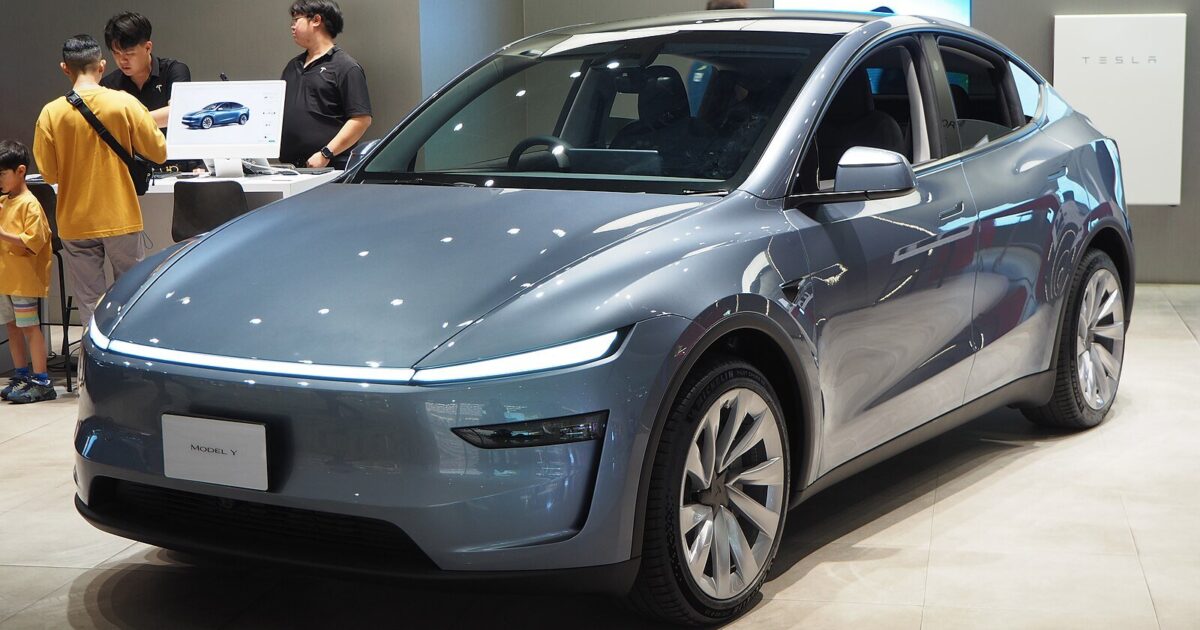
Elon Musk has put a target date on one of Tesla’s most unusual hardware combinations: Starlink built directly into cars beyond the Cybercab.
His answer is late 2027, if the plan holds.
Musk said the connection would matter once Full Self-Driving no longer requires a driver to supervise it. At that point, he argued, the people inside the car will want enough bandwidth to work or stream entertainment wherever the trip takes them.
Here is his full reply:
Hopefully available towards the end of next year.
This will be important for unsupervised FSD, so passengers have high bandwidth everywhere for work and entertainment.
— Elon Musk (@elonmusk) November 23, 2026
The word doing the most work is “hopefully.” This is Musk’s target, not a Tesla launch announcement.
He did not say which models would receive the hardware first, whether Starlink would be standard or optional, what service would cost or whether current owners could retrofit it. But this is the first real window he has offered for moving the connection beyond Cybercab.
InsideEVs reports that expanding Starlink requires more than turning on a subscription. Cybercab was designed around a Starlink panel built into the vehicle, while Model 3 and Model Y use different roof and hatch structures.
That means a factory installation across the wider lineup could require physical body changes along with a software update. The report also notes that Cybercab passengers cannot currently use its Starlink connection as a general hotspot.
According to Tesla AI chief Ashok Elluswamy, the present connection supports fleet management, navigation and customer service. Musk’s new vision would expand that from an operations link into something passengers actually notice.
That distinction matters. A satellite terminal built into a car is not the same thing as a phone using direct-to-cell satellite coverage, and neither one automatically means unlimited in-car Wi-Fi.
Not a Tesla App says Cybercab already carries both Starlink and cellular connectivity, giving Tesla two ways to reach the vehicle. The satellite link is most useful when ordinary mobile coverage is weak or unavailable.
It is not a perfect replacement for cellular service. Starlink needs a useful view of the sky, so tunnels, garages, dense buildings and heavy tree cover can interrupt the connection.
A Tesla that can switch between terrestrial and satellite networks would have more resilience than one depending on either system alone.
The report also makes an important technical point: the car does not need a live internet connection to see the road and make driving decisions. Tesla’s autonomy software runs on the vehicle’s onboard computer.
Connectivity supports the services around the drive—routing, dispatch, remote assistance, updates, rider communication and entertainment.
Tesla’s own current terms draw the same boundary.
The Tesla Cybercab Autonomy Subscription Agreement says the vehicle’s connectivity may include satellite service and supports features such as navigation, traffic data and media streaming. It also says that connectivity is for Cybercab use and is not a consumer mobile or hotspot plan unless Tesla explicitly says otherwise.
The agreement warns that coverage gaps can limit or stop operation and allows Tesla to use connectivity for remote support, updates and safety actions. That makes the network part of Cybercab’s operating system, even though the driving model itself remains onboard.
Tesla can also restrict Cybercab operation by geography, road type, weather or condition, and the vehicle must remain connected for some required software updates. The terms show why Tesla treats connectivity as operating infrastructure first and passenger internet second.
Electrek traced the hardware story back to Tesla and Starlink’s July reveal of Starlink V5 integrated into Cybercab. Tesla showed the terminal within the vehicle rather than bolted on as an external dish.
The publication noted that satellite coverage can keep fleet dispatch and remote support alive in cellular dead zones, but it also raised a fair question: Tesla’s current robotaxi service operates mainly in dense cities where mobile coverage is already strong.
Its reporting separates the driving computer from the connected services. Cybercab’s onboard AI4 hardware handles perception, planning and control, while the network carries live routing, dispatch, support, updates and passenger media.
That makes Starlink a redundancy and service layer, not the steering brain. The value grows if Tesla’s cars move beyond well-covered urban geofences or if riders begin treating travel time as office and entertainment time.
Musk’s latest explanation supplies a broader answer. Starlink would backstop the car’s connection.
It is also part of the experience Tesla wants to sell once the person in the driver’s seat becomes a passenger.
There is one major geographic exception.
Except in China, as Starlink is illegal there
— Elon Musk (@elonmusk) November 23, 2026
Musk did not identify any other excluded markets or explain how Tesla would handle countries with licensing, spectrum or satellite-service restrictions. His China reply is a reminder that “every model” cannot mean one identical connectivity package everywhere Tesla sells cars.
For owners, the unanswered questions are practical.
Will this arrive only on newly built cars? Will Tesla redesign the Model 3 and Model Y body panels around a terminal?
Will the service be bundled with Premium Connectivity, sold separately or reserved for unsupervised-FSD use?
And most importantly, will Tesla’s autonomy software actually reach the unsupervised stage on the same schedule?
Late 2027 is a meaningful target because it connects two Musk companies around a specific product plan. It is not yet a promise that buyers can price, order or install.
Cybercab is the proof of concept. The next test is whether Tesla can turn that one purpose-built installation into a clean, affordable option across ordinary cars—and whether the self-driving future Musk says will need all that bandwidth arrives with it.
Join the conversation!
Please share your thoughts about this article below. We value your opinions, and would love to see you add to the discussion!