
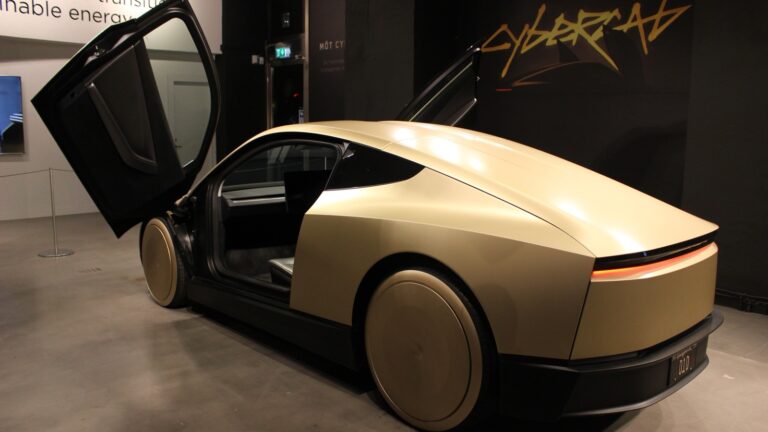
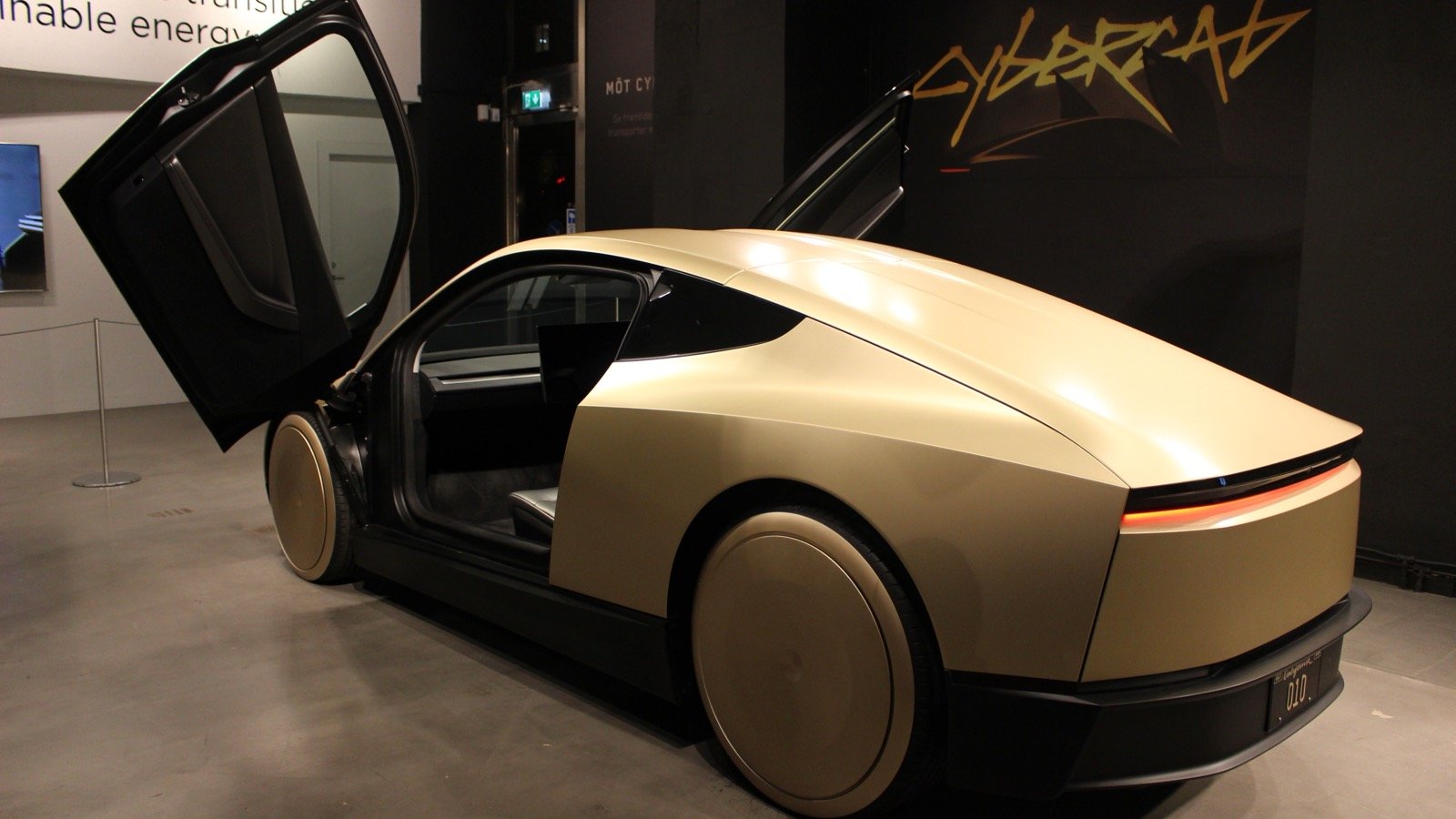
Detroit just became one of the most interesting places to watch Tesla’s Cybercab program.
Roughly two dozen of the gold two-seaters are now testing on Metro Detroit roads, according to local reporting. They are not carrying public passengers, and they are not operating without a human aboard.
These Cybercabs have test drivers and temporary steering wheels.
That detail does not make the test less important. It tells us exactly what Tesla is doing: validation work in a region that can throw rain, cold, road salt, slush, snow, potholes, freeway traffic, and construction at the same vehicle.
A current sighting from the region showed one of the cars charging with Michigan manufacturer plates:
Just spotted a Tesla Cybercab with manufacturing plates in Detroit, Michigan charging up. pic.twitter.com/K97KjTQldz
— 𝐁𝐫𝐚𝐝 (@b2wicey) November 1, 2026
Two dozen Cybercabs, four major roads
The Detroit News reported that about two dozen Cybercabs are operating from Tesla’s collision-repair facility on 12 Mile Road in Southfield. The vehicles have been seen on I-696, M-10, Telegraph Road, and Eight Mile Road, giving the fleet a mix of freeway and major arterial driving.
The local reporting also draws the critical line between testing and service. Human drivers are aboard, temporary steering wheels are installed, and Tesla has not announced a date for public Cybercab rides in Detroit.
Test drivers reportedly are operating under nondisclosure agreements, while Tesla has not publicly described the purpose or duration of the Michigan program.
That makes this a validation fleet, not a surprise commercial launch. Still, two dozen purpose-built Cybercabs in one metro area is far beyond a one-car engineering sighting.
Michigan weather is the real opportunity
Drive Tesla Canada emphasized the value of Michigan’s changing weather and noted that the test fleet is operating from Southfield across several major regional roads. Texas has given Tesla heat, intense sun, heavy rain, wide roads, and fast-growing service zones.
Detroit can add cold starts, snow, road grime, salted pavement, obscured lane markings, and the ugly transition days when every sensor and camera gets dirty, all without Tesla first promising a public launch.
That matters for a vehicle built around Tesla’s camera-first autonomy system. A polished demo in friendly weather proves only so much.
A fleet that can repeatedly handle Michigan through late fall and winter would produce a much tougher body of real-world evidence.
The temporary controls also make practical sense during this stage. Engineers can gather data from the production-shaped vehicle while retaining a direct human fallback.
The final Cybercab is designed to operate without a steering wheel or pedals, so the Michigan setup should not be confused with the passenger configuration Tesla ultimately wants to scale.
The timing is notable because Tesla’s Robotaxi footprint is expanding elsewhere at the same time. Fort Worth service began this week, while Detroit remains firmly on the engineering side of the line.
That contrast makes the Michigan fleet useful to watch: operating vehicles are accumulating regional experience before Tesla has made any passenger promise.
Tesla and Waymo are testing in the same backyard
Tesla News Wire cross-checked the Detroit fleet against Waymo’s activity in the region. Waymo began testing around Detroit about a year ago and moved to fully autonomous testing with its Zeekr-built vehicles in October, though it has not announced a public launch date there.
The comparison is useful because the companies are approaching autonomy with visibly different hardware. Waymo combines cameras with lidar and radar.
Tesla is betting that cameras, neural networks, fleet data, and purpose-built vehicles can deliver a scalable service with less sensor complexity.
Neither company has announced when Detroit residents will be able to summon one of these vehicles. For now, the meaningful development is that both autonomy programs are gathering data in the same multi-season market.
Tesla’s cars also remain visibly supervised in this phase, while Waymo’s October tests removed the human specialist from behind the wheel. That is an important operational distinction, not a minor footnote.
Detroit now gives both systems access to the same unforgiving seasonal laboratory.
There is no public Cybercab service to judge in Michigan yet. There is no Detroit launch date, fare map, rider app zone, or promise that these test cars will stay after validation work is complete.
But the scale matters.
One Cybercab in Michigan is a sighting. Two dozen Cybercabs running major Detroit-area roads looks like a program.
The next question is what Tesla learns when winter stops being theoretical.

Join the conversation!
Please share your thoughts about this article below. We value your opinions, and would love to see you add to the discussion!