Tesla has begun rolling out FSD v15, and this one is much more than a routine point release.
The company says the new system handles safety-critical cases 25 times better, introduces a radically different live driving view and changes how the car learns routes.
That 25x figure is Tesla’s claim. The company did not publish the test set or methodology in its announcement, so owners should treat it as a major performance claim—not an independently verified safety ratio.
Tesla packed the core changes into its official rollout post:
FSD v15 now starting to roll out – upgrading every part of the end-to-end driving network
Safety
25x better handling of safety critical casesTesla Reality View
Adds a live visualization of the drive that lets you see & control what FSD is planning to doNavigation for start… pic.twitter.com/Sfjk4wZecW
— Tesla (@Tesla) November 21, 2026
The headline feature is Tesla Reality View.
Instead of showing a collection of separately drawn lane lines, cars, cones and route signals, v15 generates one live representation of the scene around the vehicle. Tesla says the occupant can see what FSD plans to do and interact with that plan.
Navigation is also moving deeper into the neural network. Start- and end-of-trip decisions now learn from route preferences gathered across the fleet, with Tesla promising to expand that approach across the full route in later v15 releases.
The feature list reaches well beyond the new visualization.
Tesla says v15 improves detection of road signs, small animals, debris, potholes and deep standing water. It also adjusts speed more naturally in school zones and bad weather, can slow for speed cameras and adds a Bike Rack Mode that allows FSD to work with a hitch accessory installed.
The Electric Standard separates two announcements that are easy to blur together. Tesla said the rollout had started on November 21, while Elon Musk said v15 would go to wide release in December.
Those statements can both be true: a small first wave can begin before a much broader release. But neither Tesla nor Musk identified a specific December date, a complete country list or every eligible vehicle and hardware version.
The report also notes that Tesla’s announcement did not claim unsupervised operation in privately owned cars. For consumers, this remains FSD (Supervised), which means the person in the driver’s seat is still responsible for watching the road and taking over when needed.
It also records the timing precisely: Musk’s wide-release comment came first, followed hours later by Tesla’s formal feature post and then Musk’s demonstration of the new visualization. The sequence supports a staged rollout, not a claim that every eligible car received v15 on launch day.
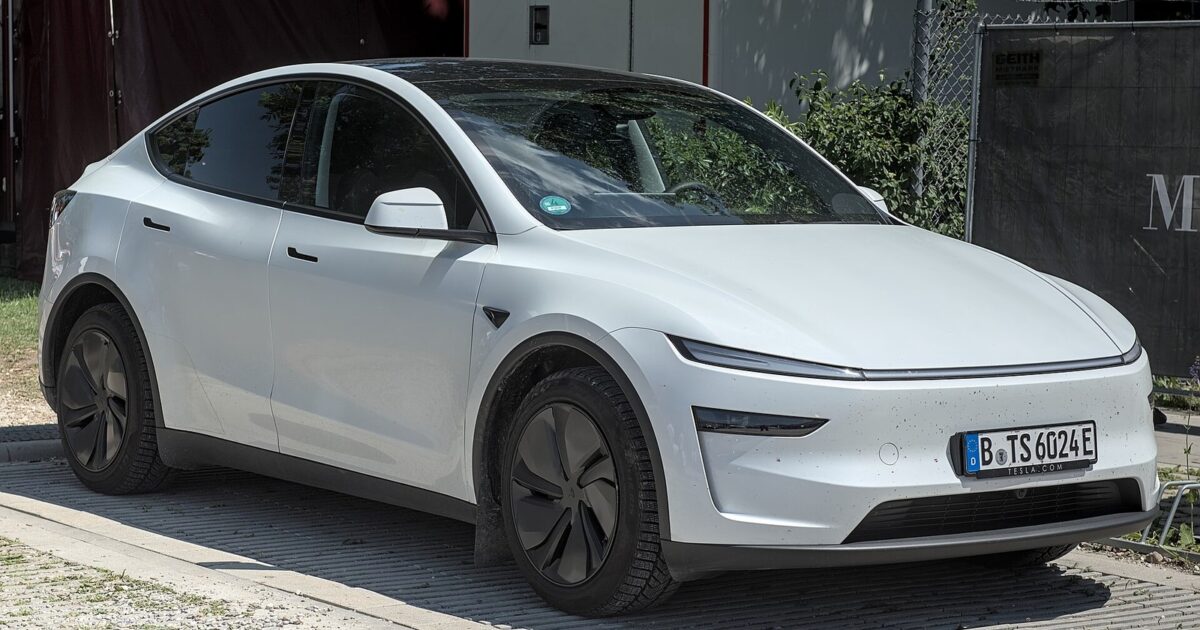
TeslaMagz tracked the first observed package as software build 2026.38.6.11 with FSD v15.0.1 on AI4 Model Y vehicles. That is a useful snapshot of the first wave, not a complete compatibility promise from Tesla.
Its release-note record says the upgraded vision encoder is shared across FSD, Robotaxi and Optimus and was trained with millions of internet videos to improve generalization and data efficiency. The record ties Tesla’s 25x claim to the rate of critical interventions, rather than claiming the car is simply “25 times safer” in every situation.
The tracked notes also add practical detail. Parking selection can learn from a driver’s history and show multiple destination options; attention monitoring is meant to work more often with hats and sunglasses; and Autoshift now uses FSD-based gear predictions.
Speed Camera Slowdown can be canceled with the accelerator or a speed-profile change. If the driver cancels it twice at the same camera, the car can remember that location and stop slowing there.
Musk showed how different Reality View is supposed to feel:
In FSD V15, the Tesla AI computer re-renders reality with chevrons in the sky for turns like a video game.
You can tap any point on the reality revisualizer to make your car go there. pic.twitter.com/A5ZB2yFkd7
— Elon Musk (@elonmusk) November 21, 2026
The tap-to-direct feature could make a real difference in places where a navigation pin is too vague—large parking lots, complicated pickup zones or entrances that the map does not understand.
It also puts more pressure on the visualization to be honest. A beautiful rendered view is useful only if it accurately reflects what the driving system sees and intends to do.
Tesla News Wire documented two smaller promises from Musk’s replies before the rollout post appeared. One driver asked for FSD to stop refusing HOV lanes when passengers are present and to quit waiting until the last moment to move into a turn or merge lane.
Musk answered that those behaviors should be fixed in v15. He also described the new interface as a complete re-rendering of reality, but did not spell out the hardware list or convert the supervised product into an autonomous one.
That leaves HW3 owners with the biggest unanswered question.
Tesla only recently began sending those cars a lighter v14.3 build. Nothing in the v15 rollout announcement says whether HW3 will receive v15, a reduced “Lite” version or remain on a separate branch.
AI4 owners still do not have a precise schedule either. A rollout that has technically started can take days or weeks to reach a particular vehicle, and Tesla can pause distribution if early data exposes a problem.
Owners should watch the software version instead of relying on the FSD label alone. The tracked first build is 2026.38.6.11 with v15.0.1, while other branches can carry older FSD versions and unrelated features.
FSD v15 is Tesla’s clearest attempt yet to merge the software used by customer cars, Robotaxi and Optimus around a larger shared vision system.
The flashy part is Reality View. The serious test is whether the driving behavior behind it delivers the claimed reduction in critical interventions once v15 moves from the first wave to ordinary owners at scale.
Join the conversation!
Please share your thoughts about this article below. We value your opinions, and would love to see you add to the discussion!