
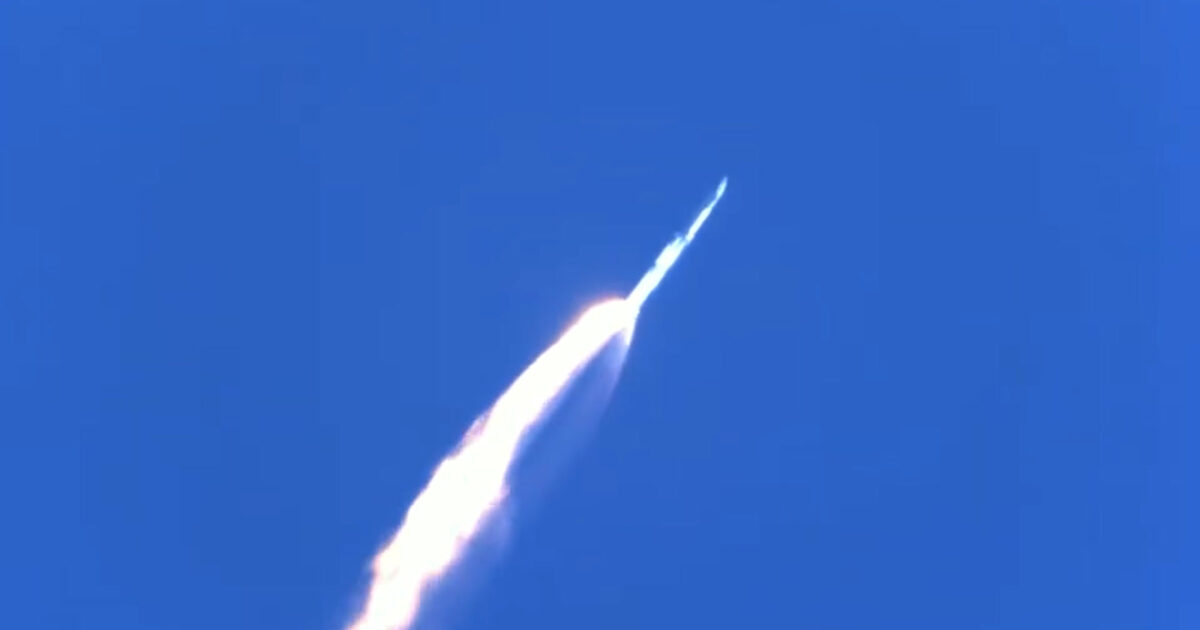
SpaceX has now done something no Starship had ever done: return from orbit and stop inside the launch tower’s mechanical arms.
Ship 42 came home Saturday after 14 trips around Earth and roughly 22 and a half hours in flight. It dropped through reentry, flipped upright above Starbase and settled between the arms of Mechazilla.
The planned double catch did not happen. Super Heavy was diverted to the Gulf on Friday after its onboard system determined the booster was outside the safe tower-approach corridor.
But the upper-stage catch was still the missing half of the reusable-rocket problem SpaceX has spent years trying to solve.
SpaceX posted the catch itself moments after the tower closed around Starship:
Mechazilla catches Starship! Congratulations to the entire SpaceX team on this incredible achievement! pic.twitter.com/YJzmGUZb2B
— SpaceX (@SpaceX) November 14, 2026
The video matters because this was not another short hop or a booster returning minutes after launch. The spacecraft in those arms had reached orbit, deployed a real payload, survived more than 20 hours in space and then crossed the atmosphere again.
SpaceX designed Flight 15 around three enormous objectives: put the upgraded vehicle into orbit, deploy 26 Starlink V3 satellites as a working payload rather than fly an empty test, and recover both the Super Heavy booster and Ship 42 at the launch site.
The mission delivered the orbit and the satellites. The ship then stayed aloft for 14 revolutions while teams monitored its heat shield, propulsion and other systems before committing to the deorbit burn.
That long coast turned the return into a much tougher test than a vehicle simply rising and falling near the launch site.
Super Heavy prevented a clean sweep. The booster ended its return burn early, and its guidance system automatically abandoned the tower approach.
SpaceX said the safety logic worked as designed, but engineers were still tracing the underlying reason the booster arrived outside the required catch corridor.
Flight 15 proved that the ship can come back from orbit and be captured. It did not prove that SpaceX can recover both stages on the same mission, inspect them quickly and fly them again.
It also left SpaceX with Ship 42 intact at Starbase, ready for the postflight inspection that will show how close the hardware is to genuine reuse.
Aerospace America reconstructed the return in useful detail. Starship restarted one sea-level Raptor for a roughly 10-second deorbit burn, left orbit over the Pacific and began bleeding off orbital speed behind about 18,000 heat-shield tiles.
The spacecraft crossed Baja and northern Mexico before approaching Starbase from over the Gulf. It descended broadside in the familiar belly-flop attitude, fired three engines for the landing flip and slowed into the tower’s waiting arms at about 3:20 p.m. Central.
That is the sequence SpaceX has to make routine if Starship is ever going to operate more like transportation than disposable hardware. Reaching orbit is only half the job.
The vehicle must return to a precise patch of sky beside an occupied launch site, with enough control and propellant left to make the catch safe.
The heat shield may be just as important as the arms. A catch saves little time if thousands of tiles require major replacement after every flight. SpaceX said the shield looked healthy, but the real measure will come when engineers inspect Ship 42 and decide how much work stands between this landing and a reflight.
The Associated Press reported that the catch followed Starship’s second trip to orbit and its first recovery at the place where it launched. The ship also carried 26 advanced Starlink satellites, turning the test into an operational deployment instead of an empty demonstration.
The report also kept the booster failure in frame. Wreckage from Super Heavy remained cordoned off in the Gulf while the upper stage hung intact at the tower.
SpaceX has caught earlier Super Heavy versions three times, but the upgraded Flight 15 booster did not join them.
That leaves the company with two separate pieces of proof, earned on different flights: it can catch a booster, and it can catch a ship after orbit. The next leap is putting those pieces together and then reusing the hardware fast enough to change launch economics.
NASA Administrator Jared Isaacman called the catch almost magical and linked it directly to America’s return to the Moon:
Congrats to @elonmusk and the @SpaceX team! It was almost magic..Making more believers by the day….one step closer to 🌖🇺🇸 pic.twitter.com/PYs9yNQMdg
— NASA Administrator Jared Isaacman (@NASAAdmin) November 14, 2026
SpacePolicyOnline explained why one spectacular landing does not finish NASA’s checklist. The lunar Starship architecture still depends on rendezvous, docking and cryogenic propellant transfer in orbit—operations SpaceX has not yet demonstrated at the scale a Moon mission requires.
NASA’s revised Artemis path gives those systems a proving ground in low Earth orbit before astronauts attempt a lunar landing. Starship must become predictable enough to meet another spacecraft, accept fuel, support mission operations and repeat the performance.
Saturday’s catch removes one giant unknown. SpaceX now has a full-size Starship back at the pad after an orbital mission instead of at the bottom of the ocean.
That gives engineers something more valuable than a dramatic video: real flown hardware to inspect, measure and prepare for whatever comes next.


Join the conversation!
Please share your thoughts about this article below. We value your opinions, and would love to see you add to the discussion!