
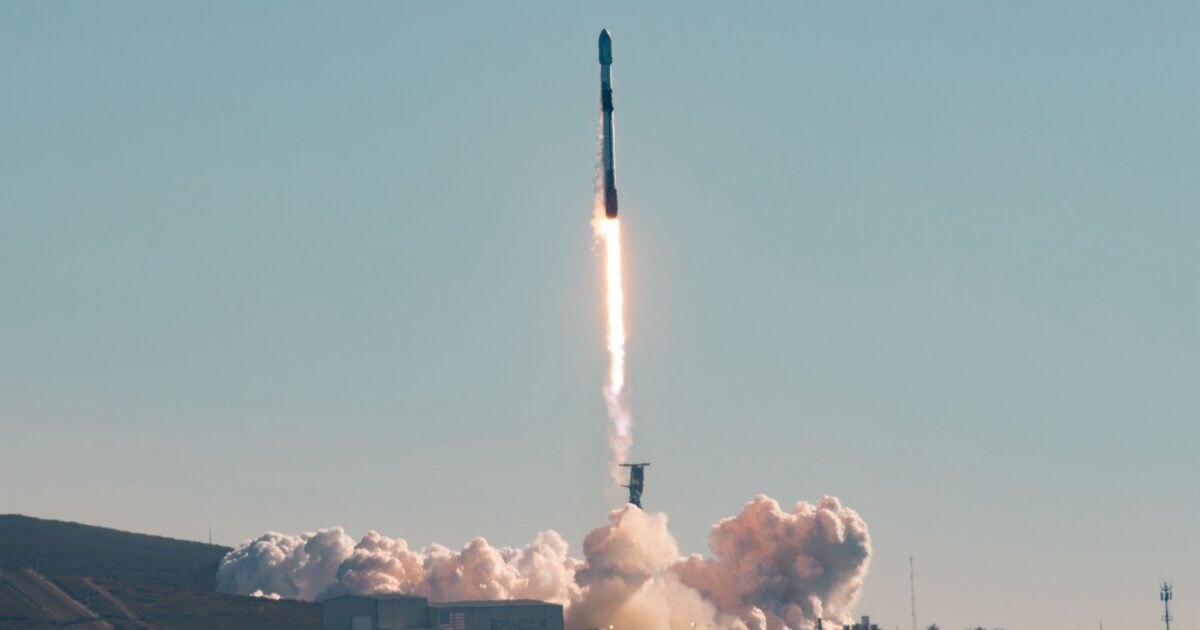
SpaceX has launched another classified U.S. Space Force mission from California—its second in just six days.
Falcon 9 lifted off from Vandenberg Space Force Base at 8:36 p.m. Pacific on Wednesday, carrying the secret USSF-627 payload toward low Earth orbit.
About eight minutes later, the first stage landed on the Of Course I Still Love You droneship in the Pacific. The upper stage and its undisclosed cargo continued out of public view.
SpaceX’s first video from the flight showed the rocket clearing Space Launch Complex 4E under the night sky.
Liftoff! pic.twitter.com/QoOtjKcP23
— SpaceX (@SpaceX) November 12, 2026
The public knows the mission name, the launch site and the rocket. What USSF-627 carried remains classified.
SpaceX identified Falcon 9 as the launch vehicle and Vandenberg’s pad 4E as the departure point. Its mission page also listed a droneship recovery in the Pacific, the familiar profile SpaceX uses for high-inclination national-security flights from California.
The launch was delayed twice earlier in the week before reaching the final Wednesday-night window. Once Falcon 9 left the pad, SpaceX showed the early ascent and first-stage recovery but did not broadcast the classified payload’s deployment.
That limited coverage is normal for missions whose orbital details are not intended for public release. SpaceX can show the booster coming home without revealing where the upper stage goes or what the spacecraft will do once deployed.
The booster was B1103, and this was its seventh trip to space. Its flight history includes an NRO mission, Space Development Agency launches and Starlink deployments—exactly the kind of mixed national-security and commercial work that has made Falcon 9 so difficult to replace.
The recovery was its own clean milestone. SpaceX’s second video showed B1103 settling onto the droneship after its return through the atmosphere.
Falcon 9’s first stage lands on the Of Course I Still Love You droneship pic.twitter.com/4uX2Ytfxzl
— SpaceX (@SpaceX) November 12, 2026
USSF-627 followed another secret Space Force launch from the same coast less than a week earlier.
Space.com reports that Falcon 9 launched USSF-432 from Vandenberg on November 6, then returned to the same base for USSF-627 on November 11. Both missions ended their public webcasts after the first stages landed, leaving the upper-stage work behind the classification curtain.
The outlet notes that outside launch observers believe the two flights may be carrying Starshield-derived spacecraft for the Space Force’s Space Based Sensing and Targeting portfolio. That remains informed speculation, not an official payload disclosure from SpaceX or the Space Force.
What is confirmed is the tempo. Two classified missions left Vandenberg six days apart, and both recovered their first stages at sea.
Space.com counts USSF-627 as Falcon 9’s 120th launch of 2026 and its 15th national-security mission of the year. Even if the payload stays secret, the pace of the launch operation is visible to everyone.
The larger campaign behind that pace is not secret.
Space Systems Command announced in July that it awarded SpaceX two task orders worth a combined $1.6 billion for 18 Falcon 9 launches supporting the Space Based Sensing and Targeting portfolio.
All 18 launches are scheduled to fly from Vandenberg and are expected to be completed by the end of 2027. The command said the acquisition moved from identifying the requirement to awarding the work in only two months.
The military describes the portfolio’s job in broad but significant terms: sensing and targeting airborne objects from space, while providing near-real-time communications across the joint force.
That does not prove USSF-627 carried a specific number or type of Starshield satellite. It does explain why Vandenberg is seeing a concentrated run of classified Falcon 9 missions and why the Space Force bought a block of launches instead of treating each flight as an isolated event.
There is also a practical reason the schedule can move this quickly. Falcon 9’s reusable boosters keep returning, getting inspected and flying again rather than forcing SpaceX to build a new first stage for every national-security payload.
B1103’s seventh landing is a small piece of that machine, but it is the part the public could actually watch. The payload disappeared into the classified side of the mission; the rocket came back eight minutes later, ready to enter the cycle again.
USSF-627 may remain secret for years. The launch tempo surrounding it is already telling the story: America’s military space buildup is accelerating, and SpaceX is carrying a very large share of it.

Join the conversation!
Please share your thoughts about this article below. We value your opinions, and would love to see you add to the discussion!