

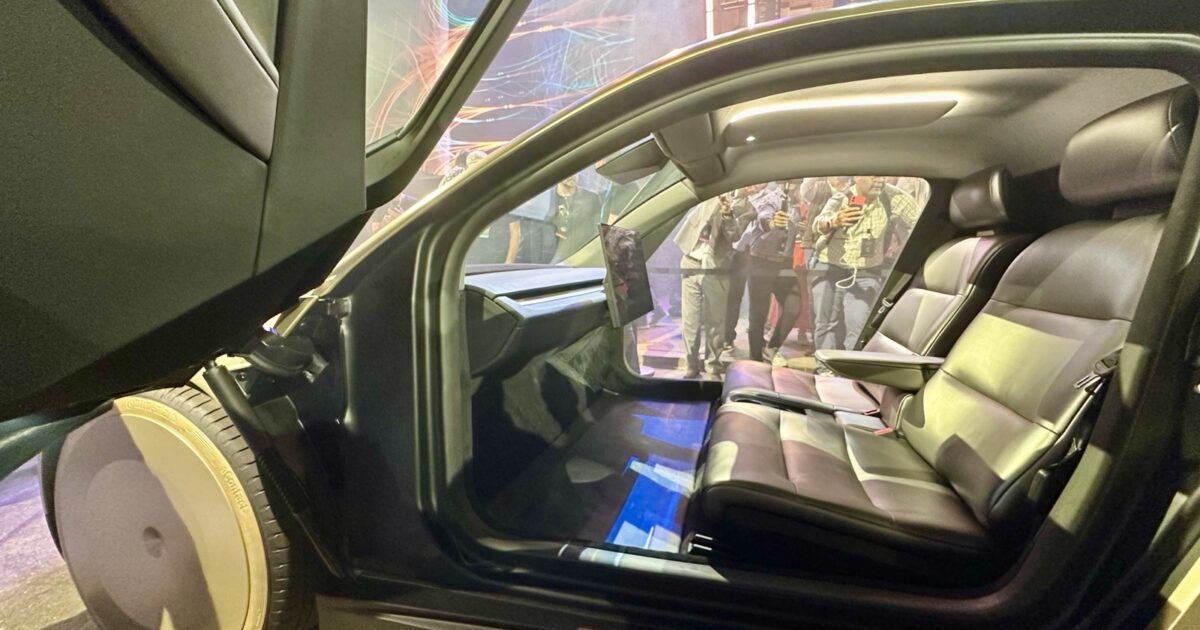
A Tesla Cybercab passenger got an unexpected look at the human side of a car built without normal human controls.
The center display briefly showed a virtual joystick, plus buttons for braking, the horn and the doors. It looked nothing like the usual Robotaxi passenger screen.
The rider could drag the joystick around with a finger. The car, importantly, did not visibly move.
Matthew Skrzypczak shared the unusual screen from an Austin ride:
Weird #cybercab situation! When I got in the vehicle, the display was in a different configuration with a virtual joystick for manual driving! I have a feeling I wasn’t supposed to see this… but I try to manually drive the vehicle anyway! 😂 @wholemars @DirtyTesLa @DavidMoss… pic.twitter.com/mQsoDFDbEJ
— Matthew Skrzypczak (@MatthewSkrzypc1) September 7, 2026
This is more than an entertaining software oddity. Cybercab has no steering wheel, accelerator pedal or brake pedal, so Tesla still needs some way for authorized people to move one when autonomy is not the right tool for the job.
A car may need to be nudged into a service bay, lined up with charging equipment, loaded onto a transporter or repositioned when its cameras cannot do the work. A hidden screen can provide those basic controls without installing permanent driving hardware in every vehicle.
Not a Tesla App examined the September 7 footage and identified a circular steering control on the left side of the screen. The visible interface also includes dedicated controls for braking, sounding the horn and closing the cabin doors.
The site reported that the joystick graphic followed the passenger’s finger while the Cybercab itself remained stationary. That distinction suggests the display can accept touch input without automatically granting authority to engage the motors.
Tesla has not publicly explained the access rules behind this screen, however. The video alone cannot establish whether the controls are limited by a staff login, a remote authorization, vehicle state, location or another safeguard.
The manual-control system had already appeared in a different setting. An August 30 video from Caleb Barry shows a Cybercab being repositioned near an Austin Supercharger after it did not line up cleanly with the charging stall.
In that earlier footage, the person inside appears to use the touchscreen to move the Cybercab away from the charger and correct its position. It establishes that the manual interface was already doing practical work more than a week before a passenger unexpectedly found it.
The controls are awkward compared with a steering wheel and pedals, but elegance is not the point. They offer a low-speed fallback for the moments when a driverless vehicle still needs a human hand.
Tesla’s Cybercab FAQ describes the production vehicle as a two-seat Robotaxi with butterfly doors, a large interactive touchscreen and no steering wheel. Tesla says Cybercab uses cameras and other sensors to navigate roads, intersections, highways and parking lots autonomously.
The same page says Cybercab rides are currently limited to parts of Austin. In normal passenger use, riders handle climate, media and trip functions through the Robotaxi app and the vehicle display; they are not given a conventional driving mode.
Tesla also lists several rider-facing controls, including the ability to open or close the doors and trunk from the screen or app. That makes the display a central part of the cabin by design, even though the virtual driving panel is clearly outside the normal rider experience.
Tesla’s Cybercab Rider Guide reinforces that separation. The normal trip begins by matching the license plate in the app, entering after the door opens, fastening the seat belt and tapping “Start Ride.”
The guide provides instructions for cabin comfort, doors, the trunk and emergencies, but it does not offer passengers a way to steer or drive. Its vehicle overview explicitly says there is no steering wheel, accelerator pedal or brake pedal in the cabin.
That leaves the screen as both Cybercab’s everyday passenger hub and, under a very different software state, a compact service tool.
The surprising part is not that Tesla built a manual fallback. It is that a passenger was able to see and manipulate its on-screen joystick at all—even if the car appears to have refused the command.
For a driverless fleet entering real public service, that brief glimpse raises a straightforward question Tesla has yet to answer publicly: what exactly keeps the service controls in the right hands?
Join the conversation!
Please share your thoughts about this article below. We value your opinions, and would love to see you add to the discussion!