
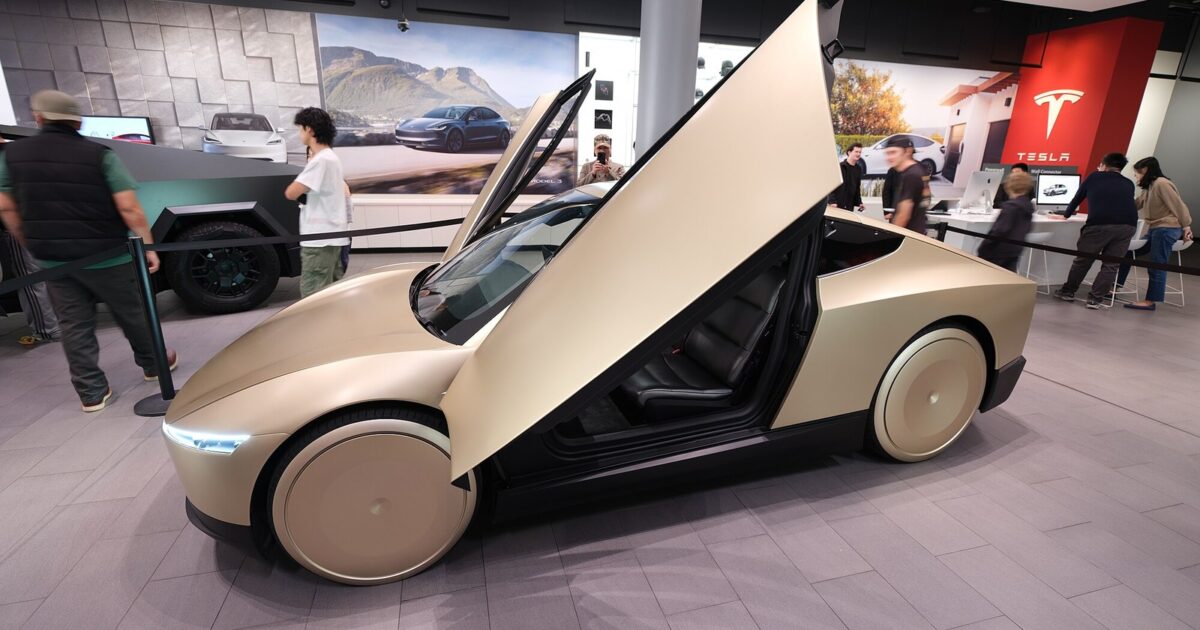
Tesla has finally put a concrete number on the factory advantage it expects from Cybercab.
The company says its Unboxed manufacturing process cuts the production-line footprint in half by building major sections of the car at the same time and joining them near the end.
Hours before that claim appeared, aerial footage from Giga Texas showed many finished Cybercabs in the outbound lot, with Starlink modules visible on their rear hatches.
Together, the updates show both sides of Tesla’s robotaxi scale-up: a smaller production system inside the factory and connected vehicles accumulating outside it.
Tesla showed the process in motion through its official Robotaxi account:
Our unboxed process for Cybercab assembles vehicle modules in parallel & frames the car in one step at the end.
This streamlines automation & reduces the line size by half, unlocking much greater production capacity.
The first real revolution in automotive manufacturing in over… pic.twitter.com/AbOCFCKM9D
— Robotaxi (@robotaxi) September 8, 2026
The production method carries unusual weight because Cybercab is meant to become a high-volume fleet vehicle rather than a low-volume technology showcase.
TeslaNorth describes the same-day video as a fresh look at the system Tesla has spent years developing. Instead of carrying one mostly complete body through a long sequence of stations, the Unboxed layout lets teams and machines work on large sections in parallel.
Those modules converge late in the process, where the car is framed together in one final stage.
The system leans into Cybercab’s dedicated purpose. A two-seat robotaxi with no steering wheel or pedals can be designed around factory automation from the beginning, without preserving every convention of a consumer car.
Tesla says the smaller line footprint unlocks greater capacity. The video demonstrates the layout, though it does not independently prove a production rate, cost per vehicle or long-term reliability figure.
A separate view of the Austin plant showed what was waiting beyond that line:
Giga Texas today is busy with production coming back up following the long weekend. Of interest today in the outbound lot is the appearance of hundreds of Mode; YL’s and many more Cybercabs and for the 1st time equipped with the Starlink module one the hatch in big numbers.
At… pic.twitter.com/G9yl6s51m4
— Joe Tegtmeyer (@JoeTegtmeyer) September 8, 2026
Joe Tegtmeyer flew over Giga Texas after the long holiday weekend and captured rows of vehicles in the outbound area. He reported hundreds of Model YL vehicles and many Cybercabs, with Starlink modules appearing on Cybercab hatches in substantial numbers for the first time.
The footage gives the public a same-day look at finished vehicles beyond the assembly footage Tesla released.
The aerial view does not provide an audited production total, and vehicles sitting in an outbound lot have not necessarily entered paid robotaxi service. It does show more than a one-off engineering prototype.
Multiple Cybercabs appear together, and the visible satellite hardware suggests Tesla is fitting at least part of the outgoing batch with another connectivity path. Tesla has not said whether every production Cybercab will ship with Starlink.
Tesla placed the current factory footage inside a longer production ramp in its second-quarter 2026 shareholder deck. The company said it started Cybercab production during the quarter and began engineering test drives of production vehicles on public roads.
Employee rides on the Giga Texas campus followed in July, which Tesla described as a precursor to putting Cybercab into its Robotaxi fleets.
The deck separated manufacturing progress from broad commercial deployment. Building cars, testing them and carrying employees were distinct steps, and the latest Austin launch has added paying passengers only in limited areas.
The September 8 factory video shows how Tesla intends to make the hardware efficiently. It does not erase the regulatory, software and fleet-operating work required to expand that service beyond its current footprint.
Tesla had telegraphed this manufacturing bet well before the first public rides.
Tesla told shareholders in its second-quarter 2025 deck that Cybercab would use an Unboxed manufacturing strategy and was scheduled for volume production in 2026. The official clip now makes that older plan visible: front, rear and cabin-related modules can advance at the same time, then meet late in assembly instead of waiting for one body to travel the entire line in sequence.
That design can save floor space and reduce the time a vehicle spends moving between stations, but Tesla has not published enough operating data to verify the final economics from outside the company. The half-size claim is Tesla’s own measurement.
The real test will be sustained output, consistent build quality and the number of finished Cybercabs that move from factory lots into regular passenger service.
The promise of Unboxed manufacturing has always sounded enormous. Tesla is now showing the machinery, the modules and a growing batch of finished vehicles on the same day.
If the factory can deliver the capacity Tesla claims, Cybercab’s next constraint will not be the amount of floor space its assembly line consumes. It will be how quickly Tesla can turn those gold cars into dependable rides across more cities.
Join the conversation!
Please share your thoughts about this article below. We value your opinions, and would love to see you add to the discussion!