

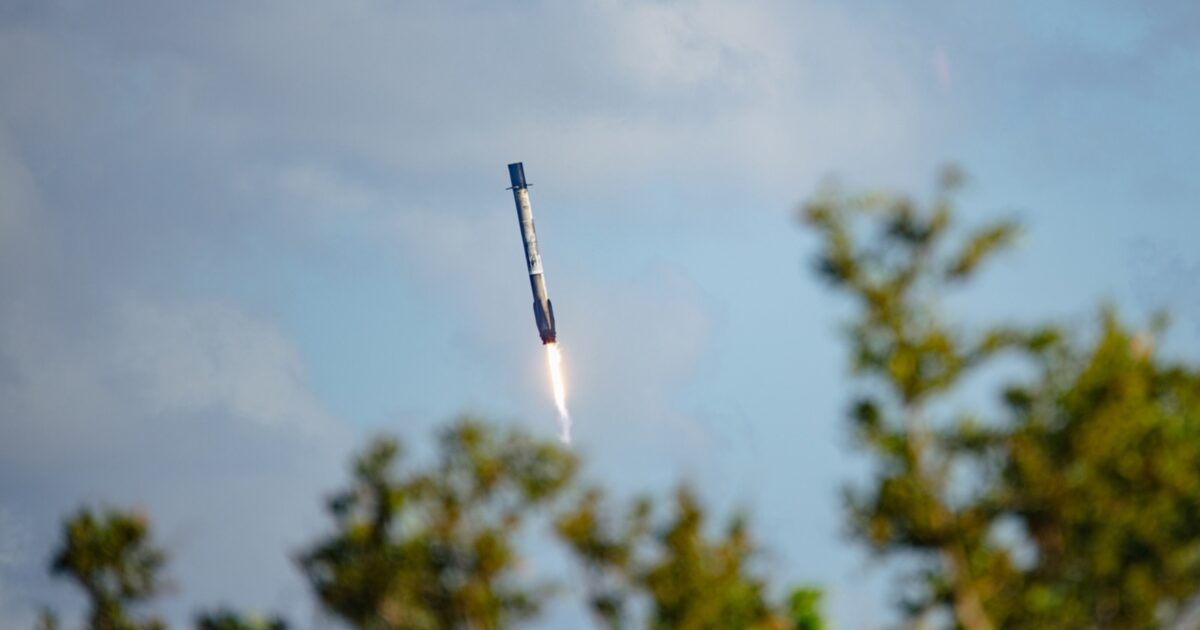
Elon Musk marked a number Saturday that still sounds impossible: more than 700 Falcon 9 flights.
The milestone came after SpaceX sent 27 more Starlink satellites into orbit from California, then brought the same first-stage booster down safely for the 18th time.
Falcon 9 has made the spectacular feel routine. That may be the rocket’s greatest achievement.
Spaceflight Now reports that Starlink 15-18 lifted off from Space Launch Complex 4 East at Vandenberg at 9:04 p.m. Pacific on Friday, or 04:04 UTC Saturday. The rocket flew southeast and carried 27 broadband satellites toward low Earth orbit.
The first stage was booster B1093, already a veteran of Transporter-16, two Space Development Agency missions and 14 earlier Starlink batches. About eight and a half minutes after liftoff, it landed on the drone ship Of Course I Still Love You in the Pacific.
The specialist outlet counted this as the 700th Falcon 9 launch. Mission counters can differ depending on how databases classify early flights and completed missions, but Musk’s own wording avoids the bookkeeping dispute: the fleet is now beyond 700 flights.
SpaceX confirmed the payload deployment after the upper stage completed its work:
Deployment of 27 @Starlink satellites confirmed
— SpaceX (@SpaceX) October 31, 2026
This flight did more than add another batch of satellites. It showed how completely SpaceX has changed the economics and tempo of orbital launch.
B1093 was not treated like a museum piece after one successful mission. It went back through inspection, refurbishment and launch processing until an 18th flight became an ordinary line in the manifest.
Next Spaceflight lists the mission as successful and identifies B1093 as flying for the 18th time after a 41-day turnaround. Its mission record places all 27 spacecraft in the Starlink Group 15-18 payload and confirms the flight originated at Vandenberg’s SLC-4E.
The database also records the landing as another successful recovery in a streak now measured in the hundreds. Those numbers matter because recovery is no longer an experimental side act; it is the operating system behind SpaceX’s launch rate.
Every reused booster spreads its manufacturing cost across more missions. Every clean landing also returns flight hardware and performance data that engineers can examine before the next launch.
Musk responded later Saturday with a direct congratulations to the team:
Congrats to the @SpaceX team on over 700 Falcon 9 flights! https://t.co/aY0V9tpvIx
— Elon Musk (@elonmusk) October 31, 2026
The timing gives the milestone an edge. Falcon 9 is reaching its highest flight totals while SpaceX prepares to move more of its future launch burden onto Starship.
SpaceX’s mission page carried the official webcast for Starlink 15-18 and documented the launch as a Vandenberg Starlink mission. It is the primary mission record behind the company’s deployment confirmation and puts the satellite batch inside SpaceX’s own launch archive.
Spaceflight Now says this was SpaceX’s final orbital launch of October. The report also notes that regular orbital Starship operations are expected to begin in 2027, with Musk projecting a path toward weekly flights and eventually an even faster cadence.
That does not make Falcon 9 obsolete overnight. NASA crews, cargo, national-security payloads and commercial satellites still depend on a rocket with a long operating record and mature infrastructure.
But the direction is clear. SpaceX wants Starship to inherit the high-volume work that Falcon 9 proved was possible.
Falcon 9 first flew in 2010. It took years to prove landing a booster was possible, then more years to turn reflights into something customers trusted.
Now one booster can fly 18 times, land on a ship and be folded back into the schedule without the mission feeling unusual.
Seven hundred-plus flights are the headline. Routine reuse is the real revolution.
Join the conversation!
Please share your thoughts about this article below. We value your opinions, and would love to see you add to the discussion!