
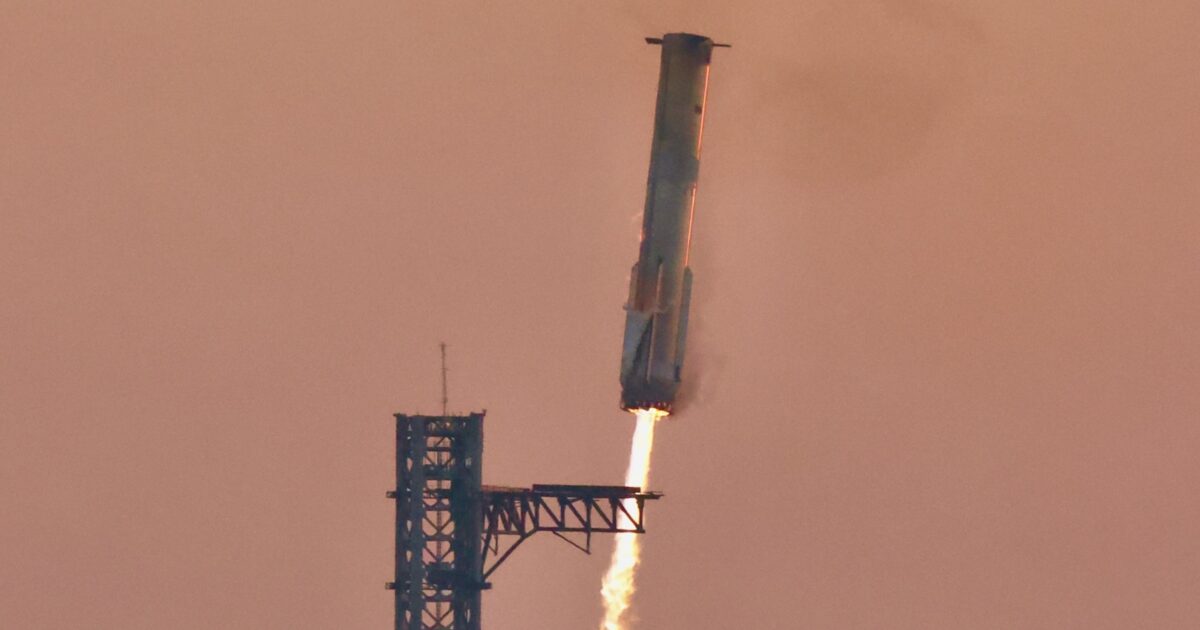
SpaceX already has its first specific hardware change from catching an orbital Starship.
Elon Musk says the ablative material that scraped against the tower arms during Ship 42’s catch will be replaced with stainless-steel wool on future flights.
He was not talking about replacing the spacecraft’s entire tiled heat shield. The reply concerned material visible around the ship’s contact area as it settled into Mechazilla’s arms.
It is a narrow change with a big purpose. Rapid reuse depends on surviving the tower as well as surviving reentry.
Elon Musk on X gave the update early Tuesday while responding to footage that showed the ablative layer rubbing and peeling at the catch point.
Musk said the material will be replaced with stainless-steel wool on future flights. He did not identify the first ship to receive it, publish specifications or announce a schedule.
Here is the full update:
That will be replaced with stainless steel wool for future flights
— Elon Musk (@elonmusk) November 17, 2026
The location matters. Starship’s black ceramic tiles protect the broad windward surface from the worst heating during reentry.
The material Musk addressed is a local backup layer in an area that also has to tolerate mechanical contact with the catch arms. A material can do its thermal job and still create refurbishment work if the tower scrapes it away.
Tesla North reports that the exchange centered on ablative material visibly rubbing against Mechazilla during the November 14 catch. Its report separates that contact-area change from any plan to discard Starship’s full tiled shield.
The outlet also notes that Musk did not say when the replacement will first fly. For now, the claim is a design direction revealed by recovered hardware, not a completed qualification test.
The distinction keeps the update grounded. SpaceX has identified a material it wants to change, but the company has not said whether stainless-steel wool will sit behind the tiles, cover only the tower-contact zone or require changes to the catch fittings themselves.
That is exactly why getting Ship 42 back matters. Engineers can inspect wear at the catch points, compare it with telemetry and camera views, then change the hardware that did not come home as cleanly as they wanted.
SpaceX designed Flight 15 to inspect the ship before it ever committed to returning over land. Three of the 26 Starlink V3 satellites carried cameras that photographed the heat shield while Ship 42 remained in orbit.
Ground cameras and satellite views fed a series of health checks. The ship could have diverted to a contingency splashdown, but the shield was judged healthy enough for reentry and a return to Starbase after roughly 22.5 hours aloft.
The mission produced more than a dramatic catch. It delivered an orbital vehicle that could be examined at arm’s length, including the places where the tower physically took its weight.
SpaceX posted a new set of images showing Ship 42 back on Earth and available for that inspection:
Starship 42 back on Earth pic.twitter.com/OEkFHSM5GJ
— SpaceX (@SpaceX) November 16, 2026
The Associated Press reported that Ship 42 completed 14 laps around Earth, deployed all 26 advanced Starlink satellites and became the first Starship upper stage caught after returning from orbit.
SpaceX’s early assessment was that the ship and its vital heat shield had performed well. The Super Heavy booster did not return to the tower, so Flight 15 still fell short of recovering both stages on the same mission.
The upper stage nevertheless gave SpaceX something it never had before: a flown orbital Starship hanging intact at the same site where it was built and launched.
The report also places the result in the program’s larger sequence. This was Starship’s 15th full-scale flight and only its second trip to orbit, so the first intact orbital return gave engineers a much richer physical record than any splashdown or debris recovery could provide.
Space.com reported that flight controllers reviewed both ground-camera views and the satellite images before confirming the shield was in the right condition for reentry.
The final review came after the ship had spent most of a day in orbit. If the vehicle had failed that health check, it could have returned to a safer ocean corridor instead of attempting the tower catch.
Passing that test proved the shield could bring Ship 42 home. The scraped material now shows that coming home is only the first half of the reuse problem.
A fully reusable vehicle cannot demand extensive patching every time the tower grabs it. Every damaged layer, inspection and replacement adds labor and time between flights.
Stainless-steel wool sounds almost ordinary next to a 407-foot rocket. Here, the goal is practical: a tougher local layer that preserves thermal protection while better tolerating contact with the catch hardware.
SpaceX still has to show that the new material works in flight, survives reentry and handles the tower without creating a different maintenance problem.
But the design loop is now moving: fly the ship, bring it back, inspect the wear and change the next one.
The catch was the spectacle. This stainless-steel-wool decision is what reusable engineering looks like the morning after.

Join the conversation!
Please share your thoughts about this article below. We value your opinions, and would love to see you add to the discussion!