
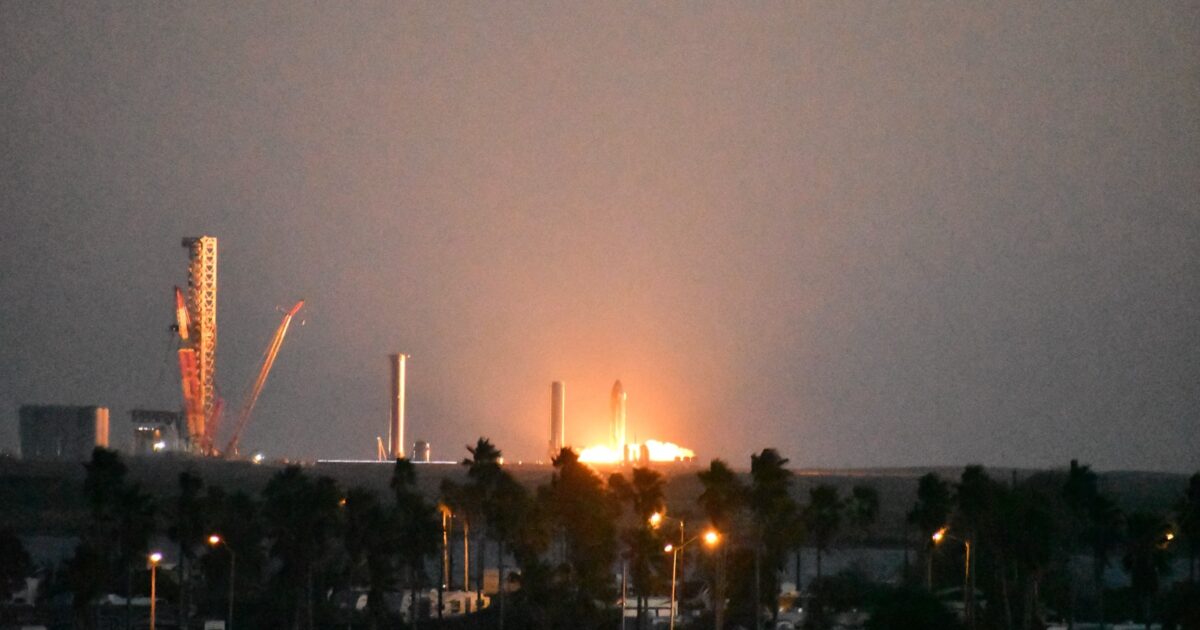
SpaceX may not have to wait long to find out whether a Starship can fly twice.
After inspecting Ship 42 at Starbase, Elon Musk said the spacecraft’s heat shield looked strong, its engines looked strong and the same vehicle could probably return to flight after only a few weeks of refurbishment.
That is an estimate, not a launch date. Musk did not say whether Ship 42 would fly on Flight 16, Flight 17 or a later mission.
It is still the first rough turnaround forecast for the Starship that just became the first upper stage in the program to return from orbit and land in the tower’s arms.
Elon Musk on X said he had gone over the whole heat shield earlier Sunday. He described both the shield and the engines as looking great, then put the possible refurbishment period at a few weeks.
He also drew a sharp line between flying again and achieving immediate reuse. SpaceX still needs many small fixes, Musk said, before a Starship can operate more like an airplane with no expected refurbishment beyond scheduled maintenance.
Here is his full post-catch assessment:
Yeah, I was going over the whole Starship heat shield earlier today. Overall, it looks great. The engines look great too. Ship 42 could probably be reflown with a few weeks of refurbishment.
However, many small fixes are needed to achieve immediate reusability (like an… https://t.co/ypGLoAkRGu
— Elon Musk (@elonmusk) November 15, 2026
The distinction is enormous. Recovering hardware saves the vehicle.
Rapid reuse is the part that can change launch economics.
A ship that survives reentry but needs months of tile replacement, engine work and structural inspection would still be reusable on paper. It would not yet deliver the airline-like cadence SpaceX has promised.
Ship 42 gives the company its first chance to measure that gap on an upper stage that completed a real orbital mission and returned intact to the same launch site.
SpaceX built Flight 15 around an ambitious sequence: reach orbit, deploy 26 Starlink V3 satellites, keep Ship 42 aloft for roughly 22 hours and then bring both stages back toward the tower.
The upper stage completed 14 trips around Earth before restarting an engine for deorbit. It then crossed the atmosphere, turned upright above Starbase and settled between Mechazilla’s arms.
SpaceX describes the catch as a benchmark on the road to reliable and rapid reuse. The returned vehicle now lets engineers examine the heat shield, engines, plumbing and structure directly instead of trying to reconstruct their condition from debris or telemetry alone.
The early inspection is encouraging, but the mission did not produce a fully reusable stack.
Super Heavy aborted its planned tower approach and diverted to the Gulf after its guidance system determined the booster was not where it needed to be for a safe catch.
The Associated Press reported that Ship 42 spent about 22 hours in flight, deployed the 26 advanced satellites and became the first Starship caught after returning from space. SpaceX said the ship’s systems, including the heat shield, appeared to perform well.
The booster told a different story. Its engines stopped firing too soon during the return, and the onboard guidance system automatically chose the offshore contingency path instead of allowing an unsafe tower approach.
Engineers were still investigating the reason for that underperformance. SpaceX therefore has proof that it can catch an upper stage after orbit and proof from earlier missions that it can catch a booster—but not both on the same flight.
Musk shared another view that makes the precision of the upper-stage recovery easier to appreciate:
This gives a clear sense of the catch maneuver https://t.co/5IlsUeDFnd
— Elon Musk (@elonmusk) November 15, 2026
The video shows why the catch is more than a dramatic landing. The ship has to arrive beside the tower inside a narrow corridor, complete the flip and place its catch fittings where the arms can take the load.
Spaceflight Now reported that the catch happened at 3:20 p.m. Central after Ship 42 reentered over the Pacific, crossed Mexico and the American Southwest, then turned out over the Gulf for its final approach.
The same account noted that Flight 15 was Starship’s most ambitious test yet. The ship reached orbit and completed its payload mission, while Booster 22 diverted offshore before the vehicle disappeared in a fiery splashdown.
Ship 42 had earlier options to end the mission with contingency splashdowns near Hawaii or Chile. Instead, healthy systems allowed it to remain in orbit for the full 14 laps and commit to the Starbase return.
That split result is the honest measure of where the program stands. The upper stage came home in good enough condition for Musk to talk about flying it again within weeks.
The booster did not come home at all.
If Ship 42 actually flies again, the next milestone will be quieter than the catch but arguably more important. SpaceX will have shown that recovery can preserve enough of an orbital spacecraft to put the same hardware back into service.
And if the refurbishment really takes weeks, engineers will have a concrete baseline to attack: fewer replaced tiles, fewer inspections, faster engine checks and less work between landing and launch.
The tower catch proved SpaceX can bring a Starship back. Ship 42’s next assignment may reveal how close the company is to making that return useful.

Join the conversation!
Please share your thoughts about this article below. We value your opinions, and would love to see you add to the discussion!