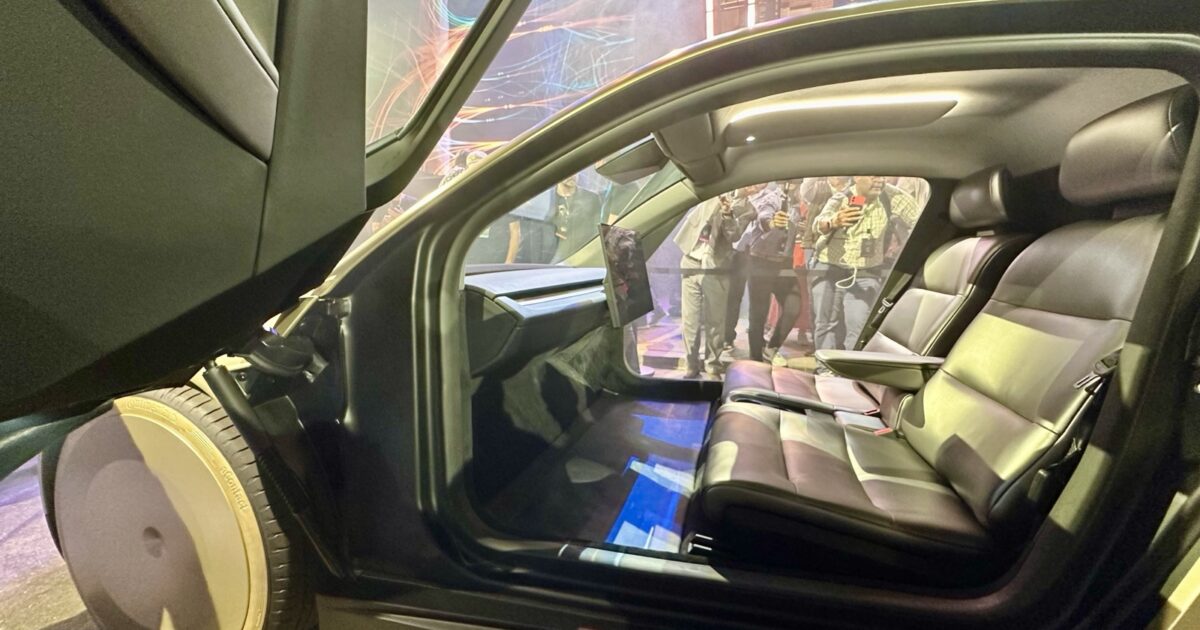
Tesla has finally put a personal-use price on Cybercab: $29,990.
There is a much bigger number hiding behind that headline. The car will not move unless its owner keeps an active Autonomy Subscription, advertised to invited buyers at $299 every month.
Elon Musk is already saying that price is too high.
Tesla’s official Robotaxi account announced the invitation Friday:
Select customers are now being invited to purchase Cybercab for personal use pic.twitter.com/LDIkKuseAZ
— Robotaxi (@robotaxi) November 13, 2026
The invitation puts the two-seat Cybercab just under the $30,000 target Musk set at the 2024 reveal. It also turns the vehicle into something Tesla has never sold before: a car whose basic ability to drive remains tied to a recurring software-and-service payment.
Tesla’s Cybercab Autonomy Subscription Agreement says the rule plainly: Cybercab will not operate without an active subscription. It defines that paid package as the software and connected systems that enable and manage the vehicle’s operation.
The subscription combines autonomous driving, vehicle connectivity, remote support, limited roadside assistance and a list of covered services, including specified routine maintenance. Tesla says towing to a service center or the owner’s home is included when needed, generally up to about 50 miles.
That does not make ownership all-inclusive. Registration, insurance, parking, charging, general cleaning and other operating costs stay with the buyer.
Unplanned repairs are excluded unless Tesla’s warranty or a listed covered service applies, and Tesla says it will seek approval before performing billable work.
The agreement never fixes the fee at the invitation’s $299 figure. Tesla promises one month’s notice before a price change, but it does not lock the current rate for the life of the car.
Tesla can also suspend or cancel service for nonpayment, unauthorized use or conduct it considers unsafe. Three or more safety strikeouts can trigger a one-week loss of autonomous-driving features, leaving the owner with hardware that still depends on Tesla’s permission to operate.
Tesla’s Cybercab order agreement adds another hard boundary: the car operates only inside Tesla-supported areas, and those areas are limited, may change and can differ by jurisdiction.
The first subscription month is included at purchase. After that, the fee is billed separately from the vehicle price until the owner cancels, with no promise that future months will retain the invitation rate.
Canceling is possible at any time through the Tesla Account. Driving without an active subscription is not.
The car also depends on the Tesla app rather than conventional controls. Owners use it to set destinations, manage trips, arrange service and get support, which makes an active Tesla Account, compatible mobile device and network access part of the operating chain.
Tesla reserves the right to change features and services by location and hardware configuration. Regulatory approval, network availability and the company’s own supported-area map all stand between the purchased vehicle and a particular trip.
Those limits are accepted at purchase, not added later as an optional software upgrade. The order terms make the subscription a condition of using the vehicle and place the geographic boundaries under Tesla’s continuing control.
That changes the meaning of the $29,990 sticker. At the advertised rate, the first three paid years add $10,764 before taxes, insurance, electricity or any subscription increase.
The Cybercab is therefore less like a conventional entry-level car and more like a rolling autonomy platform. Buyers own the hardware, but continued mobility depends on Tesla’s software, coverage map and monthly service.
TechCrunch reported that the initial invitations went to select customers, with estimated December 2026 delivery and acceptance limited to a short list of Texas cities.
The buyer-facing screen showed the $29,990 vehicle price alongside the separate $299 monthly requirement, making the recurring cost visible before an invited customer places the order.
The report also captured a key distinction from Tesla autonomy chief Ashok Elluswamy. A privately owned Cybercab is expected to drive unsupervised inside the same geographic areas served by Tesla’s Robotaxi network, but for the owner’s trips rather than as a free-roaming vehicle that can travel anywhere.
Musk said the geographic reach should eventually expand nationwide as regulatory approvals arrive. That is a roadmap, not the operating reality of the first deliveries.
His more immediate reaction was aimed at the monthly bill:
It will be available nationwide, as we receive regulatory approval.
But the monthly fee is too high. Should match the cost of Tesla FSD and connectivity for other models, which is more like ~$115/month.
— Elon Musk (@elonmusk) November 14, 2026
Musk’s proposed figure would make a dramatic difference. At roughly $115 a month, three paid years would cost $4,140—$6,624 less than the invitation’s $299 rate.
But Tesla has not changed the buyer-facing price yet. Until it does, $299 is the number attached to the invitation and the agreement leaves future pricing adjustable.
TeslaNorth reported that the invitation also requires a $1,000 non-refundable order deposit and lists an estimated December delivery in Austin. The first month of autonomy service is included, while the recurring fee sits outside the purchase price.
The outlet’s review of Tesla’s terms found another important limit: personal Cybercabs cannot be used for Tesla Robotaxi, third-party ride-hailing, delivery or rental work unless Tesla authorizes the activity in writing or enables it through the product.
That matters because one of the original Cybercab pitches was economic productivity—cars earning money when their owners were not using them. The first personal-use agreement does not hand buyers that business model.
For now, Tesla is offering something narrower and stranger: a steering-wheel-free vehicle for invited customers, confined to approved service areas, with a mandatory subscription that even the company’s CEO says is priced too high.
The purchase price is finally concrete. The real cost of keeping Cybercab moving is not.
Join the conversation!
Please share your thoughts about this article below. We value your opinions, and would love to see you add to the discussion!