
Starship Flight 15 reached orbit Friday and deployed 26 Starlink V3 satellites. But the mission’s first history-making catch never happened.
SpaceX aborted Super Heavy’s return to the launch tower and sent the booster to an offshore landing area in the Gulf instead.
That is a real setback. It is not the end of Flight 15.
Ship 42 remains in orbit for a roughly 22-hour mission, with the first attempted catch of a Starship upper stage still planned for Saturday—if the spacecraft stays healthy and every safety gate clears.
SpaceX’s full launch broadcast captured the split result in real time:
Watch Starship Flight 15https://t.co/xvmIH2diNA
— SpaceX (@SpaceX) November 13, 2026
The Associated Press reported that the booster catch was called off after liftoff from Starbase, with Super Heavy diverted offshore and destroyed after its water landing. SpaceX commentator Kate Tice said the decision reflected the safety checks designed to protect the pad.
SpaceX did not immediately explain what triggered the abort. That distinction matters: the public record supports saying the catch was canceled, not guessing whether the booster, tower, weather or another system caused the decision.
The upper stage kept going.
Ship 42 completed orbital insertion and released all 26 of its next-generation Starlink satellites. It is scheduled to circle Earth at roughly 170 miles up before beginning the far harder part of the mission: returning a 171-foot spacecraft from orbital velocity to the same tower that launched it.
SpaceX designed Flight 15 around two separate recovery events. Super Heavy was supposed to return minutes after launch, while the ship would remain aloft for most of a day and come home on November 14.
The mission’s primary payload was 26 operational Starlink V3 satellites, the second batch Starship has carried to orbit. Their deployment turned Friday’s flight into productive work even after the booster recovery plan changed.
SpaceX also built multiple off-ramps into the return sequence. Controllers can redirect Ship 42 to an ocean contingency zone if the spacecraft, tower, weather or surrounding range falls outside the catch limits.
That safety logic is not a footnote. A tower catch brings a massive vehicle back over the launch site, and SpaceX has to be willing to throw away hardware rather than risk the pad, the public or the next mission.
Space.com laid out the mission’s unusual timeline before launch: the booster return near T+6.5 minutes, satellite deployments beginning about 35 minutes after liftoff, and the ship’s return more than 22 hours later. It also noted that SpaceX had caught Super Heavy three times before Flight 15, but had never attempted to recover the ship at the tower.
Ship 42 was expected to complete roughly 14 orbits near 275 kilometers above Earth before setting up its return. The long coast gives SpaceX time to monitor the vehicle, but it also adds thermal, navigation and systems demands that a short suborbital flight cannot reproduce.
The report also explained the fallback: if the catch criteria are not met, the ship can be sent toward a Pacific splashdown rather than brought over Starbase. That makes Saturday’s tower approach a decision SpaceX must earn throughout the flight, not an automatic ending.
That is why the mission remains consequential even after Friday’s miss. Orbit and payload deployment prove Starship can do useful work.
Bringing the ship back intact would attack the cost and turnaround problem that still separates Starship from full reusability.
Hours before launch, the final preflight view showed Ship 42—the vehicle that now carries the remaining recovery attempt:
Starship 42 preparing for launch https://t.co/s2nMPoiV3H
— Elon Musk (@elonmusk) November 13, 2026
The booster failure means Flight 15 can no longer deliver that complete first. The ship can still deliver a different one.
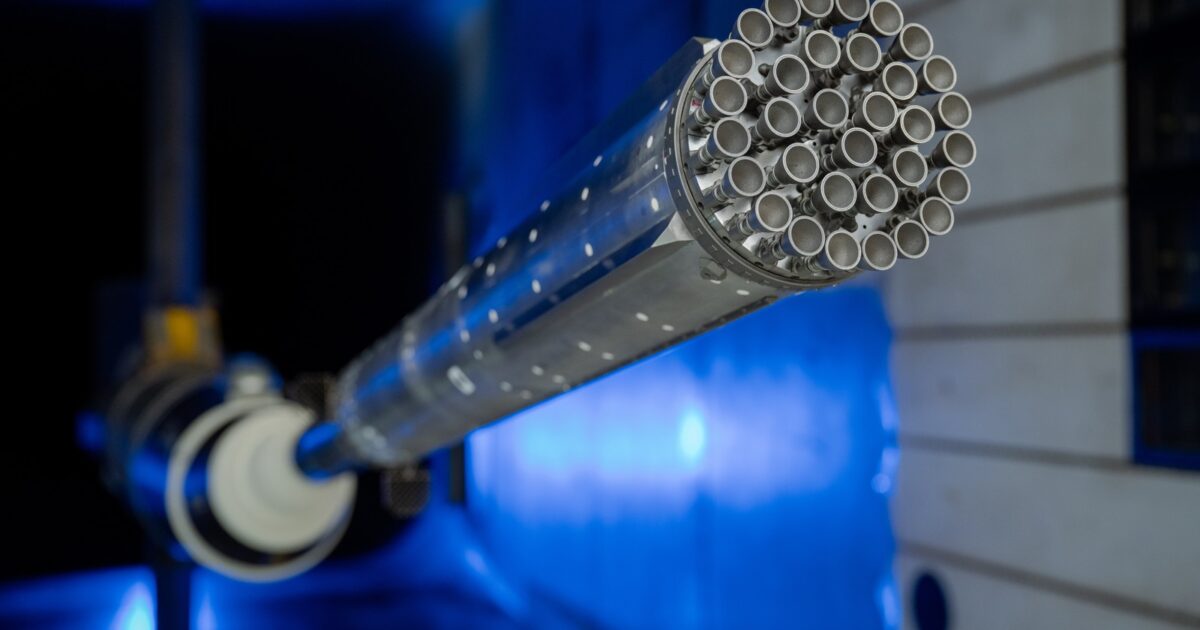
NASA tested a 1.2-percent model of the upgraded Super Heavy Version 3 at Ames Research Center to measure the extreme aerodynamic loads it encounters during reentry. The agency’s photographs show the model’s 33-engine end mounted inside the wind-tunnel test rig.
Flight 15 used that upgraded booster generation, which is intended to become SpaceX’s production architecture for lunar and Mars missions. Friday’s diverted return still produced real-world ascent, separation, boostback and landing data, but SpaceX lost the chance to inspect the booster after recovery.
The next checkpoint arrives Saturday. Ship 42 must remain stable through its long orbital coast, execute its deorbit and reentry sequence, pass the catch-commit criteria, and reach Starbase precisely enough for the tower arms to close around it.
Friday proved Starship can reach orbit and carry a full batch of V3 satellites. It also proved that full reusability will not arrive just because the mission plan says “catch.”
Now the ship has to come home.

Join the conversation!
Please share your thoughts about this article below. We value your opinions, and would love to see you add to the discussion!