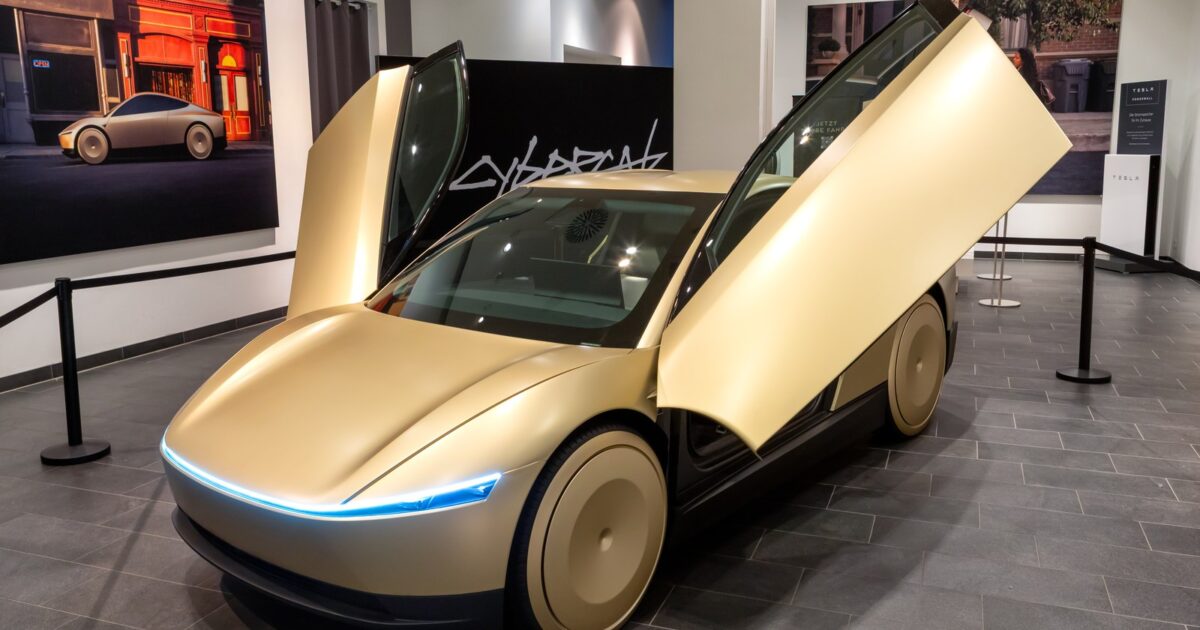
Tesla is putting €3 billion behind a plan to turn Berlin into a Cybercab production center capable of building one million robotaxis every year.
This plan already has a timetable. The company says it wants permits filed before the end of 2026, construction underway in the first half of 2027 and Cybercabs rolling out of Grünheide in 2029.
The scale is enormous. The proposed Cybercab capacity would be twice the 500,000-vehicle annual target Tesla originally set for the entire existing Berlin operation.
Giga Berlin plant manager André Thierig announced the expansion Monday:
If you ever wondered, what we would be doing at Giga Berlin with all the land that we have…
We are expanding! Cybercab production is coming to Giga Berlin!
Today we announced a first investment of around € 3b in a new manufacturing building with an anticpated start of… pic.twitter.com/vpcDdxoqlW
— André Thierig (@AndrThie) November 16, 2026
Thierig called the investment a first step, not a ceiling. Tesla plans a new production hall north of its current plant, supporting buildings and another wastewater-treatment system.
The product choice matters even more than the construction. Grünheide currently builds the Model Y.
Tesla is now reserving its next massive European manufacturing bet for a two-seat vehicle with no steering wheel or pedals.
Reuters confirmed that Tesla intends to invest €3 billion, about $3.3 billion, and design the new operation for as many as one million Cybercabs per year.
The company told Reuters it expects to submit the overall building application before the end of this year. Work is scheduled to start during the first half of 2027, with production beginning in 2029.
German newspapers first reported the plan, but Tesla supplied the core figures and timeline directly. The announced sum is an initial commitment tied to added capacity at the company’s only European vehicle plant.
That timetable gives Tesla three years to build the plant—and gives Europe three years to decide how vehicles like Cybercab can operate at real scale.
The factory commitment is arriving far ahead of a settled European market for the product.
TechCrunch reported that Tesla sees the expansion as part of its larger pivot from conventional automaking toward AI, robotics and autonomous transportation.
Cybercab entered public service only in September. Tesla’s current Texas robotaxi fleet still consists mostly of modified Model Ys, while the purpose-built Cybercab count remains in the hundreds.
A Berlin line rated for one million vehicles a year would therefore jump far beyond today’s fleet. It also would sit alongside Cybercab manufacturing in Austin, where Tesla is already redirecting factory space toward the robotaxi program.
TechCrunch counted about 1,307 Tesla robotaxis registered in Texas, including roughly 573 Cybercabs serving Austin or headed toward Dallas. Those numbers put the proposed Berlin capacity in perspective: the annual factory target is hundreds of times larger than the purpose-built fleet now on the road.
This is Tesla betting on the demand curve before regulators, riders and the current fleet have caught up.
An automation engineer at the plant added another striking detail. Steven Scholtysek said Musk personally approved the project last week and described the second operation as larger than the first:
Tesla Giga Berlin – Huddle Update!
Es ist gerade eben entschieden worden!
Letzte Woche durch Elon Musk persönlich freigegeben:Die Giga Berlin wird nun endlich erweitert.
Die 2. Factory wird größer als die 1. Giga!
Ziel sind 1.000.000 CyberCabs Produktion pro Jahr!
Der Bau der…— Steven (@s_scholtysek) November 16, 2026
The post is in German, but its numbers are unmistakable: a larger second operation and a target of one million Cybercabs annually.
Electrive reported that the project also includes auxiliary facilities and expanded water treatment, with several hundred construction and manufacturing-planning specialists expected to be needed.
The existing plant employs about 12,600 people and is producing roughly 7,000 Model Ys per week, according to the outlet. That is close to its current technical limit of 7,500 per week but still below the 500,000 annual capacity Tesla promoted when Grünheide opened.
Battery production is expanding too. Tesla expects the site’s in-house cell operation to reach full capacity by mid-2027, placing another major supply component beside the future Cybercab line.
Electrive also described a three-phase approval structure. The first partial approval covered modernization, storage and logistics, while later stages are expected to cover the second production hall, factory equipment and a freight-rail connection.
The physical buildout has a regulatory mirror image.
Electrek noted that Tesla currently has no European approval to operate Cybercab without supervision. The approval recognized across several countries covers Tesla Assisted Driving and still requires an attentive driver—something a steering-wheel-free Cybercab does not provide.
The European Union’s existing small-series route for fully driverless vehicles is capped at 1,500 registrations per vehicle type each year. That is nowhere near the output Tesla is designing into Grünheide.
Rules can change by 2029, and Berlin-built Cybercabs could also be exported. But those are paths the company still has to turn into an operating market.
For now, the hard commitment is on the manufacturing side: €3 billion, a 2027 construction start, a 2029 production target and enough stated capacity to build one million Cybercabs every year.
Tesla is not waiting for Europe’s robotaxi future to arrive. It intends to build the factory first.
Join the conversation!
Please share your thoughts about this article below. We value your opinions, and would love to see you add to the discussion!