

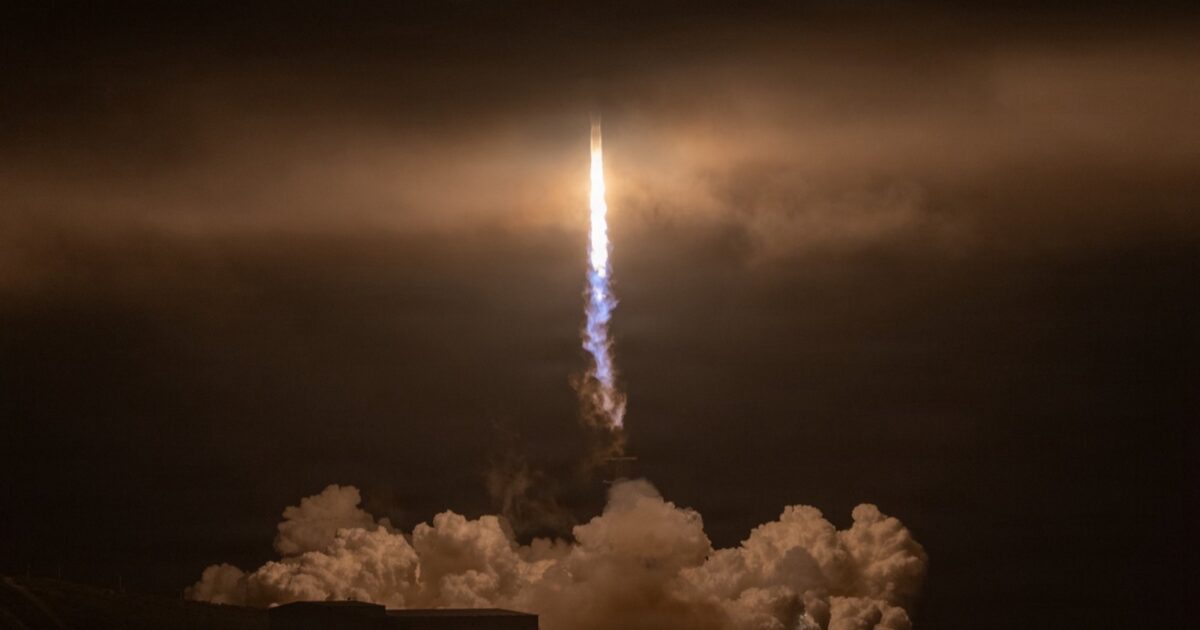
SpaceX has sent another 27 Starlink satellites skyward from California, but the more revealing number in Monday evening’s launch may be 20.
The Falcon 9 first stage assigned to Starlink 15-25, booster B1088, was making its 20th trip to space. It lifted off from Space Launch Complex 4 East at Vandenberg Space Force Base and headed south over the Pacific.
That is a remarkable amount of work for one rocket stage. B1088 has carried a NASA observatory, national-security payloads, a rideshare mission and now 15 separate Starlink flights.
SpaceX carried the mission live from the California coast.
Watch Falcon 9 launch 27 @Starlink satellites to orbit from California https://t.co/9Pauv9VbZD
— SpaceX (@SpaceX) October 13, 2026
The flight was not finished at liftoff. The upper stage still had to complete its burns and release the satellite stack, while B1088 aimed for the droneship Of Course I Still Love You in the Pacific.
SpaceX’s published timeline placed the booster landing a little more than eight minutes after launch. Satellite deployment was scheduled nearly 62 minutes after liftoff, following a coast and brief second burn.
SpaceX identifies the payload as 27 Starlink satellites bound for low-Earth orbit. The company says the first stage had already launched NROL-126, Transporter-12, NASA’s SPHEREx observatory, NROL-57, USSF-366 and 14 earlier Starlink missions.
That list shows why Falcon 9 reuse is more than a flashy landing shot. The same physical stage has moved between government missions, civilian science, commercial rideshare work and SpaceX’s own network deployment.
The company also warned that people in Santa Barbara, San Luis Obispo and Ventura counties could hear one or more sonic booms. Weather and local conditions determine whether those sounds reach any particular neighborhood.
The planned landing was offshore rather than a return to Vandenberg. That choice preserves more of the booster’s performance for the payload while still giving SpaceX a chance to recover the stage.
Spaceflight Now reports that the rocket flew a southerly path toward an orbit inclined 70 degrees to the equator. The outlet identified the payload as 27 Starlink V2 Mini Optimized satellites and put the initial deployment orbit at about 266 kilometers.
That low starting point is deliberate. Starlink spacecraft use their own propulsion to spread out, raise orbit and move into their assigned positions after deployment.
The approach gives SpaceX time to check the satellites before they climb into operational altitude. A spacecraft that does not pass those early checks can be kept low enough for atmospheric drag to bring it down sooner.
For B1088, flight 20 adds another chapter to an unusually varied record.
Its third mission launched SPHEREx in March 2025. The spacecraft was not another communications satellite; it was designed to map the entire sky in 102 infrared colors.
NASA says SPHEREx was built to study what happened after the Big Bang, trace how galaxies formed and evolved, and measure water and other ingredients for life in the Milky Way. That launch also carried four small PUNCH satellites to study the Sun’s outer atmosphere and solar wind.
The science mission makes B1088’s current assignment easier to appreciate. A booster that once launched a telescope built to survey the universe is now back on the same coast carrying another batch for the world’s largest satellite network.
In between, B1088 flew classified and military missions along with Transporter-12, a rideshare that carried many smaller spacecraft. Its resume looks less like a single rocket’s history and more like a cross-section of the modern launch market.
Twenty flights also put the economics of reuse in plain view. SpaceX still builds new upper stages for each mission, refurbishes hardware and operates launch and recovery teams, but it does not have to manufacture a new first stage every time 27 satellites need a ride.
That changes what a launch company can attempt. Starlink needs a steady stream of replacements and new spacecraft, government customers need reliable access to orbit, and science missions still have their own narrow windows.
A veteran booster can move among all three without waiting for a brand-new first stage to roll out of the factory.
Starlink 15-25 is another network-expansion flight, not a one-of-a-kind interplanetary spectacle. That is exactly why B1088’s 20th launch matters.
SpaceX has made a rocket leaving Earth look routine enough that the payload count can pass almost unnoticed. Twenty trips by the same booster should not.
Routine is the achievement.
Join the conversation!
Please share your thoughts about this article below. We value your opinions, and would love to see you add to the discussion!