
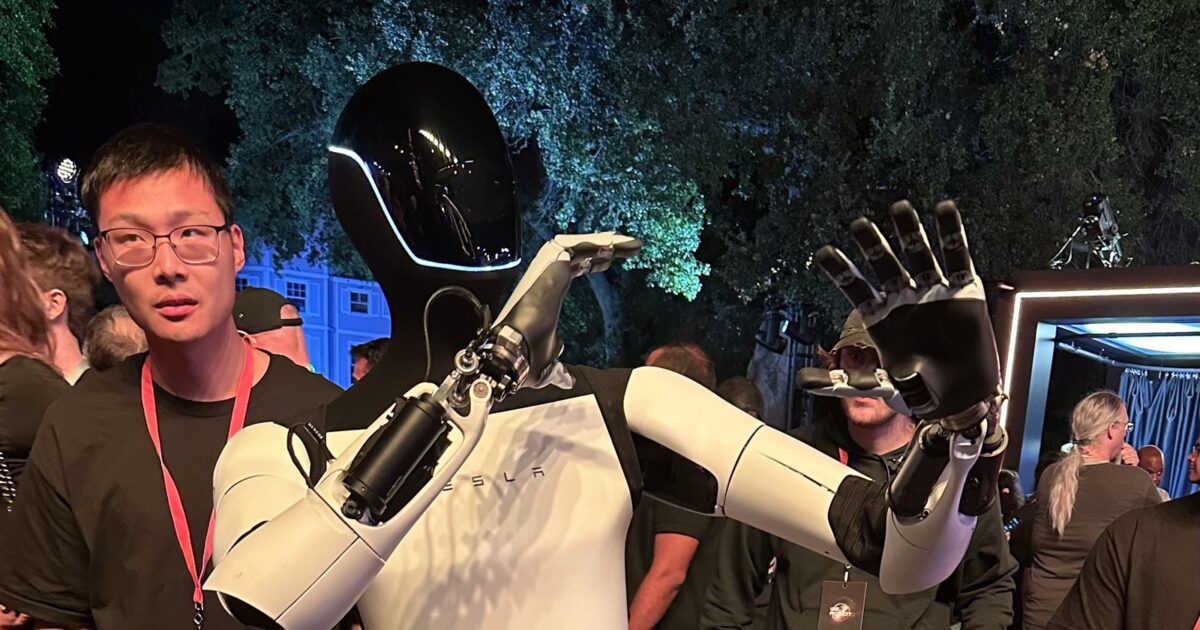
Tesla just dropped one of the biggest Optimus reveals of the year — and there wasn’t even a press release. Three international patents quietly went public this morning, and together they hand us (literally) the blueprint for the Optimus V3 robotic hand, wrist, and arm.
For anyone who’s been following Optimus development, this is the level of detail we’ve been waiting on for more than a year.
Elon Musk has said over and over that the hand is the single hardest piece of building a humanoid robot. He’s called it “harder than Cybertruck or Model X… somewhere between Model X and Starship.” He estimates it’s roughly 60% of the total Optimus engineering challenge, full stop.
And now, thanks to these filings, we can finally see how Tesla’s engineers actually cracked it.
Tesla investor and commentator Sawyer Merritt laid out the key specs right after the patent went public:
Tesla's Optimus V3 robot hand looks to have been revealed in a new international patent published today.
— Sawyer Merritt (@SawyerMerritt) April 16, 2026
The patent describes a tendon/cable-driven hand:
• Actuators in the forearm
• Each finger has 4 degrees of freedom
• The wrist has 2 degrees of freedom
• Tendon-driven… pic.twitter.com/eE8xLEYSrx
Look at that list. Four degrees of freedom per finger. Two more in the wrist. A 22-DoF hand-and-wrist architecture that gets genuinely close to what a human hand can do.
But here’s the clever part. Tesla didn’t stuff the actuators into the hand itself. They moved them up into the forearm and connected everything with cables — tendons, basically. Just like your own hand works.
That single design call changes everything. Smaller hand. Lower mass at the end of the arm. Faster, more precise finger movement. Better efficiency. And way easier to manufacture in volume.
Teslarati broke down what the patents actually protect:
Two new patents, which were coincidentally filed on the same day as the “We, Robot” event back in October 2024, protect Tesla’s mechanically actuated, tendon-driven architecture. The designs relocate heavy actuators to the forearm, route cables through a sophisticated wrist design, and employ innovative joint assemblies to achieve human-like dexterity while enabling lightweight construction and high-volume manufacturing.
This geometry significantly reduces cable stretch, torque, friction, and crosstalk during combined yaw and pitch wrist movements — common failure points in simpler tendon systems that cause imprecise or jerky motion.
That last sentence is the one that matters. Anyone who has ever watched a robotics demo go sideways knows exactly what “imprecise or jerky motion” looks like — the awkward pause, the overshoot, the dropped object. Tesla is solving it at the physics layer, with geometry, not just software tricks.
And they are clearly not building a science project here. They are building a product.
Teslarati also summed up what all of this actually points to:
Collectively, the patents portray the Optimus v3 hand not as a mere prototype, but as a production-oriented system engineered from first principles. The 22-DoF architecture, forearm-driven tendons, and crosstalk-minimizing wrist deliver a clear competitive edge in dexterity.
These filings demonstrate that Tesla has transformed years of engineering challenges into patented, elegant solutions — positioning the company strongly in the race toward general-purpose robotics.
Translation: Tesla is trying to ship a humanoid that can actually do things — pick up a plate, turn a key, open a jar, hand someone a drink — and do them at scale. Not a lab toy. A real product on a real manufacturing line.
That’s also why Musk has been sounding so much more confident about Optimus lately. He said earlier this year that Tesla had finally gotten past the “hardest” problems — human-level dexterity, real-world AI integration, and the pathway to volume production. These patents are the receipts.
For more than a year, the hand has been the bottleneck holding the entire Optimus program back. Now the bottleneck has a blueprint. A cable-driven, forearm-actuated, 22-DoF, manufacturing-friendly blueprint that Tesla just locked down with three patents in one day.
If you’ve been waiting for a sign that Optimus is much closer to becoming a real product than most people give Tesla credit for… today was that sign.
Join the conversation!
Please share your thoughts about this article below. We value your opinions, and would love to see you add to the discussion!