

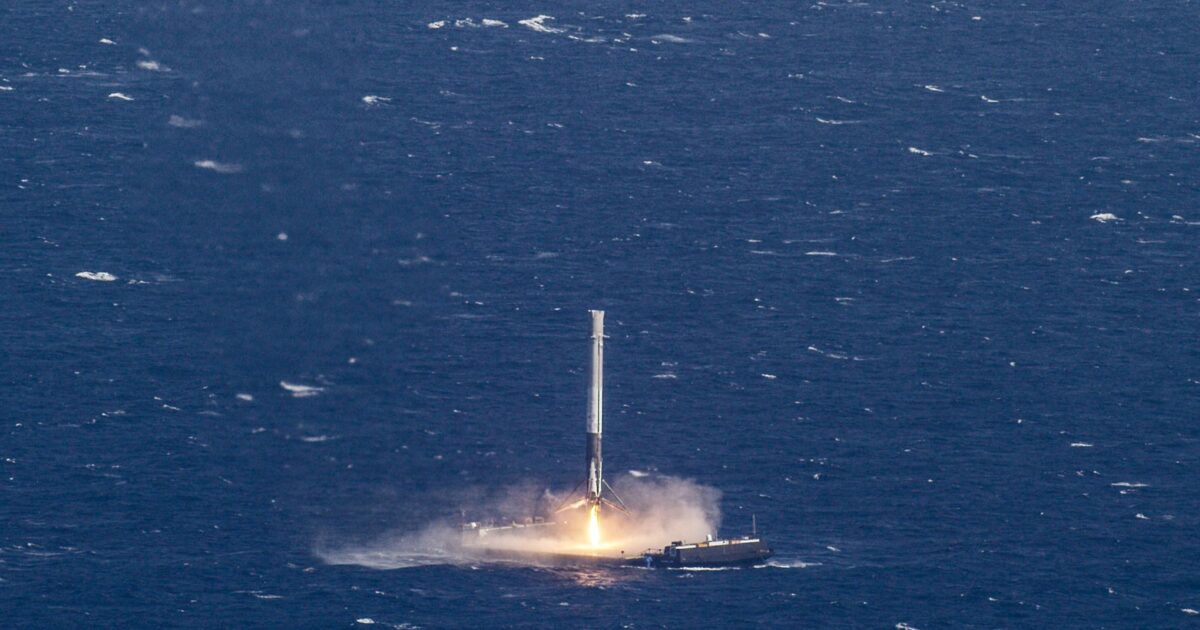
SpaceX put another 24 Starlink satellites into orbit Saturday and brought the Falcon 9 first stage home on a droneship off California.
The payload was new. The rocket underneath it was anything but.
Booster B1093 was flying for the 16th time, then stuck its 16th landing on Of Course I Still Love You.
SpaceX shared a look at Falcon 9 climbing away from Vandenberg Space Force Base with the Starlink stack on top.
Falcon 9 launches 24 @Starlink satellites from California pic.twitter.com/IhPgfkfQrX
— SpaceX (@SpaceX) August 8, 2026
The official SpaceX mission page identifies the flight as Starlink 17-38, launched from Space Launch Complex 4E on California’s Central Coast. That pad gives Falcon 9 a clean route south over the Pacific for the high-inclination missions SpaceX regularly flies from Vandenberg.
Saturday’s job was straightforward on paper: carry the 24 spacecraft to low Earth orbit, separate the second stage from the first, recover the booster at sea and release the satellites. SpaceX’s public updates confirmed each major step was completed.
The first stage’s return was a sharp reminder of how much work is packed into the word “routine.” Falcon 9 had to reverse course through the atmosphere, relight its engines and find a moving landing deck hundreds of miles offshore—all after helping push another full payload toward orbit.
Space Launch Now records B1093 as an active, flight-proven booster that first flew in April 2025. Starlink 17-38 became its 16th mission, and the successful touchdown also preserved a perfect 16-for-16 landing record for the core.
The tracker lists the destination as low Earth orbit and the payload as 24 Starlink communications satellites. It also confirms the landing on the autonomous droneship Of Course I Still Love You, which supports SpaceX’s West Coast recovery operations.
That is the real engine behind Falcon 9’s pace. SpaceX is not rebuilding an entire first stage for every launch; it is inspecting, refurbishing and flying proven hardware again while the Starlink constellation keeps growing.
About an hour after liftoff, SpaceX delivered the result that mattered most for the payload.
Deployment of 24 @Starlink satellites confirmed
— SpaceX (@SpaceX) August 8, 2026
The satellites will now begin raising their orbits and moving toward operational positions. That process turns a successful launch into usable network capacity rather than leaving the spacecraft clustered near their initial deployment altitude.
An official Starlink network update explains why SpaceX has leaned so hard into these high-inclination missions. The company said additional polar-orbit satellites were designed to improve capacity for Alaska and other high-latitude regions, where conventional broadband options can be limited and where the geometry of the constellation is especially important.
Starlink also said its second-generation satellites were adding more than 5 terabits per second of capacity to the constellation each week. The spacecraft are one piece of that buildout; ground gateways, fiber connections and points of presence move customer traffic between orbit and the broader internet.
That is why another batch of 24 is more than a launch statistic. Each successful deployment fills out coverage, adds bandwidth and gives Starlink more flexibility as demand shifts across regions and hours of the day.
The cadence is not slowing down.
Space Launch Now’s current schedule shows another 29-satellite Starlink mission from Cape Canaveral on Monday, followed by another 24-satellite flight from Vandenberg. Launch dates can move, but the planned sequence shows how SpaceX uses both coasts to keep the network buildout moving.
Falcon 9 has made that tempo feel almost ordinary. A booster flying and landing 16 times is not ordinary—it is the hardware foundation that makes the tempo possible.
Starlink 17-38 ended with 24 new satellites heading to work and B1093 still available to fly again. That is a clean Saturday for SpaceX, and one more example of reusable rocketry doing exactly what it was built to do.
Join the conversation!
Please share your thoughts about this article below. We value your opinions, and would love to see you add to the discussion!