

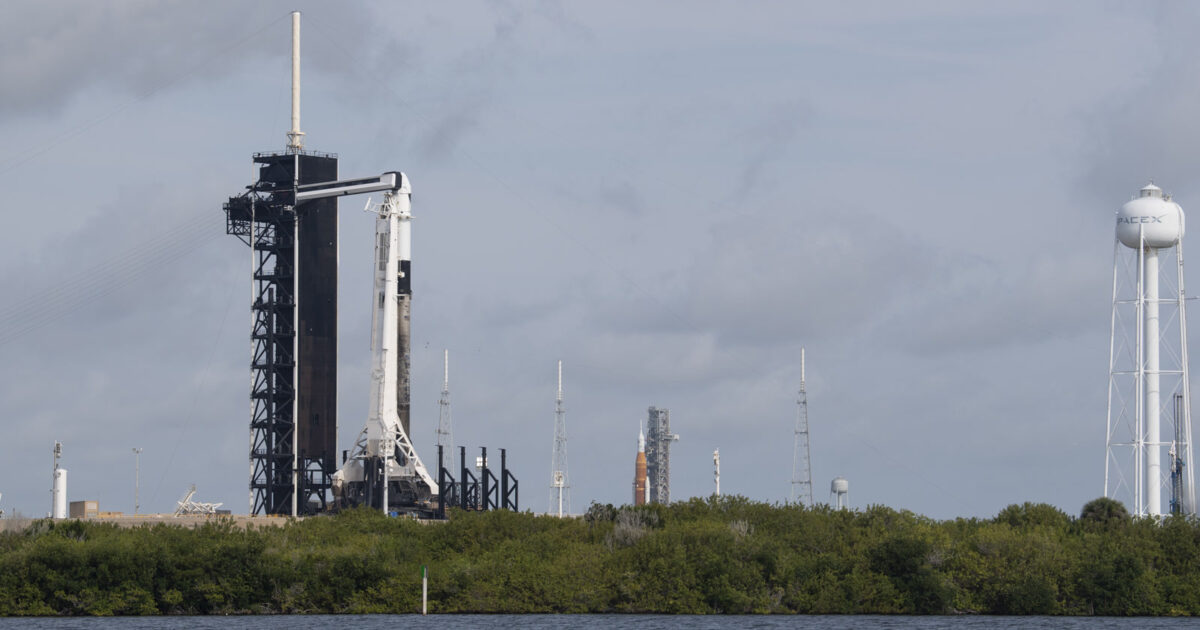
SpaceX just turned the United States into one enormous launch range.
Late Saturday, Falcon 9 rockets lifted off from Florida and California only about 39 minutes apart. Both first stages came back safely.
The launches were handled by separate teams, separate pads and separate recovery crews, but the final result looked like one tightly choreographed coast-to-coast sprint.
The second half of the doubleheader was the classified USSF-366 mission from Vandenberg Space Force Base. Falcon 9 left Space Launch Complex 4 East at roughly 6:51 p.m. Pacific, less than 40 minutes after the Globalstar mission departed Cape Canaveral.
Here was the West Coast liftoff:
Liftoff! pic.twitter.com/53ZEaBXXPC
— SpaceX (@SpaceX) August 16, 2026
The two missions did not use the same playbook. In Florida, the Globalstar booster reversed course and returned to Landing Zone 40 on the coast. In California, the USSF-366 booster continued downrange and landed on the drone ship Of Course I Still Love You in the Pacific.
That is the fun part of this doubleheader. It was not two copies of one routine launch.
SpaceX ran two different missions, from opposite sides of the country, with two different recovery profiles—and compressed both liftoffs into the length of a television episode.
SpaceX confirmed after the flights that its teams had completed back-to-back Falcon 9 launches from Florida and California. The company’s images showed both vehicles in flight and both boosters back on the ground or a drone ship.
The Florida launch began the sequence at about 8:12 p.m. Central. USSF-366 followed from Vandenberg at about 8:51 p.m. Central, putting the gap at roughly 39 minutes.
That interval measures liftoff to liftoff, not the duration of either mission. The Globalstar Falcon 9 was still working through its upper-stage mission when the Vandenberg rocket left the pad.
The Vandenberg mission was impressive on its own.
SpaceX’s USSF-366 mission page carried the official webcast for the national-security launch from Space Launch Complex 4 East. Falcon 9 passed through maximum aerodynamic pressure, shut down its nine first-stage engines, separated the stages and continued toward orbit while the booster began its trip back through the atmosphere.
The first stage then lit for its entry burn, steered toward the recovery zone and started its landing burn just before the eight-minute mark. It touched down on Of Course I Still Love You about eight minutes and 20 seconds after liftoff.
SpaceX kept the public description of the payload limited, which is normal for some Space Force missions. The verifiable story is the launch and recovery itself; there is no need to fill the classified space with guesses.
The public video therefore delivered a complete first-stage story even while the upper-stage mission continued out of view: launch, separation, atmospheric return and an upright landing in the Pacific.
The r/SpaceX USSF-366 launch tracker, a community-maintained thread populated with Launch Library 2 data and official mission links, identified the booster as B1088 on its 18th flight. Its timeline put main-engine cutoff at two minutes, 25 seconds, stage separation four seconds later and fairing separation just before the three-minute mark.
The tracker also showed how quickly the hardware had returned to service. B1088’s previous flight was less than seven weeks earlier, and this launch sent it back to the Pacific drone ship instead of treating an 18-flight booster like a museum piece.
Its running statistics counted USSF-366 as SpaceX’s 99th launch of 2026 and the 52nd flight from SLC-4E this year. Those are community-maintained figures rather than company totals, but they put the night’s compressed schedule in perspective: the pad and booster were already deep into a heavy operating year before this mission began.
That reuse is the machinery behind the headline.
SpaceX’s Falcon 9 overview describes a two-stage rocket built from the start around reuse of its first stage and payload fairings. Recovering that hardware reduces the amount that must be rebuilt for every mission, but the company still needs independent pads, range approvals, propellant operations, drone ships, landing zones and trained teams to make rapid cadence real.
Saturday night’s result showed those pieces operating as a network. Cape Canaveral handled a commercial communications mission and a return-to-launch-site landing while Vandenberg handled a Space Force flight and an ocean recovery almost simultaneously.
Then SpaceX posted the receipt:
Teams complete back-to-back Falcon 9 launches from Florida and California pic.twitter.com/6L4dyPAmXz
— SpaceX (@SpaceX) August 16, 2026
Rapid launch cadence can sound abstract when it is reduced to annual totals. This was easier to grasp: one rocket rising over Florida, another rising over California before the first mission was finished, and two boosters recovered at opposite ends of the country.
Thirty-nine minutes. Two coasts.
Two successful recoveries. SpaceX made a national launch operation look almost routine—and that may be the wildest part of all.
Join the conversation!
Please share your thoughts about this article below. We value your opinions, and would love to see you add to the discussion!