
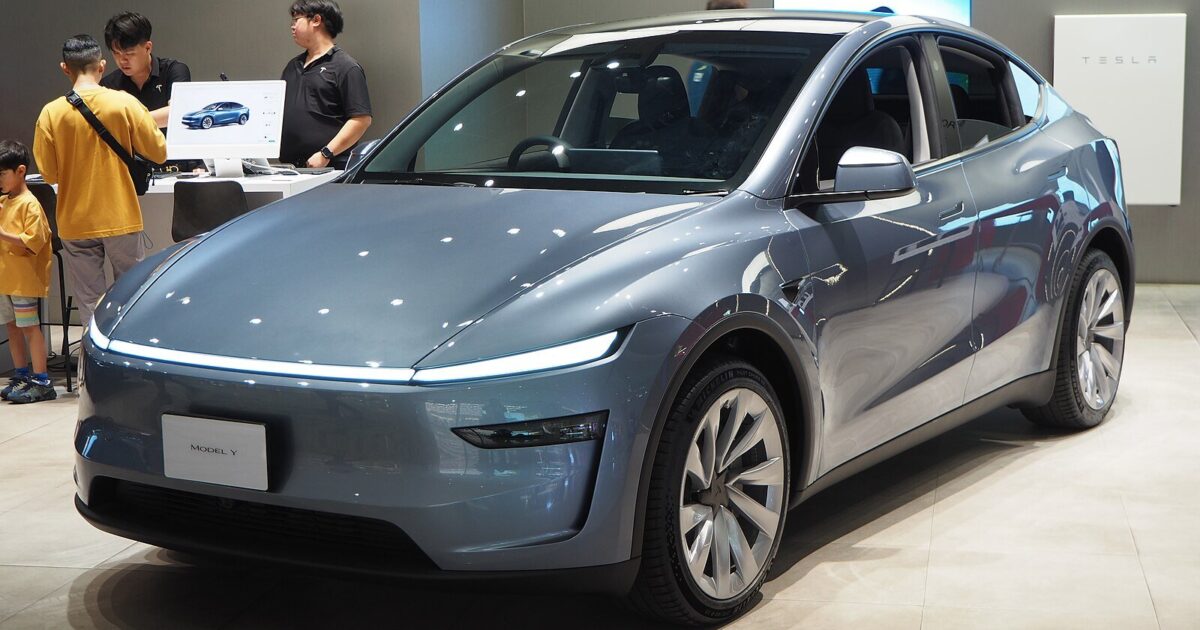
Tesla just gave the Model Y a genuinely useful new trick: compatible Premium models can now power tools, lights, laptops and other gear directly from the car.
The $80 Outlet Adapter turns the charge port into a 120-volt power source delivering up to 2.4 kilowatts at 20 amps.
That sounds simple. For a lot of recent Model Y owners, it is anything but.
The catch is buried under the car: Tesla built some vehicles with the newer PCS2 power-conversion hardware and others with PCS1. Only the right hardware can make the new vehicle-to-load feature work.
Here is what the working setup can do:
Tesla Model Y Premium in the US and Puerto Rico now supports Vehicle-to-Load (V2L), letting owners power lights, tools, laptops, and more directly from the car.
⚡ 2.4 kW | 120V | 20A
The Outlet Adapter is available through Tesla.
Your Model Y can now double as a power source. pic.twitter.com/AtNHR6MVY8
— Tesla Owners Silicon Valley (@teslaownersSV) August 16, 2026
For compatible owners, this is one of those features that becomes more valuable the moment the power goes out or a project moves beyond reach of an extension cord.
It is enough output for a refrigerator, lights, electronics or many common tools. Cybertruck can back up a home; the Model Y adapter serves a smaller purpose, turning energy already sitting in the battery into useful portable power.
The frustrating part is that “2026 Model Y” does not settle the compatibility question.
Teslarati reported Sunday that owners of some of the newest Model Y builds are seeing Tesla’s store label the adapter incompatible. The reporter’s own Long Range AWD was ordered in August 2025, delivered later that month as a 2026 model and still carries the older 48-amp single-phase power-conversion system.
Other owners reported the same surprise, including people who took delivery in 2026. The power-conversion assembly installed in the individual vehicle decides compatibility.
The model year on the paperwork and the Premium trim name can both be misleading.
The report put the adapter itself at $80 but estimated roughly $1,750 in parts to replace the older conversion hardware before labor. That turns a clever, inexpensive accessory into a much bigger decision for anyone whose Model Y missed the hardware change.
There is at least a way to check before ordering.
Tesla’s Parts Catalog allows an owner to choose the vehicle by VIN and look up its original components. The relevant listing is the assembly power-conversion entry, which can identify whether the car left the factory with PCS1 or the V2L-capable PCS2 hardware.
That VIN-specific check matters because two cars sold under the same model name—and even delivered around the same time—can carry different hardware underneath. Owners should check the actual vehicle record before buying the adapter or assuming a recent build date settles the question.
Tesla’s online store may also show whether the accessory is compatible with a vehicle tied to an owner’s account. The catalog adds the more useful detail: it can reveal which conversion assembly the car was built with and explain why one Model Y qualifies while another does not.
And yes, Tesla has documented a retrofit:
If you have a new Tesla Model Y built in the US, you can upgrade it with PowerShare Vehicle-to-Load (V2L) through a PCS1-to-PCS2 Lite retrofit.
Here is the official service procedure:https://t.co/HNO9BryLsP
Grok analysis:
✅ The procedure is complex (344 steps, including HV…— The Tesla Newswire (@TeslaNewswire) August 16, 2026
The word “retrofit” makes the job sound tidier than it is.
Tesla’s Service Manual lays out a 344-step PCS1-to-PCS2 Lite procedure. It starts with the car on a lift, requires low-voltage and high-voltage isolation, calls for protective gloves and test equipment, and opens the high-voltage battery’s ancillary bay.
Technicians then remove the original power-conversion hardware, rework connectors and harnesses, install PCS2 Lite components, disconnect and reconnect coolant lines, run leak checks, restore the battery enclosure and perform software routines before the car leaves the lift.
Tesla labels the procedure a validated draft and warns that some cautions may still be missing. The page was released July 22 and updated August 5 with revised harness-rework instructions and videos.
In other words, the retrofit path is real—but this is high-voltage battery work for trained technicians, not a Saturday morning garage project.
Tesla has not posted a consumer retrofit price in that service procedure. Until service centers offer clear pricing and eligibility, owners with PCS1 face a rough equation: spend far more than the accessory costs, or use a separate portable power station when they need electricity away from the grid.
The good news is that Model Y is finally gaining a practical capability owners have asked for, and Tesla did not leave older hardware without any documented upgrade route.
The bad news is that a recent delivery date is no guarantee. Before spending the $80, check the VIN.
Join the conversation!
Please share your thoughts about this article below. We value your opinions, and would love to see you add to the discussion!