

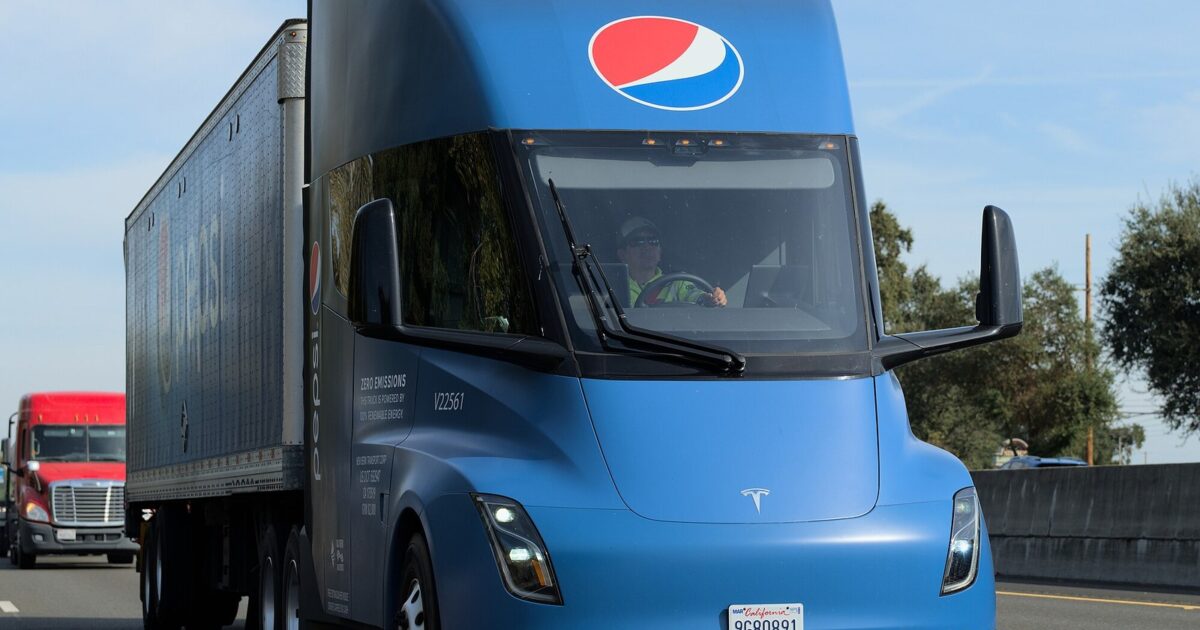
Tesla’s Semi charging network just made its first serious move into the Southeast.
Two new Georgia Megacharger sites are now live between Atlanta and Savannah, putting 14 heavy-truck charging stalls along one of the state’s most important freight routes.
One station sits in Conley, just south of Atlanta. The other is at a Pilot travel center in Ellabell, near Savannah and the I-16 freight corridor.
This is more than another pin on Tesla’s charging map.
It is the first time Tesla has connected two public Semi charging locations into a practical corridor outside California—and the Ellabell stop is the first Megacharger to open from Tesla’s partnership with Pilot.
Tesla Charging showed the eight-stall Conley site first.
New Tesla Megacharger: Conley, GA (8 stalls) https://t.co/f0zAZ7cb4I pic.twitter.com/rXGKVmItDv
— Tesla Charging (@TeslaCharging) October 8, 2026
The second opening gives the story its real weight.
Pilot Travel Centers says six heavy-duty stalls are operating at Pilot #1390 in Ellabell. It is the first live location from the Tesla-Pilot collaboration announced in January, and it puts megawatt charging where professional drivers already stop for fuel, food and required breaks.
Pilot says 12 more heavy-duty charging locations are under construction. Three are already near completion: a Flying J in Tulare, California, a Flying J in Fort Stockton, Texas, and a Pilot in North Las Vegas.
Each Pilot location is slated for four to eight stalls using Tesla’s V4 cabinet technology. Pilot says a stall can deliver up to 1.2 megawatts, enough for a Semi to recover 60% of its charge in 30 minutes.
That half-hour figure is not an arbitrary marketing target. Federal hours-of-service rules require commercial drivers to take breaks, so the charging network becomes far more useful when a meaningful energy stop can fit inside time the truck would already be parked.
Tesla Semi Charging Support lists the same operating target: up to 1.2 MW and up to 60% charge recovery in 30 minutes. Tesla directs Semi drivers to navigate to Megacharger locations through the vehicle, treating the network as dedicated trucking infrastructure rather than an oversized version of a passenger-car Supercharger.
The company has not published a universal public charging price for these Georgia sites. It also has not said that every future location will immediately support heavy trucks from other manufacturers.
Those details matter to fleet operators. A route can have enough electrical power and still fail as a business tool if access, billing or uptime are uncertain.
What Tesla can now show is a live route instead of a future map.
New Megacharger sites between Atlanta & Savannah now online
Many more Southeast sites coming soon pic.twitter.com/8LYdZXnFe4
— Tesla Semi (@tesla_semi) October 8, 2026
The two Georgia stations sit roughly 220 miles apart, connecting the Atlanta market with the Savannah side of I-16.
Electrek reports that Conley has eight stalls and Ellabell has six, giving the corridor 14 in total. The outlet also notes that Ellabell is the first Pilot-hosted Tesla Megacharger and that the route now reaches both ends of a major Georgia freight lane.
That geography is the point. Savannah is home to one of the busiest container ports in the country, while Atlanta is a massive distribution and logistics hub.
A truck that can recharge at both ends has a fundamentally different operating case from one dependent on a single isolated depot.
Tesla offers the Semi in 325-mile and 500-mile configurations. A 220-mile run is comfortably inside either published range, although payload, weather, speed and elevation will always affect real-world energy use.
The corridor still does not equal a nationwide network.
Tesla needs many more sites between major freight markets, predictable access for fleets and enough redundancy that one unavailable station does not strand a load. The company also has to prove that charging performance stays reliable when multiple Class 8 trucks arrive together.
But the rollout has crossed an important line.
For years, the Tesla Semi story centered on the truck itself: production timing, range, payload and factory capacity. Commercial trucking depends just as much on where the vehicle can stop and how quickly it can get moving again.
Georgia now has two answers on the same freight route.
Fourteen live Megacharger stalls will not electrify American trucking by themselves. They do show Tesla beginning to build the operational spine its Semi fleet needs—and doing it at the travel centers and freight corridors where trucks already work.
Join the conversation!
Please share your thoughts about this article below. We value your opinions, and would love to see you add to the discussion!