

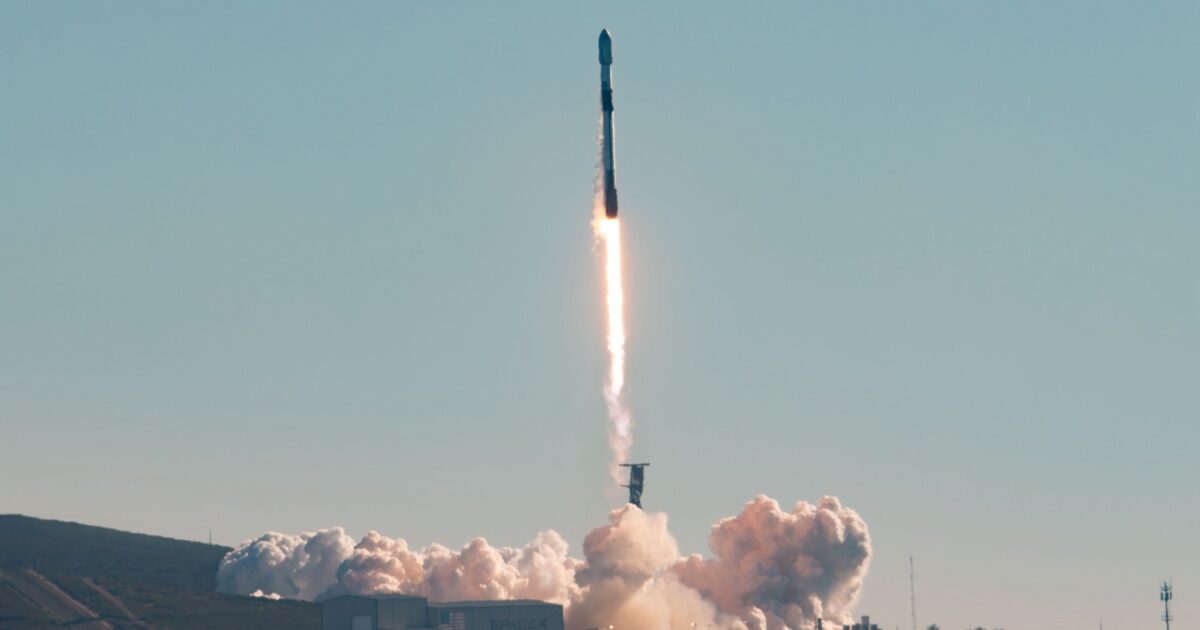
SpaceX turned a last-second abort into a successful national-security launch before dawn Saturday.
A Falcon 9 lifted off from Vandenberg Space Force Base at 12:39 a.m. Pacific carrying 21 data-transport satellites for the U.S. Space Force’s Space Development Agency.
The satellites are now in orbit. Their arrival expands the agency’s Tranche 1 transport network from 63 spacecraft to 84.
Five days earlier, the same mission stopped just before liftoff.
SpaceX’s brief update that night established the most important fact: the automated system had halted the countdown, but both the Falcon 9 and its payload remained healthy.
Falcon 9 had an auto abort just prior to T-0. Vehicle and payload are in good health, and teams are resetting for a launch attempt no earlier than tomorrow, October 6
— SpaceX (@SpaceX) October 5, 2026
The mission needed several more days, not one. Saturday’s launch completed the recovery.
The Space Development Agency confirmed that Falcon 9 successfully delivered all 21 Northrop Grumman-built space vehicles from Space Launch Complex 4 East. It was the fourth orbital plane launched for Tranche 1 and the first carrying satellites from the third of four vendors selected to build the initial network.
SDA says the spacecraft will carry secure, low-latency data beyond the line of sight and keep those links resilient under pressure. The transport layer is also supposed to move warning data from sensors detecting advanced missile threats to the people and systems that need it.
The agency expects Tranche 1 to begin providing an initial warfighting capability in 2027. Its planned services include persistent regional tactical links, enhanced missile warning and detection, beyond-line-of-sight targeting, and connections through optical and Ka-band systems.
Putting 84 transport satellites on orbit does not finish that system. It does give the network four populated orbital planes and a much larger foundation for the testing and integration still ahead.
The hardware inside the fairing was substantial.
Northrop Grumman says the 21-satellite stack stood 25.8 feet from the bottom of its dispenser to the top spacecraft and weighed more than 9,000 kilograms—roughly the mass of three elephants. The satellites are designed to operate about 1,000 kilometers above Earth while moving around 7 kilometers per second.
This plane is half of Northrop Grumman’s 42-satellite Tranche 1 transport contribution. The company says its final vehicle required about 350 hours to build and test, a glimpse at the production pace needed when a military space program shifts from a few exquisite satellites to dozens of smaller connected ones.
That scale is the central idea behind the Proliferated Warfighter Space Architecture. A larger number of linked spacecraft can spread capability across the constellation instead of concentrating too much value in one target.
The launch itself delivered another clean demonstration of Falcon 9’s national-security role.
Spaceflight Now reports that liftoff came at 12:39 a.m. Pacific from Vandenberg, followed by a return-to-launch-site landing a little more than seven minutes later. The first stage was flying for the sixth time, and its previous work included another SDA mission plus three Starlink flights.
The outlet identifies Saturday’s flight as the fourth of nine SpaceX launches assigned to assemble Tranche 1. SpaceX ended its public webcast after the booster landed at the customer’s request, leaving formal confirmation of satellite delivery to SDA’s later announcement.
The flight was Falcon 9’s 111th mission of 2026, according to the launch report. More than 70% of those flights carried Starlink satellites, making this military deployment a smaller but strategically important part of an enormous launch year.
The launch followed an attempt on October 5 that stopped in the final minute of the countdown. The delay stretched through several possible reset windows before SpaceX returned to SLC-4E early Saturday.
That sequence matters. A rocket landing is an impressive milestone, but the payload reaching orbit is the actual mission.
Saturday produced both.
The SpaceX mission page identifies the flight as SDA’s fourth Tranche 1 mission, using Falcon 9 from SLC-4E with a landing-zone return. The reusable booster profile let SpaceX bring the first stage back to the same base while the upper stage continued carrying the satellites into low Earth orbit.
The five-day delay also shows why an automatic abort is not a failed mission.
Falcon 9’s systems stopped a countdown that was not ready to proceed. SpaceX kept the vehicle and payload intact, reset the mission, and returned with the same 21 satellites.
Now the count that matters has changed: 84 Tranche 1 transport spacecraft are on orbit, and the Space Force’s low-latency military data network is another full orbital plane closer to service.
Join the conversation!
Please share your thoughts about this article below. We value your opinions, and would love to see you add to the discussion!