
Elon Musk says Tesla’s Digital Optimus can now make it about halfway through a Diablo campaign by watching the screen the way a person does.
That sounds like a gaming stunt. It is really a test of whether Tesla can build an AI agent that sees a changing interface, makes decisions in real time and keeps working toward a goal without privileged access to the software underneath it.
The claim is impressive. It is also still a claim, not a published benchmark.
That distinction matters because the bigger Digital Optimus story is much more ambitious than clearing a dungeon.
We’re making interesting progress here.
Digital Optimus can play about halfway through the Diablo campaign so far just by looking at the screen like a human.
Skill at Counter-Strike and other fast games is good too.
League is also in training.
Goal is to generalize across…
— Elon Musk (@elonmusk) October 10, 2026
Elon Musk on X said early Saturday that Digital Optimus has reached roughly the midpoint of a Diablo campaign using screen vision. He added that its skill in Counter-Strike and other fast games is good, that League is being trained, and that the goal is to generalize across games.
Musk did not say which Diablo title the agent is playing, what difficulty it uses, how many attempts it took or how long a successful run lasts. He also did not publish video or an evaluation report with the update.
So the honest reading is straightforward: this is a notable progress report from the person leading the program, but it is not yet a result outsiders can reproduce.
Tesla Careers shows what the company is actually trying to build. A current Palo Alto role describes Digital Optimus as a computer-use agent that combines high-level reasoning with real-time vision, ingests screen video, understands interfaces, takes actions and completes complex digital workflows autonomously.
The engineering brief goes well beyond teaching a model to click buttons. Tesla wants training pipelines that turn real agent interactions into better behavior, evaluation systems that expose failure modes, and inference routing that can combine vision and reasoning fast enough to act in real time.
Reliability over long jobs is part of the assignment too. That is where a long game campaign becomes useful: the agent has to remember what it is doing, react when the screen changes, recover from mistakes and keep moving without a fixed sequence of moves.
Tesla called Digital Optimus the next evolution of the company’s AI development in its Q1 2026 shareholder update. Tesla said it is building an intelligence layer for digital workloads that complements the real-world AI already being developed for vehicles and humanoid robots.
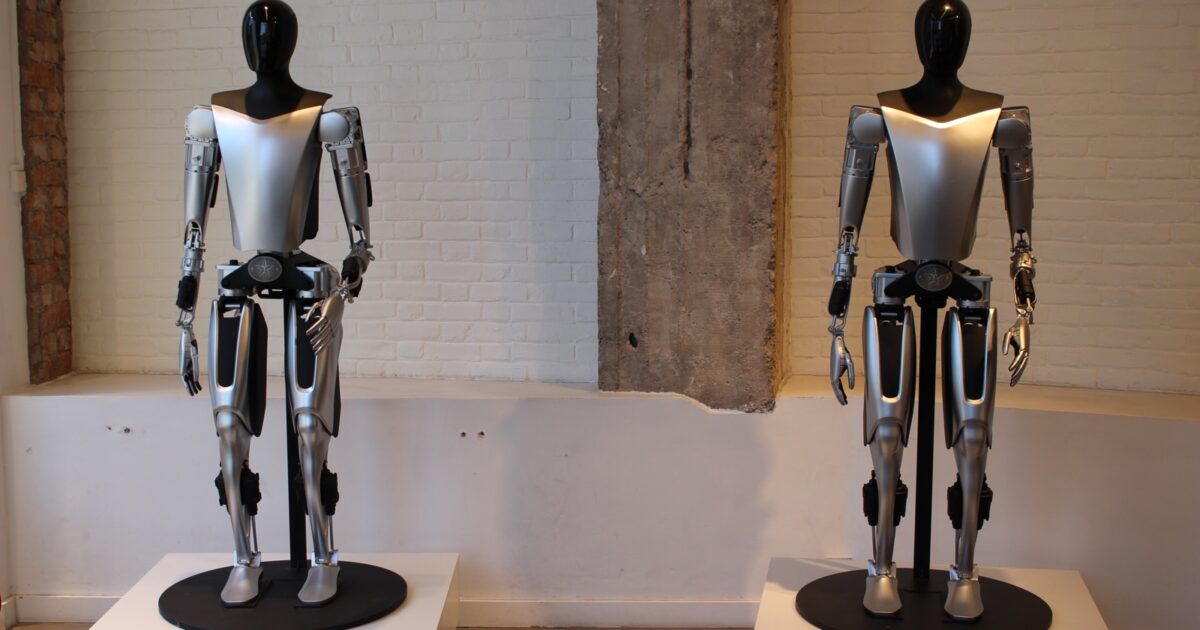
That wording draws an important line. Digital Optimus is software; it is separate from the physical humanoid robot.
The two programs still share Tesla’s core bet: vision should be enough to understand a messy environment, and learned policies should turn that understanding into useful action across vehicles, robots and on-screen workflows without hand-programming every edge case.
The physical robot has to do that with hands, feet and objects. The digital version has to do it with windows, menus, mouse movement and keyboard input.
The same update said Tesla had sharpened its vehicle vision encoder for low-visibility conditions and cut inference latency by as much as 20 percent. It also reported the final design of the company’s next-generation AI5 inference processor.
Those details do not prove Digital Optimus can handle ordinary computer work. They do show that the agent sits inside a much larger Tesla effort to improve vision, faster decision-making and custom inference hardware together.
The game result also drew an immediate challenge.
Can I challenge you? Digital Optimus vs General Intuition models. Same constraints / harnessing. Pixels in computer actions out only. We both pick 5 games and have them play each other!
— Pim de Witte (@PimDeWitte) October 10, 2026
Think Facility reported that Pim de Witte, who leads game-data lab General Intuition, proposed a five-game match using the same rules: pixels in and computer actions out. The outlet had not found a public Musk response when it checked later Saturday.
That kind of test would be valuable because it forces both systems into the same harness. It would show more than a single progress claim and make speed, consistency, recovery and game-to-game transfer easier to compare.
The same report noted the biggest holes in Saturday’s update: no footage, no difficulty level, no run-time data and no clear statement about how much planning came from Grok during the run.
Those gaps do not erase the milestone. They are the next questions Tesla needs to answer.
Tesla’s current MIT-CSAIL event page gives another clue about the company’s direction. Tesla says robust vision-and-planning policies already support autonomy at scale and that similarly robust policies will be needed for millions of robots performing thousands of tasks in unpredictable environments.
The event is focused on Optimus, but the engineering problem is the same one Digital Optimus is attacking on a screen: generalization without hand-programming every move.
Getting halfway through Diablo does not prove that Tesla has solved computer use. It does show why games are a useful proving ground for the kind of agent Tesla wants.
The real test comes next. Can Digital Optimus repeat the run, publish the evidence, handle unfamiliar software and finish useful work with the same persistence it brings to a campaign?
Join the conversation!
Please share your thoughts about this article below. We value your opinions, and would love to see you add to the discussion!