

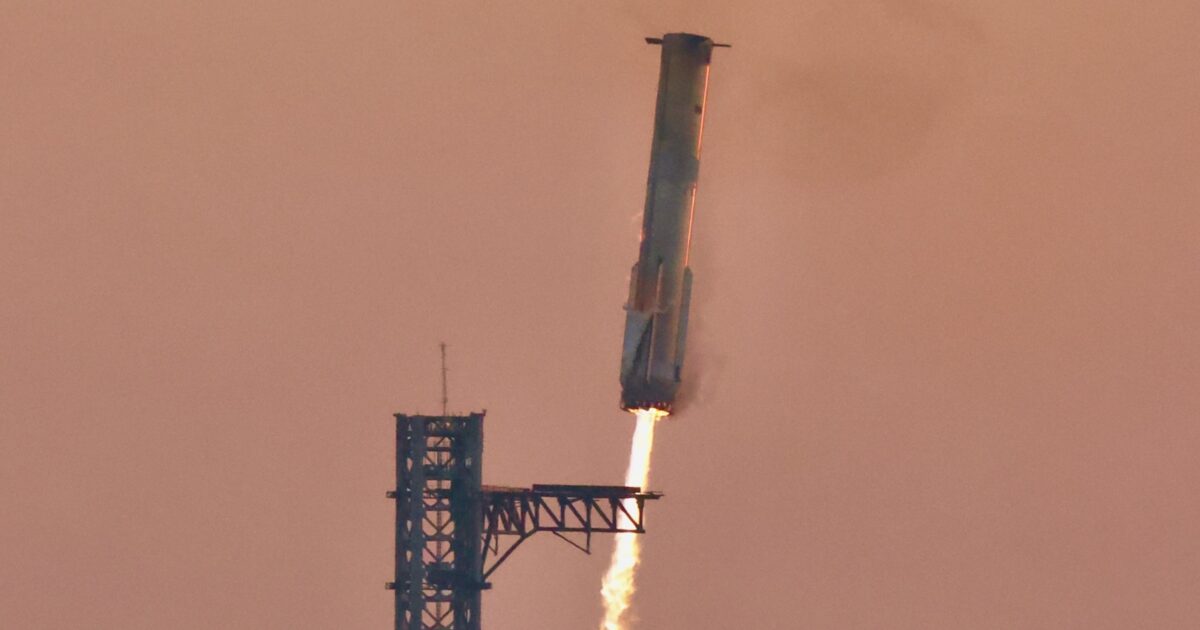
Elon Musk says SpaceX is aiming to fly Starship again in four to six weeks—and this time, the company wants to catch both halves of the rocket.
That would mean another Super Heavy booster catch at Starbase and the first attempt to grab the returning Starship upper stage with a launch tower.
It is the most aggressive recovery test SpaceX has put on the calendar yet. If it works, the company will have brought both stages of an orbital-class rocket back under control without landing legs.
Musk laid out that target Saturday during a virtual appearance at X Takeover, held at Tesla’s Giga Texas factory.
Elon Musk: What Comes Next for Humanity @elonmusk @thextakeover https://t.co/dYoXSP8Ge7
— Tesla Owners Silicon Valley (@teslaownersSV) October 10, 2026
Tesla Owners Silicon Valley on X carried the full conversation. Musk called Flight 15’s major milestone the ship catch and put the flight hopefully four to six weeks away, before Thanksgiving.
He said SpaceX plans to catch the booster too, then hopes Flight 16 can refly the recovered booster and ship.
Those are targets, not a launch license or a locked date. SpaceX has not posted a firm Flight 15 schedule, and Musk used the word “hopefully” for good reason.
Still, the sequence matters. Catching hardware is only the first half of reusability.
Flying the same hardware again is the proof that recovery can become an operating system instead of a spectacular demonstration.
The interview also supplied the clearest explanation yet for the engine trouble that changed Flight 14’s plan.
Musk said the early shutdown traced to software in one engine computer. He described the heat shield and engines as robust overall, but stressed that SpaceX still needs extremely high engine reliability.
SpaceX’s Flight 14 mission recap records two separate propulsion issues. One Super Heavy Raptor shut down during the initial climb.
Later, after an upper-stage engine issue, controllers decided to cut the planned orbital coast short and send Starship toward a pre-cleared northern Pacific splashdown zone.
The rest of that mission gave SpaceX plenty of reason to move forward. Starship reached orbit for the first time, deployed 26 Starlink V3 satellites, completed its first deorbit burn and came through reentry for a controlled landing burn and splashdown.
That means Flight 15 is not starting from a theory. SpaceX now has orbital entry data, heat-shield data and a full landing sequence from the version of the ship it wants to bring back to the tower.
A ship catch is harder than repeating the booster catch.
Super Heavy returns minutes after liftoff on a relatively direct path. Starship must first complete its orbital work, survive much higher-energy reentry and line up with Starbase after circling Earth.
The tower, the booster recovery and the later ship arrival all have to fit into one launch-site operation.
The vehicle also cannot simply be accurate on a good day. A reusable system has to make the right decision when an engine, sensor or trajectory is not behaving normally.
Flight 14’s shortened mission is a reminder that SpaceX is still building those judgment calls into the hardware and software.
SpaceX shows how much of the next step sits below the stainless-steel skin. The V3 generation uses redesigned propulsion systems, a different Raptor startup method, larger propellant volume and upgraded reaction control for steering in flight.
SpaceX also describes roughly 60 custom avionics units across Starship and Super Heavy, with distributed fault isolation, redundant high-speed Starlink connections and more precise navigation. The upper stage’s flap system now uses one actuator with three motors per flap, a change intended to improve redundancy while cutting mass and cost.
Those improvements are not glamorous compared with a tower catch. They are the machinery that has to make the catch repeatable.
The same update says hardened ground systems now place oxygen and methane equipment in separate rooms closer to the launch mount. That work matters when two returning stages must be recovered around a pad that also has to be prepared for the next flight.
Tesla North preserved the timing from Saturday’s interview and noted the distinction SpaceX fans should keep in view: Musk gave a hopeful four-to-six-week window, not a firm company date. The report also tied the new timetable to Flight 14’s engine-computer diagnosis and the goal of catching both stages before attempting a reflight on Flight 16.
It also noted that a ship catch was already the stated next-flight goal after Flight 14. Saturday’s real news was the tighter post-flight timing, the software diagnosis and Musk’s confidence that the heat shield came through the orbital mission in robust shape.
If Flight 15 reaches the tower on Musk’s schedule, the ship catch will be the headline. The more important question will come after the arms close: how quickly can SpaceX inspect that vehicle, turn it around and trust it to fly again?
That is where full reusability stops being a promise and starts becoming a flight cadence.
Join the conversation!
Please share your thoughts about this article below. We value your opinions, and would love to see you add to the discussion!