
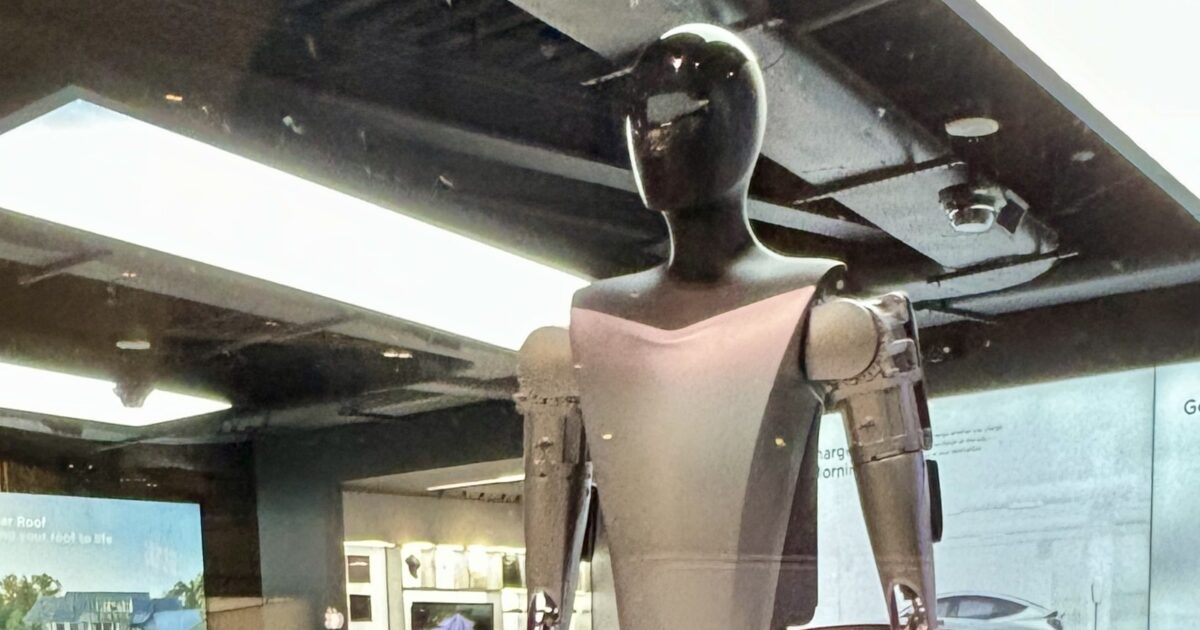
Tesla says its first production-quality Optimus robots are now coming off a high-volume manufacturing line in Fremont.
That is a different claim from a lab demo, a hand-built prototype or another ambitious target date.
Tesla is saying the robot has entered early production—and that the process building it is suitable for a commercial product.
The milestone is real. The scale is still the open question.
Tesla lists California Optimus as being in “Early Ramp” in its Q3 2026 update. The company says production began in Fremont on high-volume lines and calls the units now emerging from that line the first production-quality bots it has manufactured.
Tesla also says it has proven the current manufacturing process is suitable for a commercial product. At the same time, it warns that both the robot hardware and the way it is manufactured will keep changing.
The update does not attach an annual capacity number to Fremont’s Optimus row. It does not disclose how many robots have been completed, how fast the line is moving, which Optimus version is being built or when an outside customer can buy one.
That makes this a manufacturing threshold, not a finished consumer launch.
Software remains half of the Optimus bet. Musk said this month that Tesla’s digital robot is learning to play several games by watching a screen and using controls as a person would:
We’re making interesting progress here.
Digital Optimus can play about halfway through the Diablo campaign so far just by looking at the screen like a human.
Skill at Counter-Strike and other fast games is good too.
League is also in training.
Goal is to generalize across…
— Elon Musk (@elonmusk) October 10, 2026
The physical line and the learning system now have to advance together. A robot body that can be built repeatedly is not valuable at Tesla scale unless its software can generalize across useful work.
Tesla says it plans to reach 400 megawatts of SI training compute by the end of 2026. That infrastructure is meant to support autonomy software for both vehicles and humanoid robots.
The Tesla Q3 earnings-call transcript adds the scale Musk has in mind. He described the Fremont operation as early production on a high-volume line and said the vast majority of equipment for a line designed around one million units per year has already landed at the factory.
That does not mean Fremont is producing one million robots today. Installed equipment, early production and sustained annual output are three very different stages.
Musk also said Tesla has started constructing an Optimus factory in Austin that should be capable of producing far more robots than Fremont. Tesla’s quarterly table lists the Texas program as “Construction,” meaning factory and infrastructure work plus tool installation are underway.
The call therefore draws a two-step plan: use Fremont to prove the product and its first large manufacturing system, then build a much larger operation in Texas.
TeslaNorth traced the Fremont line back to Tesla’s January decision to end Model S and Model X production and reuse that floor space for Optimus. By the second quarter, Tesla said those vehicle lines had been decommissioned and its first robot lines were being installed.
The report also identifies what Tesla has not yet supplied: a current rate, a unit total, a price, a customer-sale date or confirmation of the exact Optimus generation on the line.
Those omissions matter because Tesla has made enormous long-range forecasts for humanoid robots before. Production-quality hardware is the first hard checkpoint; repeatable output, reliability, useful work and cost are the checkpoints that follow.
TeslaNorth also notes that steel for the dedicated Optimus factory at Giga Texas was already rising by September.
The California line is therefore not an isolated experiment. It is the first production system in a broader manufacturing plan.
The Associated Press via ClickOrlando places that robot milestone inside a quarter when Tesla’s revenue was nearly flat at $28 billion and its capital spending came in much lower than analysts expected. Tesla generated about $1.5 billion in free cash flow while funding AI, robotics, batteries and new factories.
Investors are increasingly valuing Tesla on businesses beyond selling cars: autonomous transport, energy storage, AI software and robots. Initial Optimus production gives that story a physical foothold, but it also makes future progress easier to measure.
The next useful numbers are not another trillion-dollar forecast. They are units per week, manufacturing yield, hours of reliable work, cost per robot and a real delivery schedule.
Tesla has not provided those numbers yet.
What it has provided is the clearest line Optimus has crossed so far.
The robot is no longer only being developed. Tesla says it is being manufactured.
Join the conversation!
Please share your thoughts about this article below. We value your opinions, and would love to see you add to the discussion!