
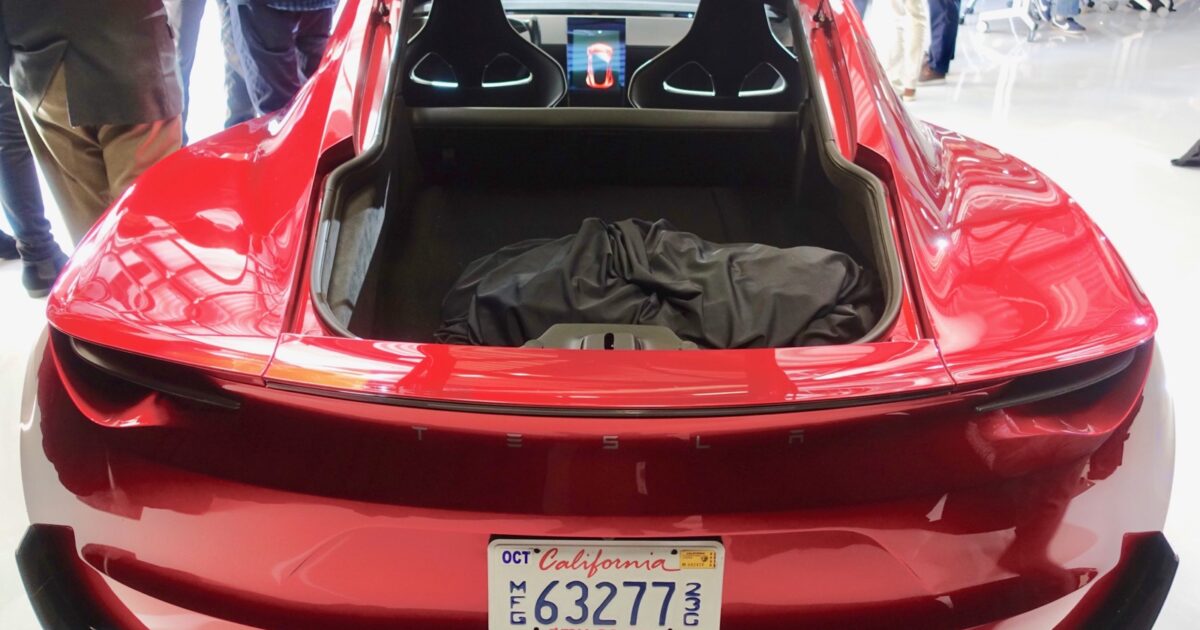
Photo: The Rear of the Tesla Roadster 2.0 — Steve Jurvetson, CC BY 2.0; Cropped to 1600 by 900.
.jpg)
Tesla unveiled a fast Roadster on Thursday night, then went far beyond a normal car launch. It drove one upside down, launched another into the air on cold-gas thrusters and said customers could buy the wildest version of the machine.
The event finally put working hardware behind claims that had followed the long-delayed supercar for nearly a decade. It also exposed which promises remain engineering targets rather than finished production specifications, a gap that will define the road to 2028.
The demonstration at SpaceX’s McGregor, Texas test facility turned years of Elon Musk promises into three physical variants: Performance, Thrust and Rocket.
They share a new Roadster platform, but they are not the same car with three software packages.
Each step changes the hardware, the performance envelope and the basic question of what a road car is allowed to do.
Performance is the road-focused foundation. It uses active bodywork and a fan system that pulls air from beneath the car, creating downforce even before speed builds across a conventional wing.
Thrust adds four rear-facing cold-gas nozzles. Tesla used that hardware to demonstrate a claimed 0-to-60 mph run in 0.8 second.
Rocket goes much further. It gives up the passenger seat for a larger pressure vessel and adds downward and directional thrusters that can lift, propel and rotate the car in the air.
Tesla’s full event stream carries the demonstrations from the company itself.
Roadster event livestream https://t.co/G0jU4mWfid
— Tesla (@Tesla) October 15, 2026
The Rocket prototype first climbed a curved structure until it was inverted. It then left the ramp, rotated in the air and came down under thruster control in a cloud of compressed gas.
That distinction matters. Tesla did not hide the maneuver inside a glossy concept video.
A real machine performed it outside at a rocket test site, with all the noise and risk that implies.
MotorTrend attended the event and described the displayed vehicle as a production-intent prototype, not a finished production car. Its reporting says the platform uses two rear motors, a structural 4680-cell battery pack, by-wire controls and individually actuated carbon-ceramic brakes.
The outlet reported that the target weight is about 3,748 pounds and the current driving-range estimate is more than 300 miles. Those numbers remain development targets, while the exact battery capacity, final pricing and some base-model specifications were withheld or remain unsettled.
The fan system is more than a launch trick. Flexible skirts lower toward the pavement so the car can generate suction at low speed, while movable body panels and a large rear wing change position for braking, cornering or reduced drag.
The gas hardware is equally physical. MotorTrend says the Thrust model stores highly compressed nitrogen in a carbon-wrapped pressure vessel and feeds it through four rear nozzles.
Rocket adds a second, larger vessel and six more nozzles for lift and directional control.
Track Mode adds another crossover from Musk’s engineering empire: hardware derived from the Optimus robot.
Roadster transforms in Track Mode
These aero features aren't just for looks: they provide the best passive downforce package of any road car (approaching F1 levels!) with wing actuation driven by the @Tesla_Optimus actuator system pic.twitter.com/AqrC4qUga9
— Tesla (@Tesla) October 16, 2026
The company says the wing moves with actuator technology derived from the ankle system in its Optimus robot. That is a more interesting connection than a borrowed logo: Tesla is moving hardware between a humanoid robot and an electric supercar.
Car and Driver separately reported that the airborne prototype used SpaceX-supplied thrusters producing more than 80 kilonewtons of force. Its account also notes that the stunt vehicle and the polished car driven onto the stage were visibly different prototypes.
The publication watched Tesla make two acceleration runs, first at a claimed one second to 60 mph and then at 0.8 second. It also reported Musk’s claim that the Roadster should exceed 230 mph, while correctly separating that target from a finished production specification.
The system does not burn rocket fuel. The tanks hold ultra-high-pressure gas and are intended to recharge, which makes the setup closer to an onboard pressure system than a tiny combustion rocket.
There is still a gulf between a controlled demonstration and a vehicle approved for public streets. The flying Rocket trim will face regulatory, safety, noise, packaging and service questions that a stage show cannot answer.
Axios put those unanswered questions in useful perspective. Tesla has not published final prices, a complete production range or a clear measure of how long the Rocket version can remain airborne, and the flying configuration is not approved for public roads.
The outlet also points to the Roadster’s unusual place in Tesla’s lineup. While the rest of the company is pushing toward robotaxis and less human involvement, this car is being sold as a final celebration of the driver.
That tension is part of the product’s purpose. Roadster is not being positioned as Tesla’s next mass-market volume engine; it is a halo machine built to make the company’s engineering ambitions visible again.
The reveal answered whether the prototype could leave the ground. It did not answer how regulators will classify an owner-operated vehicle with enough thrust to do aerial rotations, or what restrictions Tesla will place on that capability.
Tesla now says production will begin in 2028. That date deserves caution after the second-generation Roadster’s long string of delays, but it is more concrete than another promise of a demonstration sometime later.
Tesla has reopened the product and reservation path around the new family, while warning that the Rocket trim will not be available in every region. The page also describes the Thrust hardware as an optional performance upgrade, reinforcing that the airborne car is not the default Roadster.
The product page still presents Roadster as a supercar shaped around aerodynamic efficiency, but Thursday’s hardware changes the meaning of that claim. Conventional aero improves as speed rises; the fan system is meant to create grip before the car has built that speed.
The regional warning is equally important. Even if Rocket reaches production, availability will depend on local rules, and customers should not read a successful private-site demonstration as permission to use airborne capability on public streets.
The strongest result from McGregor is not a spreadsheet claim. Tesla showed that its active-aero and compressed-gas ideas can move a full-size prototype in ways no road car has attempted in public.
Now comes the harder part: turning the spectacle into a production vehicle, proving where it can legally operate and holding the 2028 date.
Join the conversation!
Please share your thoughts about this article below. We value your opinions, and would love to see you add to the discussion!