

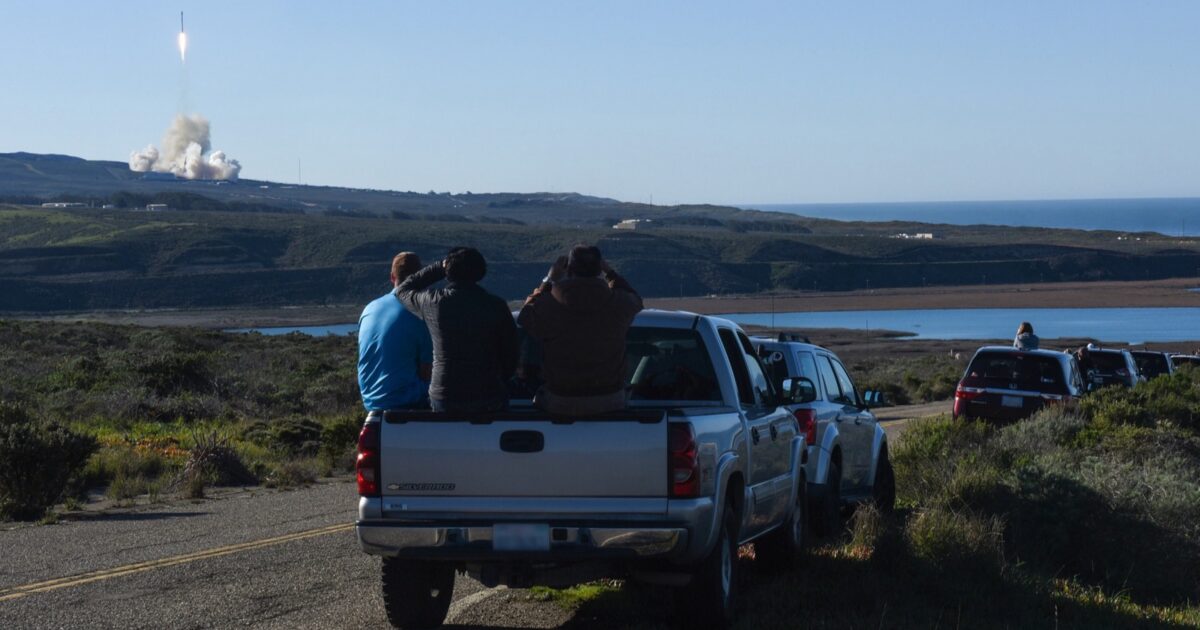
Photo: Michael Peterson/U.S. Air Force via DVIDS; public domain; cropped to 1600×900.
SpaceX sent another classified U.S. Space Force mission into the night sky from California on Thursday, then brought the same Falcon 9 booster home for the 28th time.
USSF-481 lifted off from Space Launch Complex 4E at Vandenberg Space Force Base shortly after 7 p.m. Central. About eight minutes later, the first stage settled onto the Of Course I Still Love You droneship in the Pacific.
The launch itself was visible. What rode under the fairing remains deliberately murky.
SpaceX posted the clearest possible confirmation of the first milestone: liftoff from Vandenberg.
Liftoff! pic.twitter.com/yjEQXS2RKu
— SpaceX (@SpaceX) October 16, 2026
The date on the embed reads October 16 because X is displaying the post in UTC. The launch occurred Thursday evening, October 15, in Central and Pacific time.
SpaceX says USSF-481 flew for the U.S. Space Force from Vandenberg’s SLC-4E. Its published sequence put main-engine cutoff at roughly two minutes and 26 seconds, stage separation three seconds later and fairing separation just after the three-minute mark.
The company did not identify the spacecraft or disclose a deployment sequence on the public mission page. That is the line worth respecting: this was plainly a national-security launch, but a classified payload is not an invitation to turn online guesses into reported fact.
What SpaceX did disclose is almost as interesting as what it withheld.
The first stage was making its 28th trip. Its résumé spans Crew-7, CRS-29, NASA’s PACE mission, EarthCARE, TRACERS, Transporter rideshares, national-security flights and 16 Starlink launches.
That mix matters. The same core has carried astronauts, science spacecraft, commercial payloads, internet satellites and military missions.
Reusability is no longer a special demonstration attached to Falcon 9. It is the operating system.
The second official video closed the loop on Thursday’s booster work.
Falcon 9’s first stage lands on the Of Course I Still Love You droneship pic.twitter.com/uBK14MgJZ0
— SpaceX (@SpaceX) October 16, 2026
Twenty-eight flights would once have sounded like a lifetime goal for a rocket stage. Here it was the expected number printed on the mission plan before propellant loading began.
KEYT, reporting locally from the Vandenberg region, said the classified mission was bound for polar low-Earth orbit. The station also warned residents in Santa Barbara, San Luis Obispo and Ventura counties that sonic booms were possible, depending on weather and the flight profile.
That local detail explains why Vandenberg is so important. California launches can reach high-inclination and polar paths without flying over densely populated land, while the Pacific gives SpaceX room to recover boosters downrange.
KEYT also documented the four-hour launch window and Friday backup opportunity, useful context for a mission whose exact liftoff time shifted inside the published range. Its report kept the known destination separate from the undisclosed payload.
The mission also shows why a secret payload does not have to produce a vague story. The customer, launch site, rocket, booster history, liftoff and landing are all public and verifiable.
The spacecraft’s identity is not.
Next Spaceflight tracked USSF-481 as a classified Space Force mission headed toward polar orbit and identified the core as B1081. Its manifest places Thursday’s flight 35 days after the booster’s previous mission, another measure of how routinely SpaceX now moves veteran hardware back through inspection and onto the pad.
Public mission trackers have offered theories about the payload. Until SpaceX or the Space Force confirms more, those theories should stay labeled as theories.
The hard result needs no embellishment: Falcon 9 left Vandenberg carrying a U.S. national-security mission, and a booster on its 28th flight landed upright at sea minutes later.
That is the kind of routine SpaceX spent years trying to build—spectacular enough to light up the California coast, disciplined enough to do the job and come back again.
Join the conversation!
Please share your thoughts about this article below. We value your opinions, and would love to see you add to the discussion!