

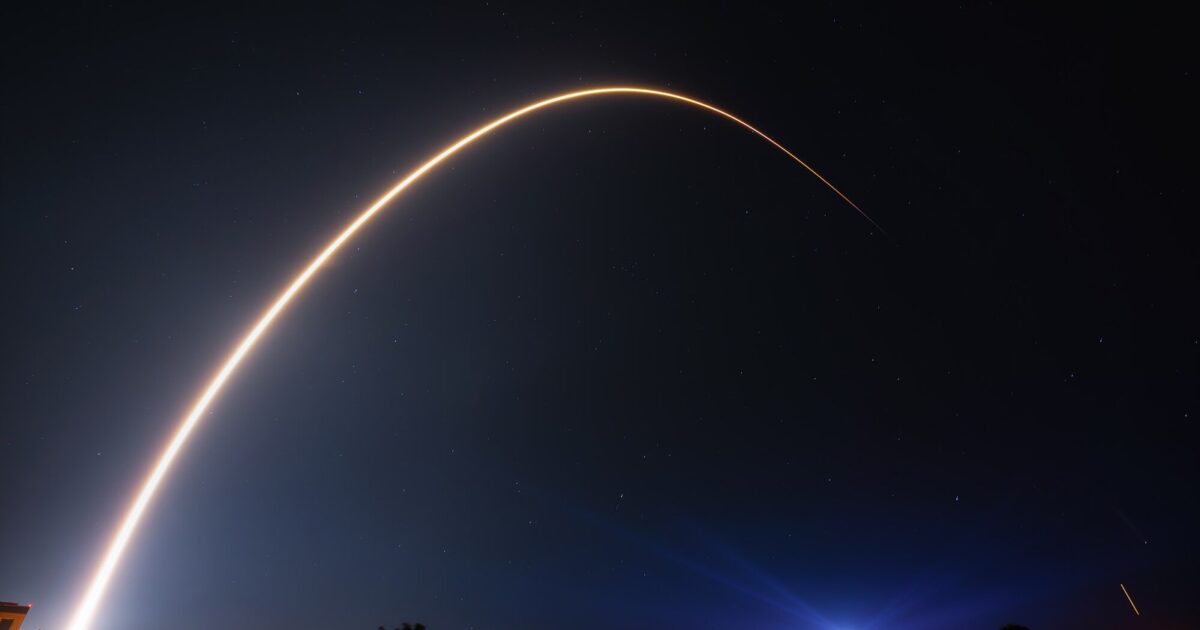
If you feel like SpaceX is launching a rocket every time you turn your head — it’s because they basically are.
SpaceX is on an absolutely unprecedented launch tear in 2026, stacking Starlink missions back-to-back from both Florida and California at a cadence that no launch provider in history has ever come close to. And it’s not slowing down — it’s accelerating.
Here’s one of the most striking visualizations of the pace we’re seeing:
@SpaceX will launch its 1,000th Starlink satellite of 2026 to orbit with today's Falcon 9 launch from Cape Canaveral, FL! https://t.co/Z7APPxLT3n pic.twitter.com/iRRGlzi0a2
— Brian Basson (@BassonBrain) April 14, 2026
That is multiple Falcon 9 launches per week, every week, from two coasts. And SpaceX isn’t just flying these rockets — they’re landing them, inspecting them, and flying them again, sometimes within a month. The Falcon 9 booster fleet has become effectively an airline for orbit.
Space.com broke down just how historic this run has been:
SpaceX is currently on pace to conduct more orbital launches in 2026 than the rest of the world combined. The vast majority of these missions are dedicated Starlink flights, each carrying batches of next-generation V3 satellites designed to deliver direct-to-cell service in partnership with T-Mobile and other carriers worldwide.
The Falcon 9 booster fleet has set records for reuse, with individual boosters now regularly flying more than 20 missions each.
More launches than the rest of the world combined. From one company. With one rocket family. That is not a statistic — that is a paradigm shift in what access to space costs and who controls it.
NASASpaceflight.com dug into what all those Starlinks actually do:
The Starlink V3 constellation represents a major upgrade over prior generations, with each satellite featuring larger phased-array antennas, optical inter-satellite links, and direct-to-cell capability. Once the constellation reaches operational density, Starlink will be able to deliver broadband and cellular connectivity to virtually any point on Earth, with no dead zones.
No dead zones. Anywhere on Earth. That’s the prize. Once V3 is fully deployed, the phrase “out of service” essentially goes away for anyone with a compatible phone — hiking in the Rockies, sailing in the Pacific, driving through the most remote stretches of West Texas. Signal everywhere.
And Starship is still coming. When Starship fully takes over the Starlink deployment job from Falcon 9, the constellation buildout will shift into an entirely new gear. SpaceX isn’t just winning the launch market. They’re redefining what the launch market even is.
Join the conversation!
Please share your thoughts about this article below. We value your opinions, and would love to see you add to the discussion!