
The federal government just handed Zoox a landmark robotaxi exemption. The most interesting part for Tesla may be the legal reasoning underneath it.
NHTSA approved up to 5,000 Zoox vehicles over two years even though the purpose-built robotaxi has no steering wheel, brake pedal, or conventional mirrors.
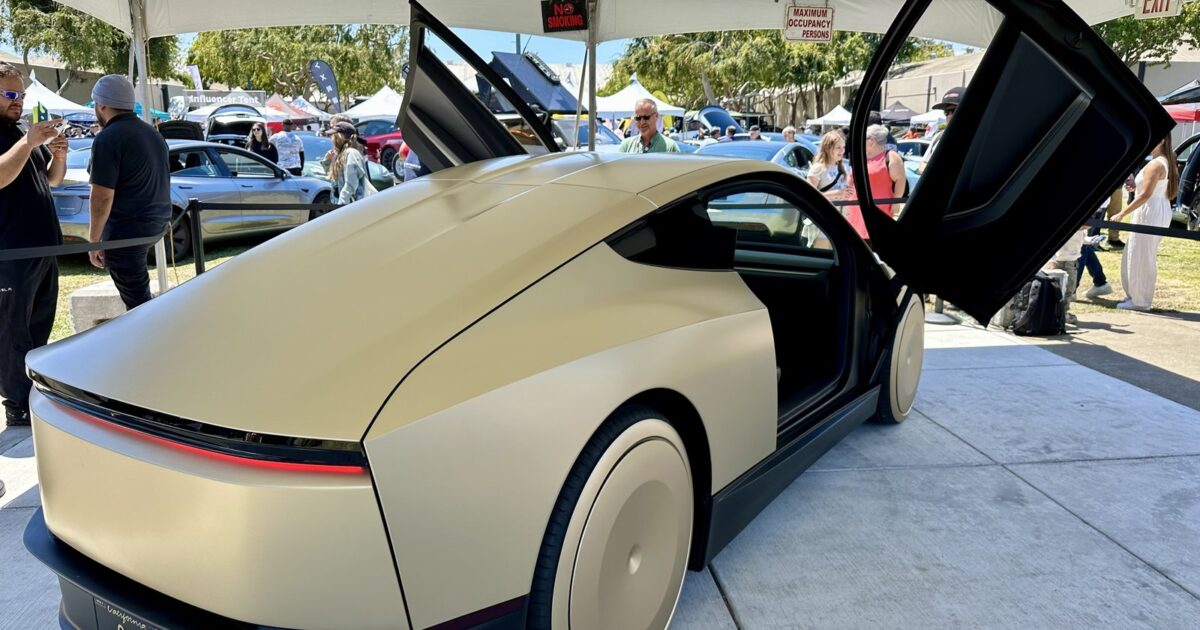
The decision does not approve Tesla’s Cybercab. It does, however, spell out a regulatory lane that could matter enormously to Tesla.
That Tesla connection moved quickly into view Wednesday:
Zoox's regulatory win is a win for Tesla, too https://t.co/1Rcjdlmlc4
— Axios (@axios) August 5, 2026
The Federal Register says Zoox’s exemption runs from July 31, 2026, through July 31, 2028. It allows the company to introduce no more than 2,500 exempt vehicles into interstate commerce for commercial deployment during each 12-month period.
The order covers portions of eight federal safety standards. They include rules for brake systems, rear visibility, windshield defrosting and wiping, lighting, glazing, and occupant protection—requirements largely written around a human sitting in the driver’s seat.
Zoox’s vehicle is built around a completely different idea. It has a symmetrical body, inward-facing carriage-style seating, and an automated driving system intended to perform the entire driving task without a passenger taking over.
NHTSA found that forcing Zoox to add equipment meant only to help a human driver would not necessarily make that vehicle safer. The agency granted the exemption with enhanced oversight and operational authorizations that can be changed as the system matures.
Then came the line that matters most for Cybercab.
NHTSA said there are currently no federal requirements that prohibit an automated vehicle from operating on public roads if its manufacturer self-certifies that it complies with all applicable safety standards and the system does not present an unreasonable risk to motor-vehicle safety.
The agency also made clear that its exemption analysis was narrow. It compared the Zoox robotaxi with a hypothetical compliant version of the same vehicle and focused on the specific safety standards Zoox asked to escape.
NHTSA did not broadly certify Zoox’s automated driving system as safer than a human driver. It said the law does not give the agency authority to demand a higher level of ADS performance while deciding whether the specific exemption qualifies.
That distinction is where Tesla’s possible opening appears.
Axios reports that Tesla has not sought a Zoox-style exemption for Cybercab and may believe it does not need one. Rob Grant, a former executive at Cruise, Aurora, and Lyft, told the outlet that NHTSA’s limited analysis helps Tesla’s argument for self-certification because overall ADS performance is not the central test for each equipment standard.
Tesla still carries the compliance burden. It would have to identify every standard that applies to Cybercab, certify that the vehicle meets those standards, and stand behind the safety of its camera-based driving system.
NHTSA retains defects, recall, investigation, and enforcement authority. States and cities can also impose their own operating requirements for commercial robotaxi service.
But the federal ruling pushes back on a major assumption: that every purpose-built autonomous vehicle must first win a sweeping federal blessing for its driving software before it can move toward commercial deployment.
Zoox is already turning that regulatory win into a business move.
The company’s next step is paid robotaxi service in Las Vegas, taking a vehicle designed without human controls from a free demonstration fleet into commercial operation:
Zoox's big bet on robotaxis starts in Las Vegas https://t.co/c9Y4sofpzy
— Axios (@axios) August 5, 2026
That real-world transition is important. Federal paperwork only matters if it lets a company put vehicles into useful service, collect fares, and prove the system can work day after day.
There is another piece moving in Tesla’s direction.
NHTSA opened rulemaking in June to eliminate the manual brake-pedal mandate for vehicles designed to be driven exclusively by an automated system. The agency said stopping-distance and other braking-performance requirements would remain intact even if the physical pedal disappears.
That is exactly the kind of modernization a vehicle like Cybercab needs. A two-seat robotaxi with no steering wheel cannot reach its simplest, lowest-cost form if regulators insist that it carry controls no passenger is supposed to use.
Tesla still has hard work ahead. Cybercab must meet the standards that apply, its autonomy system has to perform safely in the real world, and commercial service must satisfy state and local rules wherever Tesla wants to operate.
Still, the path looks clearer than it did a week ago.
Zoox asked for an exemption and won one. In explaining why, NHTSA may have handed Tesla something nearly as valuable: a written map of where federal authority ends, where self-certification begins, and how a car without human controls can move from a bold design into an actual business.
Join the conversation!
Please share your thoughts about this article below. We value your opinions, and would love to see you add to the discussion!