

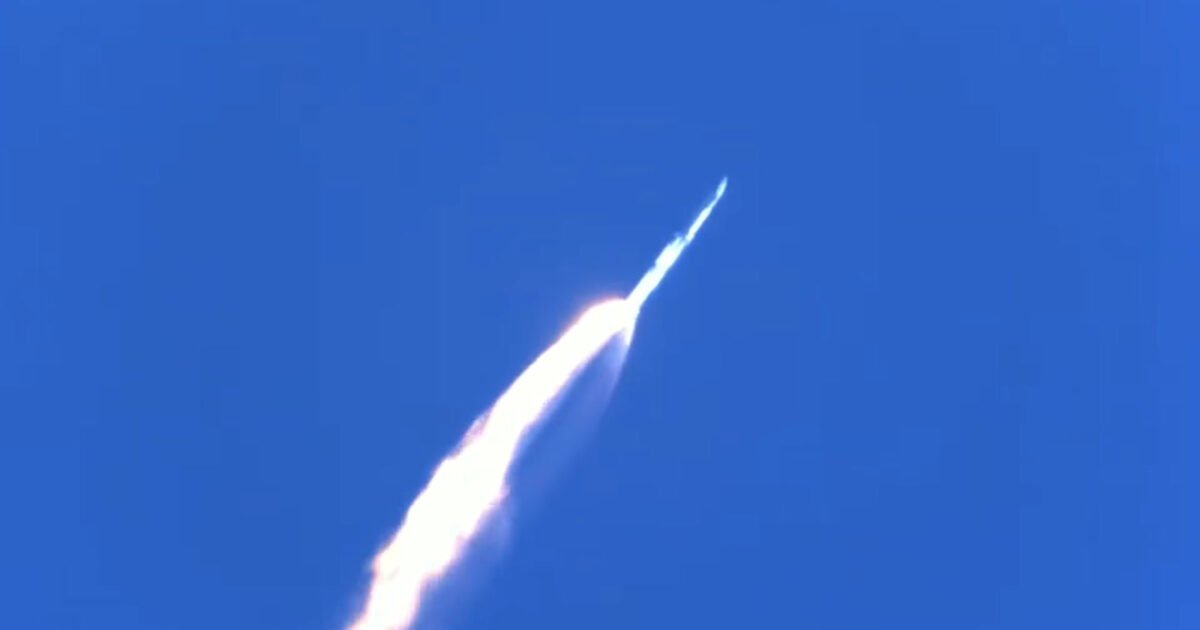
Starship is finally an orbital rocket.
SpaceX sent Flight 14 into orbit from Starbase on Monday morning, then opened the ship’s payload bay and deployed all 26 Starlink V3 satellites aboard.
The milestone did not come easily. One of Ship 41’s Raptor 3 engines shut down early during ascent, forcing flight controllers to stop and assess whether the vehicle still had enough margin to continue.
After several tense minutes, the call came back: go for orbit.
SpaceX laid out the launch window and official coverage plan the day before liftoff:
Starship’s 14th flight is set to launch on Monday, Sept 28. The 75-minute launch window opens at 7:15 a.m. CT. Live coverage of the mission starts ~35 minutes before launch → https://t.co/uQKQvgaTmJ
— SpaceX (@SpaceX) September 27, 2026
Flight 14 lifted off from Pad 2 at 7:49 a.m. Central. Super Heavy separated cleanly, flew back toward the Gulf and completed its planned landing burn over the water rather than attempting a tower catch.
Ship 41 kept climbing. The early engine shutdown briefly put the orbital maneuver in doubt, but the spacecraft compensated during ascent and remained healthy enough for controllers to authorize the insertion burn.
That short burn at roughly 170 miles, or 275 kilometers, made the difference. Mission Control announced that Starship was orbital, and the room at Starbase erupted.
Space.com tracked the flight in real time from the 7:49 a.m. Central liftoff. Its updates recorded hot-stage separation at two minutes and 34 seconds, Booster 21’s landing burn over the Gulf and Ship 41’s climb toward space.
The outlet reported that one Raptor 3 engine shut down early during the ship’s initial burn. SpaceX paused to assess the spacecraft before deciding it still had the redundancy needed to complete an insertion burn and, later, leave orbit safely.
At roughly 275 kilometers altitude, a single Raptor performed the short maneuver that circularized the trajectory. The live report then recorded deployment beginning minutes later, turning the morning’s most uncertain stretch into Starship’s first orbital payload mission.
The outlet also reported that all 26 Starlink V3 satellites were released after orbit was established. Three of those spacecraft carry cameras pointed back toward Ship 41 so engineers can inspect its heat-shield tiles during the orbital coast.
The Starlink team subsequently made contact with all 26 satellites. That turned Flight 14 into more than a test of altitude and speed: Starship had delivered an operational payload to orbit for the first time.
SpaceX describes Flight 14 as the bridge into the next phase of Starship development. Previous integrated tests followed intentionally suborbital paths, even when the ship traveled through space and survived reentry, so they did not require a deliberate orbit-raising maneuver followed by a deorbit burn.
Flight 14 was designed to test that complete chain. Its primary objectives included the first orbital insertion, deployment of 26 Starlink V3 satellites, an in-space relight using one Raptor and a controlled return toward the Pacific.
SpaceX also planned the mission around operational hardware rather than inert simulators. Each deployed satellite is meant to join the constellation, while three camera-equipped spacecraft are gathering unusually close inspection data on Ship 41 during the orbital coast.
This mission added the orbital insertion maneuver, a full batch of V3 satellites and a much longer coast phase. The remaining plan calls for a single-Raptor deorbit burn, controlled reentry and splashdown in the Pacific west of Chile.
SpaceX is not bringing Ship 41 home to Starbase on this flight. The company is collecting the data it needs before attempting that far more aggressive return profile with a later vehicle.
The Associated Press reported that Flight 14 is the 14th full-scale Starship launch in three years. The 407-foot rocket carried the newest Starlink generation while NASA watched progress on the vehicle it expects to use in its Artemis lunar program.
The planned flight profile runs for nearly 10 hours before the Pacific return near Chile, far beyond the roughly hourlong suborbital paths used on earlier tests. Booster 21 was deliberately sent toward the Gulf instead of returning to the launch tower.
The AP also captured why the engine issue mattered. SpaceX would authorize orbit only if the remaining hardware could still support a safe deorbit, and a no-go decision would have ended the flight early.
Controllers judged the vehicle capable and pressed ahead.
That judgment produced the result SpaceX had spent years chasing: a Starship circling Earth with real satellites released behind it.
The flight was still underway as this article was published, so the final deorbit, reentry and splashdown outcomes remained ahead. Those phases will decide how complete the day’s success becomes.
But the central milestone is already in the books. Starship reached orbit, deployed its payload and gave SpaceX a working foundation for the high-volume launches the entire program was built to perform.
Join the conversation!
Please share your thoughts about this article below. We value your opinions, and would love to see you add to the discussion!