

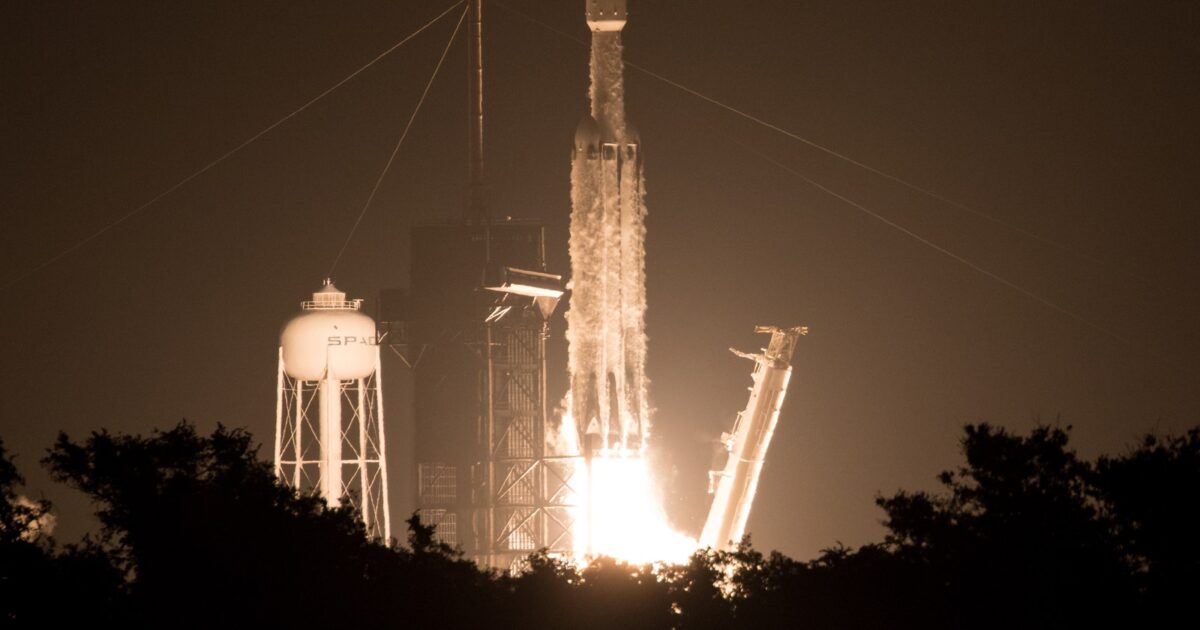
SpaceX is trying to fit three launches into October 1—and two of them are major Florida missions less than 13 hours apart.
The day is scheduled to begin with NASA’s four-person Crew-13 mission from Cape Canaveral. A Transporter rideshare is then due to leave California, followed by Falcon Heavy carrying the classified NROL-97 mission from Kennedy Space Center before midnight Eastern.
If the schedule holds, SpaceX will launch astronauts, a commercial rideshare and a national-security payload from three pads on two coasts in a single day.
Crew-13 cleared one of its last visible milestones Tuesday when the astronauts and launch team completed a full rehearsal:
Crew-13, SpaceX, and @NASA completed a full rehearsal of launch day activities pic.twitter.com/RP9MUppxpm
— SpaceX (@SpaceX) September 29, 2026
SpaceX currently lists Crew-13 for 11:10 a.m. Eastern from Space Launch Complex 40 at Cape Canaveral Space Force Station. The Falcon 9 first stage is slated to return to a Florida landing zone after sending Dragon toward the International Space Station.
The same calendar puts Transporter-18 at 11:18 a.m. Pacific from Vandenberg Space Force Base. That gives SpaceX a little more than three hours between its first and second launches, assuming both leave on time.
NROL-97 is scheduled last, at 11:53 p.m. Eastern from Launch Complex 39A at Kennedy Space Center. That is 12 hours and 43 minutes after Crew-13, with the two Florida rockets operating from different launch complexes.
Launch times are targets, not promises. Weather, range conflicts, vehicle checks or mission requirements can move any one of them.
The fact that all three are sitting on the same calendar is still a sharp measure of how far SpaceX’s launch operation has scaled.
NASA says Crew-13 will carry Jessica Watkins and Luke Delaney of NASA, Joshua Kutryk of the Canadian Space Agency and Sergey Teteryatnikov of Roscosmos to the station. The mission is SpaceX’s 13th crew-rotation flight for the Commercial Crew Program and the 14th Crew Dragon flight with astronauts when Demo-2 is included.
The crew is expected to join Expedition 75 and spend roughly six months aboard the station. NASA says its work will include research involving heart disease and Parkinson’s disease, crop production for long missions, blood-flow changes in space and new equipment for monitoring astronaut health.
The Falcon 9 booster assigned to Crew-13 is preparing for its third flight. Dragon is expected to reach the station about nine hours after launch, turning the morning mission into a tightly managed human-spaceflight operation before SpaceX moves through the rest of the day’s manifest.
The Canadian Space Agency reports that the crew entered quarantine in Houston on September 17 and arrived at Kennedy Space Center on September 26. Their formal mission training is complete, but they have continued reviewing procedures and working through the final preflight sequence.
During Tuesday’s rehearsal, the astronauts put on their pressure suits, traveled to the launch pad and boarded Dragon. The mission team monitored the vehicle and practiced the countdown steps without fueling or launching the rocket.
That exercise does not fuel or launch the rocket. It runs the people, communications and procedures through the same chain they will follow on launch day, exposing small problems while there is still time to fix them.
The night mission brings a completely different machine and customer.
SpaceX showed Falcon Heavy and its 27 first-stage Merlin engines together in the LC-39A hangar as NROL-97 moved toward launch:
Falcon Heavy and its 27 Merlin engines in the hangar at Launch Complex 39A in Florida pic.twitter.com/ETejT6zPD2
— SpaceX (@SpaceX) September 28, 2026
SpaceX says NROL-97 has an October 2 backup opportunity at 11:48 p.m. Eastern. The National Reconnaissance Office payload is classified, so the public mission profile focuses on the launch vehicle, timing and booster returns rather than the spacecraft’s capabilities or destination.
The two Falcon Heavy side boosters are making their second and fourth flights. SpaceX says the hardware previously supported GOES-U, Viasat-3 F3 and NASA’s Roman Space Telescope mission.
After separation, both side boosters are scheduled to fly back to Landing Zones 1 and 2. Combined with the Crew-13 booster return, SpaceX is planning three Florida landings around two launches in the same calendar day.
Falcon Heavy’s center core is not listed for recovery. The rocket’s architecture trades the center vehicle when a demanding mission needs more performance, while the side boosters can still return for reuse.
There is plenty that can reshuffle this lineup before Thursday. Crewed missions get conservative weather and safety rules.
NROL-97 carries its own national-security constraints, while Transporter-18 is moving through a separate California launch flow.
But that independence is the real story. SpaceX no longer operates like a company preparing one rocket for one marquee launch.
It is preparing a crew, a rideshare and Falcon Heavy at the same time—and asking three separate launch teams to turn October 1 into one of the busiest days in the company’s history.
Join the conversation!
Please share your thoughts about this article below. We value your opinions, and would love to see you add to the discussion!