

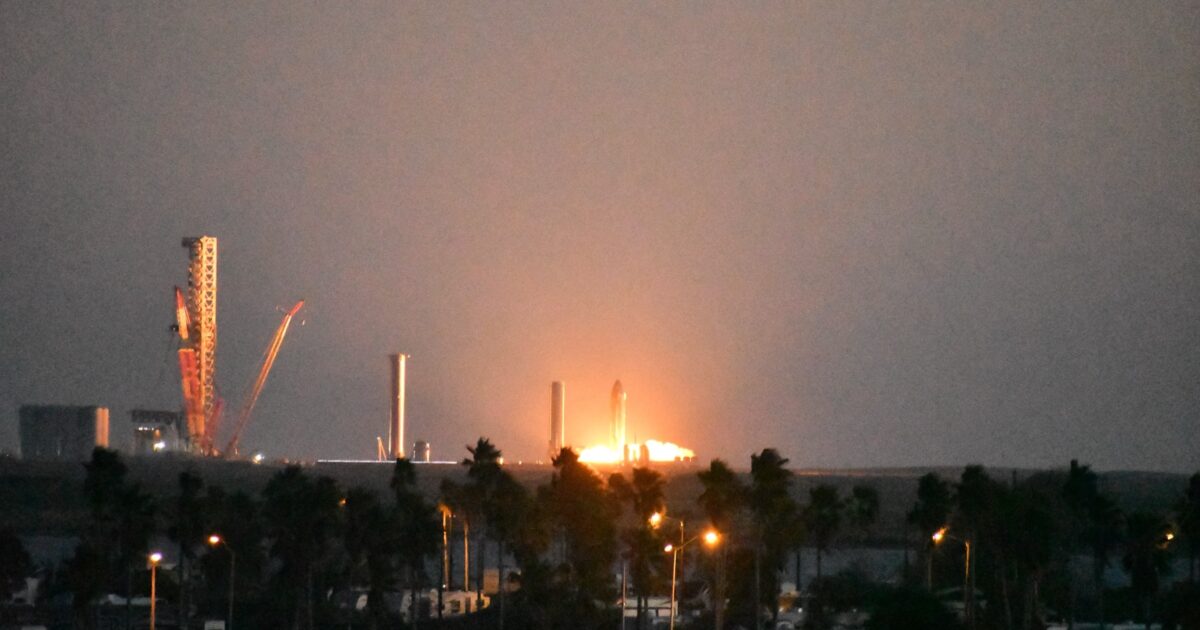
SpaceX got Starship home safely from orbit. It just did not keep it there nearly as long as planned.
Flight 14 was supposed to spend close to 10 hours circling Earth before returning near Chile. Instead, an early Raptor shutdown during ascent pushed controllers to end the orbital phase after roughly three hours and send Ship 41 toward a backup splashdown zone north of Hawaii.
That was not a loss of control. It was a deliberate retreat after the mission had already reached orbit and deployed all 26 Starlink V3 satellites.
The interesting part is what happened next: the contingency plan worked.
SpaceX confirmed the deorbit burn and the ship’s commitment to the Pacific return in this live update:
Deorbit burn complete. Starship is on course to reenter Earth’s atmosphere ahead of a planned splashdown in the Pacific Ocean in ~1 hour pic.twitter.com/eV3zLEpWdZ
— SpaceX (@SpaceX) September 28, 2026
SpaceX said the flight-control team shortened the mission out of caution because of the engine issue during ascent. The company had already identified two Pacific landing zones before launch and cleared them of air and sea traffic.
The northern zone was the nearer option. Once the decision was made, Starship used a single center Raptor for the deorbit burn and began dropping out of its roughly 275-kilometer orbit.
That choice surrendered most of the planned endurance test. Flight 14 had been designed for about six laps around Earth, a long coast phase and a return near Chile. SpaceX kept the higher-priority gains—the first orbital insertion and the first operational Starlink V3 deployment—then removed hours of exposure after the propulsion warning.
Ars Technica reported that one of Ship 41’s six Raptors shut down early during the initial climb. The other five burned longer to compensate, and controllers spent several minutes deciding whether it was safe to attempt orbit at all.
The engine selected for orbital insertion was healthy. It restarted for 19 seconds, added the final sliver of velocity and placed Starship in a stable orbit about 171 miles above Earth.
That same core engine system also had to remain trustworthy enough to bring the 100-ton ship back down on command.
The outlet noted that the upper-stage problem was not the only propulsion concern. One Super Heavy engine appeared to shut down during launch, and another stopped early during the boostback maneuver.
The booster still completed a controlled Gulf splashdown.
Those details matter because every orbital success now raises the bar. Reaching space is only the first demand on the vehicle.
SpaceX needs dozens of Raptors to light, relight and throttle predictably enough for routine launches, tanker flights and eventual tower catches.
Spaceflight Now reconstructed the full return. Starship reentered belly-first, used its flaps to control the descent, then lit three engines and flipped upright above the ocean.
The ship reached the water at 11:57 a.m. Eastern—just over three hours after liftoff. It settled tail-first at the planned point north of Hawaii before tipping onto its side and breaking apart as residual propellant ignited.
That fireball was dramatic, but it came after the controlled touchdown. SpaceX was not trying to recover Ship 41 from the water or preserve it for another flight.
The report also tracked Super Heavy’s return minutes after launch. Despite an apparent engine shutdown during boostback, the booster descended vertically and completed its own planned Gulf splashdown.
That left Flight 14 with two controlled water returns on a day when propulsion trouble changed the upper stage’s plan. The ship’s heat shield, flaps, deorbit system and landing sequence still completed the jobs SpaceX asked of them.
The company’s splashdown video shows the final flip and landing burn:
Splashdown confirmed. Congratulations to the entire SpaceX team on the first orbital flight of Starship! pic.twitter.com/urjmiwnvNl
— SpaceX (@SpaceX) September 28, 2026
The Associated Press confirmed that the original plan called for six orbits over nearly 10 hours, ending west of Chile. The revised path brought Starship down after only a couple of laps, once the satellites were safely away and controllers had collected the data they needed most.
The AP also placed the test in the larger Artemis schedule. NASA needs a Starship-derived lunar lander, and that architecture depends on repeated launches and orbital refueling—not one heroic flight that works around a bad engine.
Flight 14 proved that Starship can reach orbit, deliver real payloads and execute a safe off-nominal return plan. It also left SpaceX with an uncomfortable engineering fact: the Raptor 3 generation has now shown engine trouble on each of its first three Starship flights.
That makes the next mission more interesting, not less. Orbit is no longer the unanswered question.
Reliability is.
Join the conversation!
Please share your thoughts about this article below. We value your opinions, and would love to see you add to the discussion!