
AT&T CEO John Stankey just picked a very public fight with SpaceX over the future of mobile service.
His verdict on SpaceX’s plan to turn Starlink into a true wireless competitor was blunt: “not a viable strategy.” He also said AT&T, not Elon Musk’s company, is the real disruptor.
That is a confident line from the leader of one of America’s largest carriers. It may even prove correct in dense cities, where fiber, towers and indoor coverage still give terrestrial networks enormous advantages.
But dismissing SpaceX outright is a much bigger bet than it sounds.
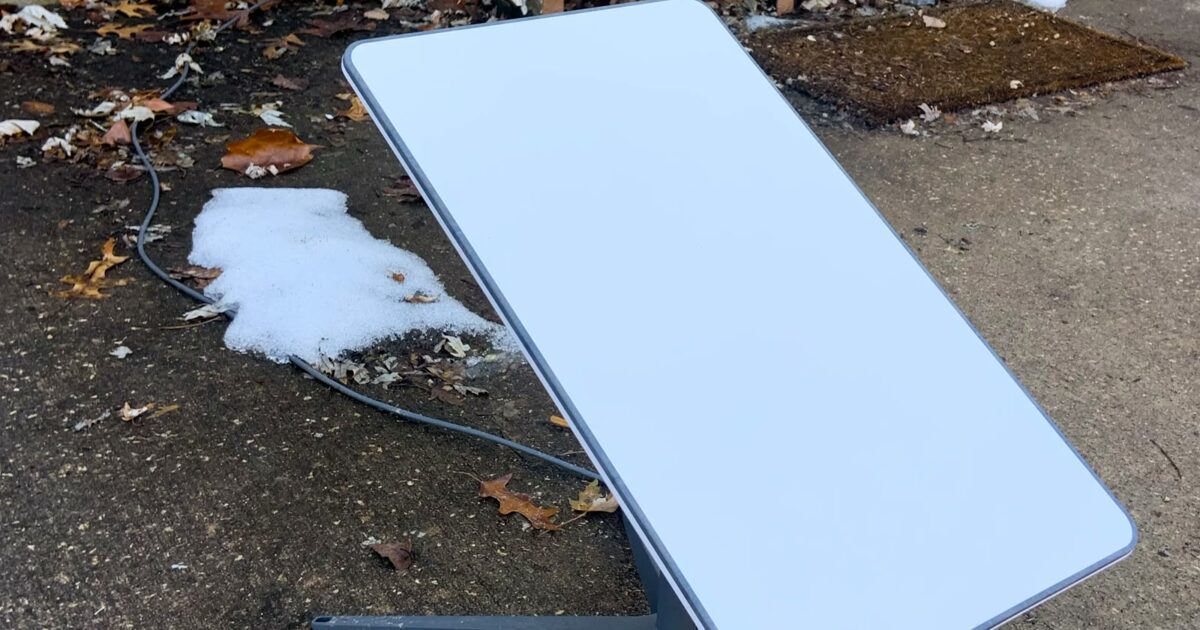
Axios reports that Stankey challenged both the economics and the physical design of SpaceX’s proposal. The company has discussed placing small cellular base stations beside Starlink dishes at homes and businesses, using its satellite network to carry traffic without reproducing every piece of a conventional carrier’s infrastructure.
Stankey argued those small stations could cost as much as building a macro network. He also pointed to a thorny practical issue: a carrier cannot simply radiate cellular signals from somebody’s property without permission.
If that approach were truly cheaper and better, he said, AT&T could already be attaching radios to its huge fiber footprint.
His strongest point is that satellites do not erase the need for ground capacity. Phones must work inside buildings, on crowded streets and in places where thousands of people may compete for bandwidth at once.
Fiber still moves staggering amounts of data with low latency, and a nationwide wireless network needs a careful mix of spectrum, towers, backhaul and local density.
SpaceX is not pretending otherwise. Its plan is no longer satellite-only.
Investing.com, carrying Reuters reporting, detailed after SpaceX’s August earnings call that the company acquired 65 megahertz of EchoStar spectrum licenses for $19.6 billion through two deals announced last year. SpaceX President Gwynne Shotwell said that spectrum includes terrestrial components and confirmed that the company intends to build ground infrastructure.
The goal is to combine satellites, spectrum and terrestrial equipment into a broader service instead of asking orbiting hardware to do every job. Analysts told Reuters that a national buildout would still take years and enormous execution, especially against carriers that have spent decades and hundreds of billions of dollars creating their networks.
Shotwell’s own words make clear that SpaceX knows what kind of fight it has entered:
$ASTS: 🚨 SPACEX PLANS TO BUILD OUT TERRESTRIAL NETWORK TO COMPETE DIRECTLY AGAINST AT&T, VERIZON AND T-MOBILE
Gwynne Shotwell:
"Uh, the spectrum that we purchased from EchoStar does have terrestrial components, so we definitely intend to build out terrestrial. Um, the… pic.twitter.com/Vq88mG4dHN
— Anp🅰️nman (@spacanpanman) August 4, 2026
SpaceX’s second-quarter results show why the threat cannot be waved away. Starlink ended June with 12 million subscribers, double its year-earlier total and 1.7 million above the previous quarter.
The Connectivity business generated $4.291 billion in quarterly revenue and $1.656 billion in operating income. SpaceX reported another $1.367 billion of Connectivity capital spending during the quarter, evidence that it is already pouring money into the network rather than merely describing one.
The same filing says SpaceX received FCC approval for the transfer of 65 megahertz of U.S. spectrum and certain global mobile-satellite licenses. It also lists new Starlink Mobile partnerships with SoftBank, NTT Docomo and Spark NZ.
Those numbers put real customers, spectrum, operating profit and investment capacity behind the plan.
Stankey is also drawing an important distinction between replacing carriers and extending them.
Light Reading covered his earlier explanation that direct-to-device satellite service fills a relatively small but valuable gap for a carrier whose terrestrial network already reaches most of the country. Remote roads, rural homes, maritime routes and disaster zones are exactly where satellite coverage can matter most.
AT&T’s preferred model is to use satellites as a complement while keeping the customer relationship, billing and most traffic on its own network. That is a rational strategy.
It is also why SpaceX selling mobile service directly would be far more threatening than SpaceX remaining a wholesale coverage partner.
The real disagreement is not whether fiber beats a satellite link in a neighborhood that already has fiber. Of course it does.
The question is whether SpaceX can stitch together enough satellite coverage, terrestrial spectrum and cheap local radios to create a useful network without copying the incumbents tower for tower.
Stankey sees a plan that collapses under cost, permissions and radio physics. SpaceX sees a chance to redesign the network around assets it already owns.
One side has decades of infrastructure and operational experience. The other has 12 million satellite customers, launch capacity no carrier can match and a history of making old cost assumptions age badly.
Calling the winner today would be foolish. Calling SpaceX’s strategy irrelevant would be just as foolish.
Join the conversation!
Please share your thoughts about this article below. We value your opinions, and would love to see you add to the discussion!