

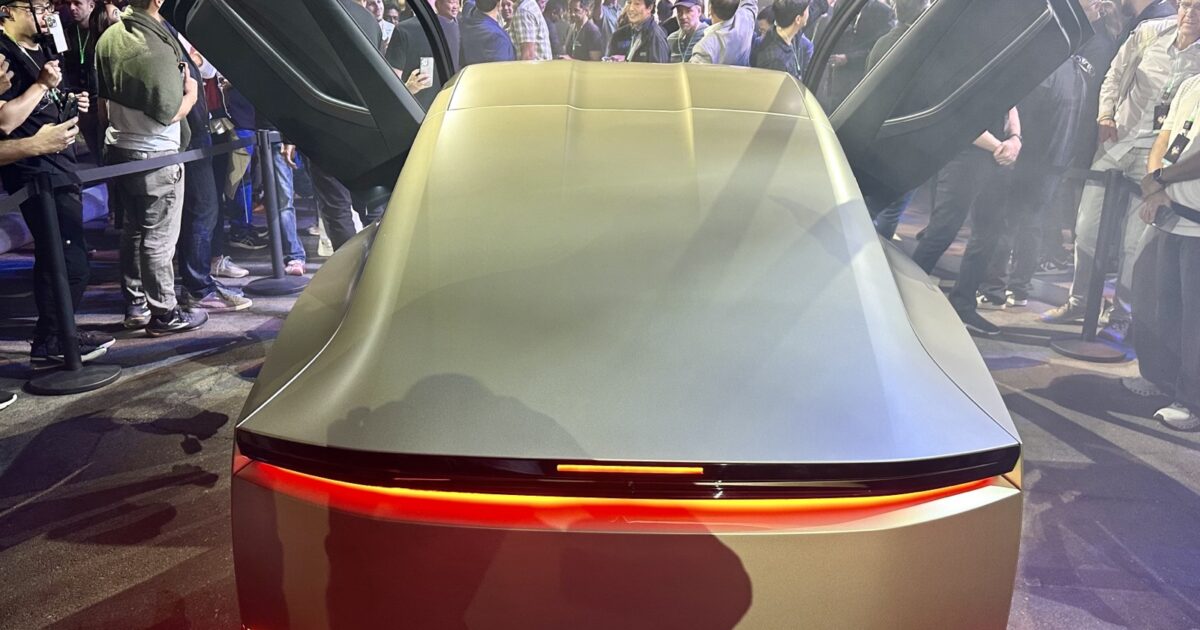
Tesla is putting firefighters and other first responders face to face with the strangest practical problem created by Cybercab: what happens when emergency crews need to stop, enter or move a car that has no steering wheel or pedals?
The company offered its clearest public look at that work early Friday, releasing video of responders training around a Cybercab and saying their feedback is being incorporated directly into the vehicle’s design and safe operation.
The video matters because Cybercab is no longer a concept sitting under show lights. Paying riders are now using the two-seat robotaxi in Austin, which means emergency procedures have to work on a real street, under pressure, with no conventional controls waiting behind the dashboard.
Tesla’s training footage shows responders working through the vehicle itself, including its unconventional doors and cabin controls:
Train like you fight, fight like you train
First responder feedback is directly incorporated into the design & safe operation of Cybercab pic.twitter.com/AqNyM53Kdh
— Robotaxi (@robotaxi) September 18, 2026
The steering-wheel-free design changes the basic emergency playbook. A responder cannot simply reach through a broken window, shift the car into neutral and turn a physical wheel.
Tesla’s answer is a combination of local controls, remote support and specialized training.
The official Texas Department of Public Safety interaction plan says Cybercab has an emergency-stop button in the overhead console. Once pressed, it stops autonomous operation and prevents the vehicle from moving until the system is restored through Tesla support.
The same plan directs responders to contact Tesla’s Robotaxi First Responder Support line when possible. Tesla can remotely place the vehicle in park, unlock the doors, open the trunk and move it to a safer location.
A Rapid Response Team can also be dispatched when remote help is not enough.
There is a local fallback. The center touchscreen can expose manual controls that allow a responder to move the vehicle briefly, including an on-screen accelerator, brake and steering interface.
If the car has lost power or the screen is damaged, the plan allows emergency entry using ordinary rescue methods, including breaking glass when necessary.
Those details explain why Tesla is training directly with local departments instead of treating a PDF as the whole answer. Touch controls, remote operators and gull-wing doors may be familiar to Tesla engineers.
They are not automatically familiar to the crew arriving at a crash, fire or blocked roadway.
Axios Austin reported that Tesla supplied first-responder guides and held training with Austin crews before the paid Cybercab launch. City officials said the preparation included crashes and other emergencies, while Austin’s autonomous-vehicle working group had been discussing Cybercab with Tesla since the vehicle’s 2024 debut.
The local record gives that preparation real weight. Axios reported that 45 Cybercabs had been added to Tesla’s Texas authorization and that Austin had logged 10 incidents or complaints involving Tesla autonomous vehicles since testing began in June 2025.
Seven were categorized as safety concerns, including reported failures to yield and a vehicle traveling the wrong way on a temporarily converted one-way street.
That does not establish that Cybercab is uniquely unsafe, and a logged complaint is not the same thing as a confirmed defect. It does show why emergency coordination cannot be an afterthought.
A growing driverless fleet will eventually encounter collisions, disabled vehicles, road closures and medical emergencies, even if the autonomous system performs exactly as intended most of the time.
Tesla said in its Q2 2026 update that Cybercab production had started and listed first-responder training alongside testing and permitting as the company prepared to expand Robotaxi service into more U.S. metropolitan areas. That places the Austin work inside a broader rollout plan, not a one-off demonstration.
The challenge now is consistency. Every city will have different departments, dispatch systems, road rules and levels of familiarity with autonomous vehicles.
Tesla has to make the procedure fast enough for a firefighter at 2 a.m., clear enough for an officer seeing the car for the first time and resilient enough to work when connectivity or the center display does not.
Cybercab’s lack of conventional controls is one of the vehicle’s defining ideas. Tesla’s new video shows the other half of that bet: removing the steering wheel does not remove the need for human access when something goes wrong.
Join the conversation!
Please share your thoughts about this article below. We value your opinions, and would love to see you add to the discussion!