

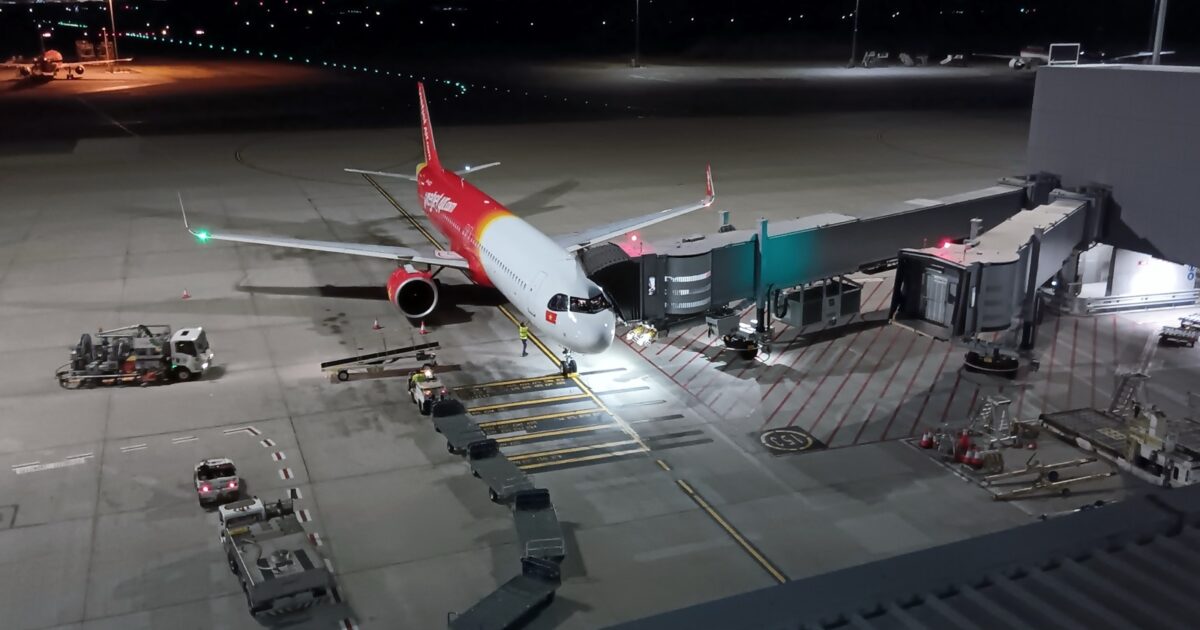
Starlink is coming to Vietjet—and the plan reaches across the Vietnamese carrier’s entire 120-aircraft fleet.
SpaceX’s satellite-internet company announced the deal on September 21, promising high-speed, low-latency connectivity for passengers and crew from gate to gate.
Gate-to-gate service changes the promise. The connection is meant to follow the trip from boarding through arrival, rather than waking up somewhere above the clouds.
Soon, passengers and crew onboard @Vietjet_Global can access Starlink’s high-speed, low-latency connectivity from gate to gate https://t.co/jqJ2Lw3YSv
— Starlink (@Starlink) September 21, 2026
The announcement is short, but it locks in the part passengers will actually notice: the airline intends to make a normal flight feel far less disconnected.
It does not yet say when the first equipped Vietjet aircraft will carry paying passengers. Pricing, installation order and the timetable for completing the fleet also remain open.
Drive Tesla reports that the rollout grows out of an agreement Vietjet and Starlink Services Vietnam reached in May. The airline is preparing to introduce the service across 120 aircraft, with a more detailed announcement expected in New York on September 23.
The fleet scale makes this more than another single-aircraft trial. Vietjet has built a large low-cost network around Airbus narrow-body aircraft while also expanding with A330 wide-bodies.
A full deployment would put Starlink in front of travelers on domestic, regional and longer international routes.
The technical path is farther along than the two-line announcement suggests. Drive Tesla says Starlink has already obtained supplemental type certification covering the Airbus A320, A321neo and A330 families used by Vietjet.
Installation work still lies ahead, but those approvals remove a major aircraft-certification hurdle from the rollout.
What still needs to happen is the physical work: scheduling aircraft, mounting the low-profile terminals, integrating cabin networking, testing each installation and returning the plane to service. Doing that across 120 jets is a real fleet program, not an overnight software switch.
Vietjet has not said whether every passenger will receive the connection free, whether access will depend on fare class or loyalty status, or whether certain routes will go first. Those are exactly the questions the fuller September 23 announcement should answer.
Starlink Aviation says its network has already carried high-speed internet on more than 200,000 flights. The company presents the airline product as a connection that begins when passengers step aboard and continues throughout the trip, backed by a dedicated aviation support and reliability operation.
The network’s reach is not built only around ground stations near cities. Starlink says optical links move traffic between satellites across a laser mesh, helping maintain service over oceans, polar routes and other areas far from terrestrial infrastructure.
That architecture is a natural match for Vietjet’s expansion. A carrier flying between Vietnam, Australia, India and destinations across Asia needs connectivity that does not disappear when an aircraft leaves the footprint of a conventional ground network.
Starlink also says its commercial-airline offering is designed to support streaming across the cabin. Actual performance will still vary with installation, network demand and route, but the goal is plainly different from the slow, fragile in-flight Wi-Fi many travelers have learned not to trust.
For SpaceX, Vietjet adds another sizable airline platform in a region where Starlink has been collecting aviation customers quickly. For Vietjet, it offers a way to upgrade the passenger experience without changing what made the airline grow: a broad network and low fares.
The headline promise is now official. The next proof will be the rollout plan—and then the first Vietjet passengers opening a laptop or streaming a video before their aircraft has even left the gate.
Join the conversation!
Please share your thoughts about this article below. We value your opinions, and would love to see you add to the discussion!