

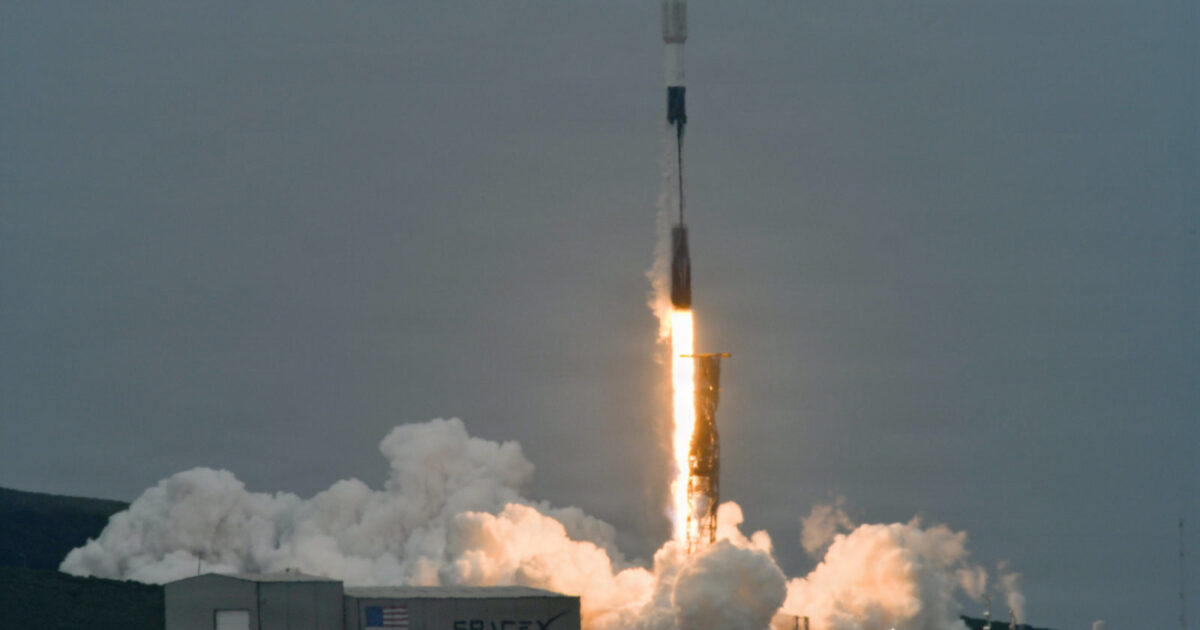
SpaceX closed out Saturday night with another clean Falcon 9 mission from California, sending 27 Starlink satellites into low Earth orbit and bringing its 2026 launch pace into sharper focus.
The rocket lifted off from Space Launch Complex 4 East at Vandenberg Space Force Base at 6:47 p.m. Pacific time. About eight and a half minutes later, the first stage touched down on the drone ship Of Course I Still Love You in the Pacific.
SpaceX carried the full mission live on X. The replay shows the night launch from Vandenberg, stage separation, and the opening stretch of the flight toward deployment.
That first stage was B1093, flying for the 17th time. Its earlier work included two missions for the U.S. Space Force’s Space Development Agency, the Transporter-16 rideshare mission, and 13 previous Starlink flights.
This was not a record-setting booster flight. That is precisely what makes it revealing.
Seventeen launches and landings can now sit inside the normal rhythm of SpaceX operations, with the same hardware moving between national-security work, rideshare customers, and the company’s own broadband network.
Spaceflight Now tracked the mission from the 6:47 p.m. Pacific liftoff through the recovery attempt. Its report identified B1093, listed the booster’s two Space Development Agency flights, Transporter-16, and 13 earlier Starlink missions, then confirmed the landing aboard Of Course I Still Love You.
The touchdown was the 225th on that drone ship and the 662nd Falcon booster landing across the fleet. The outlet also identified the payload as 27 Starlink V2 Mini Optimized satellites and placed deployment a little more than an hour after liftoff.
Those numbers show how much infrastructure now sits behind a launch that can look routine from the outside. The rocket, West Coast pad, recovery ship, refurbishment flow, and satellite-production line all have to meet on the same clock.
SpaceX keeps making that coordination look ordinary because it repeats it so often.
Space.com reported that all 27 satellites deployed as planned about 62 minutes after liftoff. Its mission count puts Saturday’s flight at Falcon 9’s 107th launch of 2026 and the 81st mission this year devoted to Starlink.
The outlet placed the active Starlink fleet above 11,100 spacecraft, citing satellite tracker Jonathan McDowell. It also compared this year’s pace with 2025, when Falcon 9 flew 165 times and 122 of those missions carried Starlink satellites.
At the current pace, the report projected 149 Falcon 9 missions and 113 Starlink flights by the end of 2026. That would trail last year’s record while still representing a launch tempo no rival currently approaches.
One batch of 27 barely changes that total by itself. The real story is accumulation: launch after launch, landing after landing, and another set of satellites beginning its path into the operational constellation.
KEYT, the local Central Coast station, laid out the mission plan before launch. Its preview identified the four-hour window, the 27-satellite payload, B1093’s 17-flight manifest, and the planned Pacific recovery.
The station also told local residents that sonic booms could be heard across the region, with the actual reach depending on weather and other conditions. That detail captures the ground-level side of a launch that is otherwise discussed mostly in orbital numbers.
That local perspective matters at Vandenberg. A Starlink mission is a global network expansion for SpaceX, but it is also a real event over California’s coast, with a visible ascent, marine recovery operations, and communities living under an increasingly busy launch corridor.
SpaceX did not need a brand-new rocket or a one-off stunt to make this mission worth watching. It used a heavily experienced booster, landed it again, and completed another orbital deployment on schedule.
That is the machine SpaceX has built on the West Coast: reusable hardware cycling through missions fast enough that the extraordinary keeps arriving disguised as routine.
Join the conversation!
Please share your thoughts about this article below. We value your opinions, and would love to see you add to the discussion!