

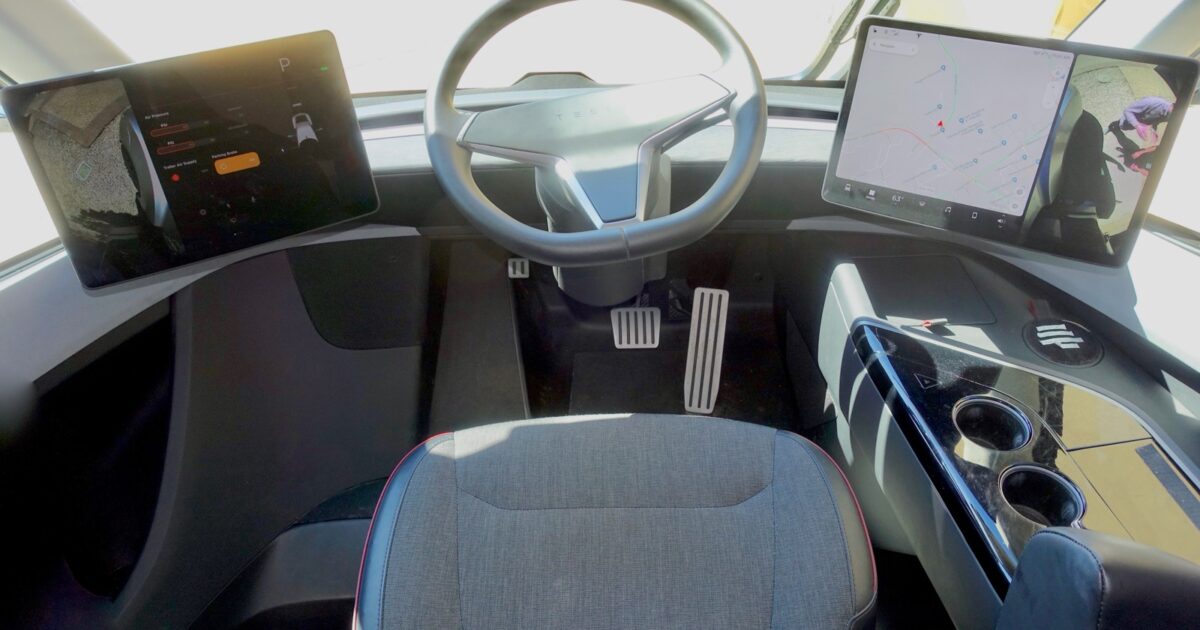
Tesla launched high-volume Semi production only after going back into the truck and changing the parts drivers said would not work.
The clearest example is almost comically ordinary: the window now rolls down.
After years of pilot-fleet feedback, Tesla has also cut roughly 1,000 pounds from the truck, moved it to in-house 4680 battery cells and replaced hydraulic steering with an electric system built for both lower maintenance and future automation.
Tesla marked that transition with an official video from the new Nevada factory, declaring that high-volume production is now underway.
Semi is here
Today, we're launching high volume production pic.twitter.com/QQjYDmcPsf
— Tesla Semi (@tesla_semi) September 25, 2026
The production launch matters because the Semi that fleets can order now is not the same truck Tesla showed in 2017 or delivered from a pilot line in 2022.
TechCrunch reports that Semi program lead Dan Priestley openly called the original pop-out window design “not sufficient.” Truck drivers need to reach badge readers, toll booths and call boxes from the cab, and a window that only cracked open made those routine jobs harder than they needed to be.
The production truck now has a conventional roll-down window. That sounds small beside an 82,000-pound loaded vehicle, but it is exactly the kind of practical correction that separates a showpiece from equipment somebody has to operate for ten hours a day.
The same report says Tesla removed about 1,000 pounds from the earlier Semi design. During the rollout event, the company also demonstrated a truck charging from 3 percent to 60 percent over the course of the roughly 30-minute presentation.
Customers can begin taking delivery as their operations and charging sites are ready. Tesla did not announce a final sticker price onstage, though the most capable version is expected to come in just under $300,000 before incentives.
Electrek details how deep the redesign goes. Tesla moved the battery from 2170 cells to its own 4680 format, which the company says reduces battery mass and the number of kilowatt-hours required without cutting the truck’s rated range.
The drive axle now uses a steel-caged rotor instead of the earlier carbon-fiber-sleeved design. Tesla says the new rotor costs less, improves reliability and efficiency, and works with a bar-wound stator already produced at scale for Cybertruck.
Hydraulic steering is gone as well. Tesla calls Semi the first heavy-duty truck with electric steering, eliminating pumps and fluid while creating the control architecture needed for future autonomous features.
Then there are the details aimed squarely at the person in the center seat: acoustic glass, enough room to stand, automated portions of the required pre-trip inspection and electronic records showing when those checks were completed. The new “Megamanifold” heat-pump system handles cabin comfort and powertrain heating and cooling together.
Tesla says its Semi fleet has stayed above 98 percent uptime during 2026. The real test will be whether that figure holds as the company moves from a relatively small group of tightly supported fleet trucks to thousands of vehicles working across more routes and climates.
Tesla Semi lists the Long Range truck at up to 500 miles on a charge and energy use of 1.7 kWh per mile. Its Megacharger can deliver up to 1.2 megawatts and recover as much as 60 percent of the truck’s range in 30 minutes.
Tesla’s cost pitch is built around fewer moving parts, no diesel engine, no transmission and no exhaust aftertreatment system. Electricity can also cost less per mile than diesel, but fleets will still have to account for the price and lead time of depot charging, utility upgrades and route coverage.
The dedicated Sparks factory gives Tesla room to build Standard Range, Long Range and European versions on one line, with stated capacity of 50,000 trucks a year.
Capacity is not production. Tesla still has to prove how quickly it can ramp without sacrificing quality or fleet support.
That is why the roll-down window may be the most revealing change of all.
Tesla spent years selling the Semi as a futuristic machine. The production version looks more credible because the company finally listened when truck drivers asked for something completely normal.
Join the conversation!
Please share your thoughts about this article below. We value your opinions, and would love to see you add to the discussion!