

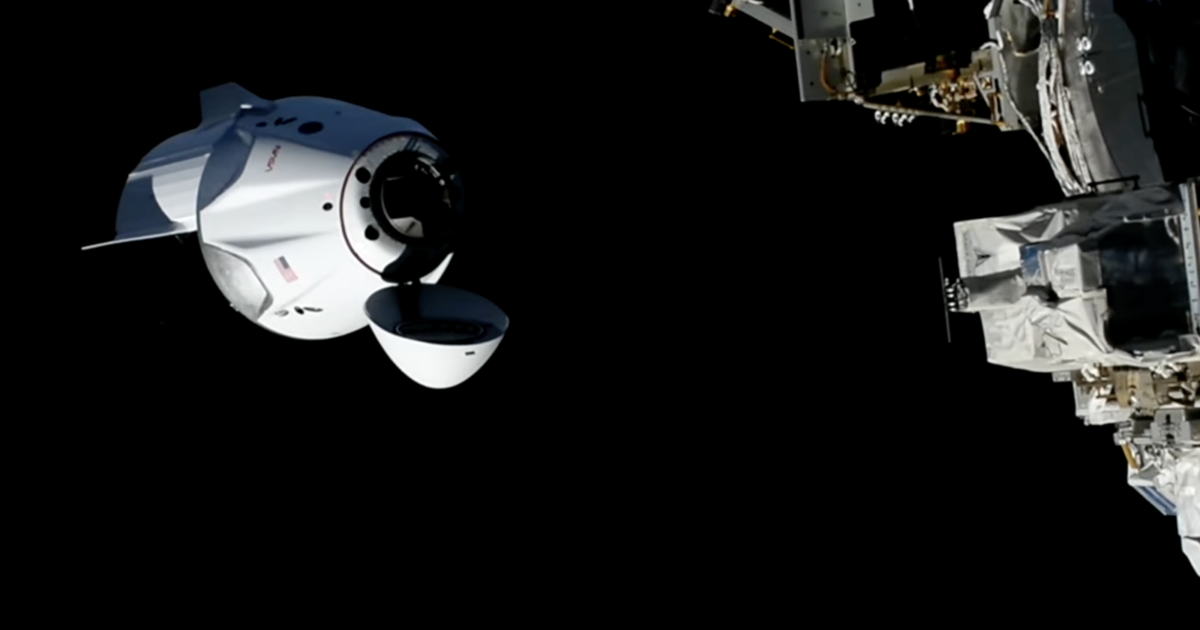
SpaceX just turned the trip from a Florida launch pad to the International Space Station into a same-day sprint.
Crew-13’s Dragon spacecraft reached the station Thursday evening only 7 hours and 55 minutes after liftoff. NASA says that is the fastest launch-to-docking trip ever completed by a U.S. spacecraft.
The record matters because Dragon did not get there by cutting corners. It flew the same controlled rendezvous, approach and autonomous docking sequence.
This time, the station was in the right place and the orbital geometry lined up.
NASA showed the four-person crew leaving Cape Canaveral aboard Falcon 9 at 11:10 a.m. Eastern:
Liftoff!
The four astronauts of NASA’s @SpaceX Crew-13 mission are launching to the @Space_Station to perform research, technology demonstrations, and maintenance aboard the orbiting laboratory. pic.twitter.com/Du1IVmYEET
— NASA (@NASA) October 1, 2026
NASA confirmed that Dragon Grace docked to the forward port of the station’s Harmony module at 7:05 p.m. Eastern. The elapsed time from launch was 7 hours and 55 minutes, establishing the U.S. record.
The spacecraft arrived carrying NASA astronauts Jessica Watkins and Luke Delaney, Canadian Space Agency astronaut Joshua Kutryk and Roscosmos cosmonaut Sergey Teteryatnikov. Leak checks and pressurization followed before the hatches could open.
The result is a sharp contrast with the early station era, when rendezvous timelines were often measured in days. It also cut hours from the fastest previous American trips.
The docking completed the riskiest visible phase of a day that began under uncertain Florida weather. Falcon 9 still hit its instantaneous launch window, Dragon reached orbit and the station approach stayed on the compressed plan.
Space.com reports that the previous U.S. record belonged to the uncrewed CRS-31 cargo Dragon, which reached the station in 12 hours and 33 minutes in November 2024. The fastest earlier American crewed trip was Crew-11 at 14 hours and 43 minutes, so Crew-13 cut almost seven hours from that crewed benchmark.
SpaceX’s Julianna Scheiman explained after launch that the station happened to be in a particularly favorable position. The orbital mechanics lined up close to the fastest practical profile available to Dragon.
The overall station record still belongs to Russia’s Soyuz program. A Soyuz spacecraft completed the trip in 3 hours and 3 minutes in 2020.
Crew-13’s achievement is specifically the U.S. record, and NASA described it that way.
Against the prior crewed benchmark, Thursday’s trip removed nearly seven hours from the time astronauts spent between launch and station docking.
Once Dragon reached orbit, NASA confirmed the launch was clean and the crew had begun its short chase to the station:
Destination: @Space_Station📍
NASA’s SpaceX Crew-13 mission has successfully launched! The Dragon spacecraft carrying the crew is set to dock at about 7pm ET (2300 UTC) tonight, kicking off several months of scientific exploration. Watch with us here! https://t.co/AhTPqwgEKV pic.twitter.com/u475yGA8S6
— NASA (@NASA) October 1, 2026
SpaceX says Dragon Grace was making its second flight after carrying Axiom Space’s Ax-4 crew. The Falcon 9 first stage was on its third mission after supporting Crew-12 and one Starlink launch.
That booster returned to Landing Zone 40 shortly after liftoff. The spacecraft continued alone, using a series of automated burns to match the station’s altitude, speed and position before the final approach.
Reused hardware is no longer the novelty in that sequence. The impressive part is how much of the system has become repeatable: a flown booster, a flown crew capsule, a precision launch window and an autonomous docking completed before the day was over.
The booster landing also closed its part of the flight within minutes. Mission control in Hawthorne then monitored Dragon’s automatic maneuvers while NASA’s Houston team handled station operations.
NASA says Crew-13 will join Expedition 75 for a roughly six-month mission. The new arrivals temporarily bring the station population to 11 while they overlap with Crew-12 and complete a handover.
The research program goes far beyond simply keeping the station occupied. The crew will work with human stem-cell-derived tissues for disease modeling and drug testing, test a largely autonomous plant-growth system and study blood-flow changes in microgravity.
They will also evaluate a new inflight diagnostic device. Those projects are meant to improve health care in orbit while building systems NASA can carry into longer missions where quick help and regular resupply are not available.
The handover is operational work, too. Crew-13 will absorb the status of experiments, maintenance and station systems before Crew-12 departs, preserving continuity aboard a laboratory that never closes.
The Canadian Space Agency identifies Kutryk’s flight as Canada’s fourth long-duration mission to the station and the first by a Canadian astronaut through NASA’s Commercial Crew Program.
Kutryk, Delaney and Teteryatnikov are making their first trips to space. Watkins is returning after spending 170 days aboard the station on Crew-4 in 2022, and she now commands the new mission.
A fast ride does not make the next six months shorter. It does show what a mature transportation system can do when the hardware, teams and orbital timing all line up.
Crew-13 left Florida in the late morning. Before dinner on the East Coast, its four astronauts were attached to their new home 250 miles above Earth.
Join the conversation!
Please share your thoughts about this article below. We value your opinions, and would love to see you add to the discussion!