

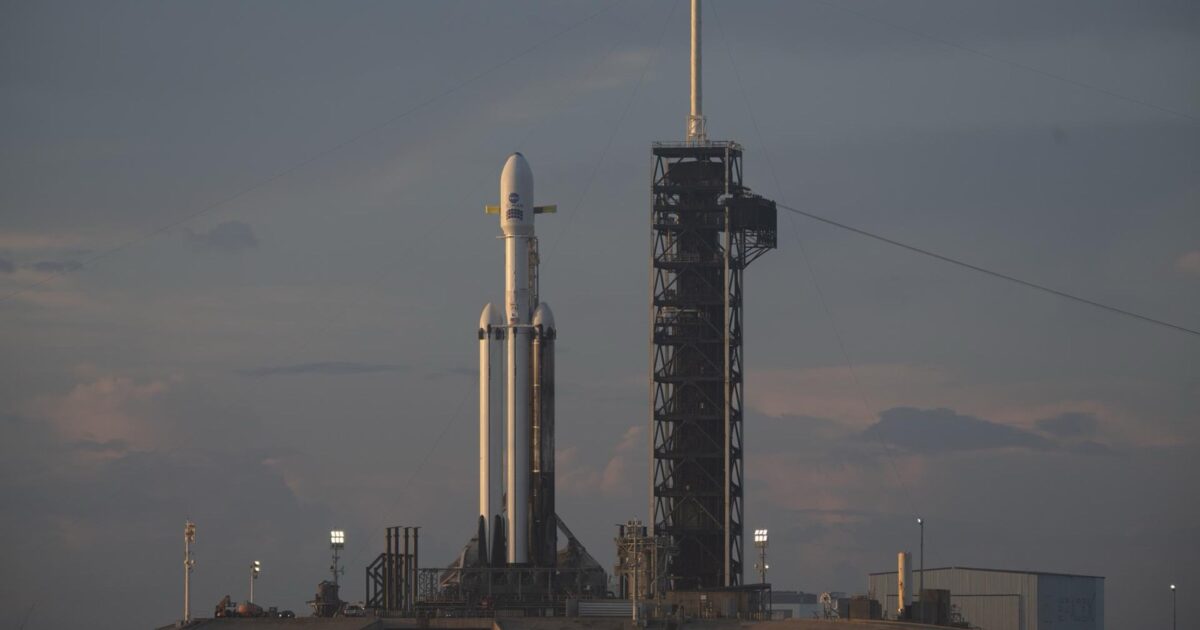
SpaceX has flown Falcon Heavy for America’s spy satellite agency for the first time, and the night ended with two boosters dropping back onto the Florida coast almost in unison.
NROL-97 lifted off from Launch Complex 39A at 11:54 p.m. Eastern Thursday, carrying a classified National Reconnaissance Office payload toward a high-energy orbit.
The payload stayed secret. The rocket did not.
Twenty-seven Merlin engines lit the sky, the center core committed itself to the climb, and the two side boosters came home minutes later.
SpaceX showed Falcon Heavy standing ready at pad 39A less than two hours before launch:
Less than two hours until tonight’s Falcon Heavy launch of NROL-97 from pad 39A in Florida. Liftoff is targeted for 11:53 p.m. ET, and weather is 80% favorable → https://t.co/Lv1aXt0Ywq pic.twitter.com/878GFBxRbR
— SpaceX (@SpaceX) October 2, 2026
SpaceX identified NROL-97 as a Falcon Heavy mission from NASA’s Kennedy Space Center for a classified national-security payload, with coverage beginning shortly before liftoff. The company assigned side boosters B1104 and B1072 to the flight, on their second and fourth missions respectively, while a new B1106 served as the center core.
Those side boosters were already proven hardware. Between them, they had supported GOES-U, Viasat-3 F3 and NASA’s Nancy Grace Roman Space Telescope.
The mission plan called for both to separate, reverse course and return to Landing Zones 1 and 2 at Cape Canaveral Space Force Station.
The center core had a different job. It was expended so Falcon Heavy could devote more performance to the classified payload’s high-energy destination.
The launch was Falcon Heavy’s 14th flight and its third of 2026. For a rocket that once went years between missions, that cadence is becoming a story of its own.
The official mission page set liftoff for 11:53 p.m. Eastern, and the rocket cleared the tower one minute later. SpaceX ended its public coverage before the classified upper-stage work was complete.
Spaceflight Now reports that NROL-97 was the National Reconnaissance Office’s first payload on Falcon Heavy after 22 NRO launches aboard Falcon 9. It was also the agency’s first mission procured through the National Security Space Launch Phase 3 Lane 2 contract awarded in 2025.
That makes the flight more than another classified launch. It brings SpaceX’s heavy-lift vehicle into a new part of the national-security manifest, where the payloads are demanding, the schedules matter and mission details often disappear behind the fairing.
The report confirms that both side boosters completed their landings. Their return produced the familiar twin sonic booms and put Landing Zone 1 back to work after more than a year away from Falcon operations.
NROL-97 also closed an extraordinary day for SpaceX. Crew-13 launched from Florida in the morning, Transporter-18 followed from California, and Falcon Heavy capped the sequence late at night.
Across those three missions, SpaceX landed four boosters in one day for the first time.
Then Falcon Heavy delivered the moment everyone along the Space Coast had been waiting to see:
Falcon Heavy launches NROL-97 from pad 39A in Florida pic.twitter.com/LQxZZzTneI
— SpaceX (@SpaceX) October 2, 2026
AstroSpace reports that the mission reused more than its side boosters. The two payload-fairing halves had previously protected NROL-95 during a July launch, extending SpaceX’s recovery model to hardware flying sensitive government payloads.
The side boosters’ turnaround was even more striking. B1104 and B1072 had launched NASA’s Roman Space Telescope only about 33 days earlier, then returned to the same Falcon Heavy configuration for NROL-97.
That was the shortest interval yet between Falcon Heavy flights and the fastest reuse of the rocket’s side boosters. It is the kind of quiet operational improvement that can matter as much as a new performance record: heavy-lift missions become easier to schedule when the hardware can be inspected, prepared and flown again in weeks instead of months.
The center core was never meant to come back. Sending it farther and faster gave the upper stage the energy needed for the mission profile, while thermal protection on the second stage pointed to an extended flight after the public webcast ended.
Because NROL-97 is classified, neither the payload’s identity nor the final deployment sequence was made public. A successful liftoff and booster recovery do not reveal what went inside the fairing, and they should not be stretched into claims the NRO has not made.
What the public could see was still remarkable.
Falcon Heavy rose from the same pad that sent Apollo astronauts to the Moon. Minutes later, two-thirds of its first stage came back to Florida side by side, ready to enter the recovery cycle again.
The secret was on top. The progress underneath it was impossible to hide.
Join the conversation!
Please share your thoughts about this article below. We value your opinions, and would love to see you add to the discussion!