

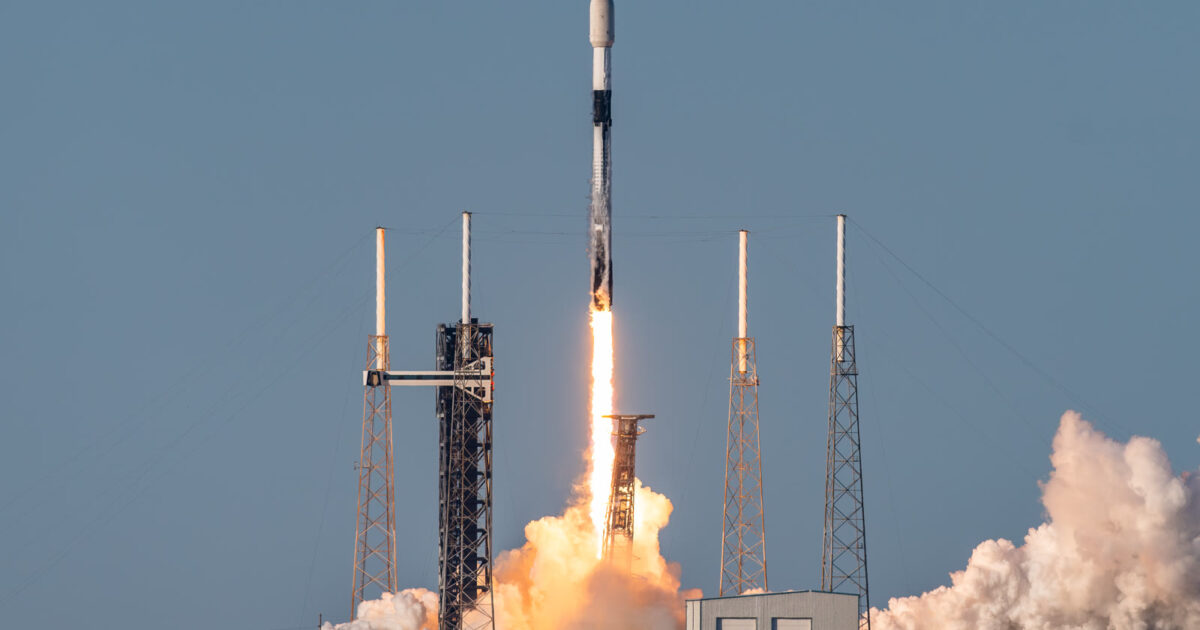
SpaceX pulled off a clean early-morning mission from Cape Canaveral on Wednesday—and the payload was anything but ordinary.
Falcon 9 carried three enormous BlueBird communications satellites into orbit for AST SpaceMobile. The rocket’s first stage then came home to a droneship after completing its 30th flight.
BlueBird 11, 12, and 13 are built to deliver high-speed cellular broadband directly to everyday smartphones.
No satellite dish. No special handset.
SpaceX shared a striking look at Falcon 9 climbing away from pad 40 in Florida:
Falcon 9 launches from pad 40 in Florida pic.twitter.com/kmjCBMVd9Z
— SpaceX (@SpaceX) August 5, 2026
SpaceX says the mission lifted off at 3:49 a.m. Eastern from Space Launch Complex 40 at Cape Canaveral Space Force Station. After stage separation, the first stage landed on the A Shortfall of Gravitas droneship in the Atlantic.
This was the booster’s 30th flight. Its history includes Crew-5, GPS III Space Vehicle 06, Inmarsat I-6 F2, CRS-28, Intelsat G-37, NG-20, TD7, 21 Starlink missions—and the June launch of BlueBird 8, 9, and 10.
That last entry makes Wednesday’s mission especially satisfying. The same first stage that carried AST SpaceMobile’s previous three satellites returned to launch the next three less than two months later.
The upper stage performed a second engine burn before beginning a carefully timed deployment sequence. BlueBird 13 separated at 53 minutes and 45 seconds after liftoff, BlueBird 12 followed at 59 minutes and 5 seconds, and BlueBird 11 deployed at 1 hour, 4 minutes and 25 seconds.
Three heavy spacecraft, three clean separations, and another booster recovery. That is Falcon 9 doing exactly what it was built to do.
The BlueBirds themselves are remarkable machines.
AST SpaceMobile describes each next-generation satellite as carrying a phased-array antenna spanning nearly 2,400 square feet. That is more than three times the 693-square-foot array used by the company’s first-generation BlueBird satellites.
The company says each satellite is designed for peak speeds above 150 Mbps per coverage cell, with more than 2,000 active cells operating at once. The goal is real broadband—calls, streaming, apps, and data—delivered from low Earth orbit to the same phones people already carry.
That scale is the key. A satellite link that works only for emergency texts is useful.
A network capable of supporting normal high-speed phone service across areas where towers do not reach could change the map for rural communities, travelers, disaster zones, ships, and remote work.
Wednesday’s launch does not mean those three satellites are instantly ready for commercial service. They still have to complete orbital checkout, deploy their huge arrays, and move into position before adding operational capacity.
But getting them safely off the rocket is the first big step, and SpaceX confirmed that all three reached that milestone:
Deployment of all three BlueBird satellites confirmed
— SpaceX (@SpaceX) August 5, 2026
The mission also shows how quickly commercial space infrastructure is maturing.
Falcon 9 no longer has to prove that a booster can fly again. This one has now done it 30 times, carrying crew, government payloads, communications satellites, cargo missions, and a long list of Starlink flights along the way.
That kind of reuse gives companies like AST SpaceMobile something they badly need: a launch vehicle with a deep track record and enough cadence to keep a constellation buildout moving.
SpaceX can launch a communications network that competes with Starlink and keep both businesses moving. Falcon 9 serves the wider orbital economy while Starlink expands on its own track.
BlueBird and Starlink use different architectures and business models, but both point toward the same future: the dead zone is becoming a solvable engineering problem.
Wednesday morning’s flight put three more giant antennas in orbit and returned a veteran booster to sea one more time.
That is a serious win for AST SpaceMobile—and another reminder that Falcon 9 has turned extraordinary launches into a working rhythm.
Join the conversation!
Please share your thoughts about this article below. We value your opinions, and would love to see you add to the discussion!