

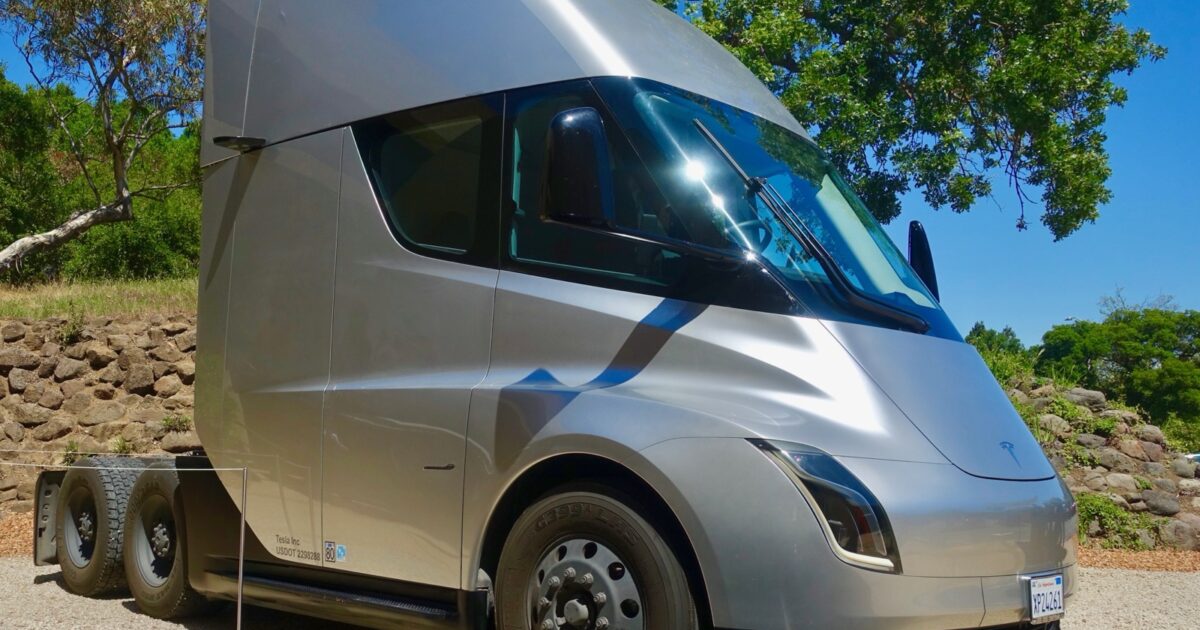
Tesla’s Semi expansion in Europe is starting to look less like a distant plan and more like a real commercial rollout.
Jean-William Dubal says he has joined Tesla as a Business Development Manager to support the all-electric Class 8 truck’s launch in France. Tesla’s own careers inventory backs up the move with full-time Semi business-development openings tied to three French locations.
Tesla has hired a Business Development Manager for the Tesla Semi's entry to France.
Jean-William Dubal said he has joined Tesla as Business Development Manager to support the launch of the all-electric Class 8 truck in the French market.
Jean: "I am delighted to continue the…
— Sawyer Merritt (@SawyerMerritt) August 4, 2026
The important part is not the job title by itself. It is what Tesla is asking the role to do: build fleet relationships, develop customer opportunities and expand Semi deployments in a major European trucking market.
Tesla lists the role in Dardilly, Saint-Ouen-sur-Seine and Aix-en-Provence under Operations & Business Support. The description centers on turning customer needs into deployments, which means fleet economics, charging plans and operational requirements have to be worked through before trucks begin arriving at scale.
That is commercial groundwork, not a French delivery-date announcement. Tesla still has to move from U.S. production and pilot fleets into a European launch shaped by local customers, infrastructure and regulatory requirements.
France is not an isolated dot on the map. Tesla has also been building a Semi business-development presence near Munich, giving the company visible customer-facing work in two of Europe’s biggest freight markets.
So we've got Germany ✔️ and France ✔ for confirmed Tesla Semi team movement.
Great to see them laying the European entry groundwork, and thanks for sharing our EVwire article, Sawyer! 🤜⚡️🤛
— Jaan of EVwire.com ⚡ (@TheEVuniverse) August 4, 2026
That two-country pattern matters. A heavy truck does not enter a market the way a passenger car does.
Operators need charging sites, route models, payload assumptions, maintenance plans and confidence that the vehicle can fit the work they already do.
Tesla said in its Q1 2026 update that Semi remained on schedule for volume production beginning in 2026, alongside Cybercab and Megapack 3. Its manufacturing table listed the Nevada Semi operation as pilot production.
The report did not assign an installed annual capacity to Semi, and Tesla cautioned that installed capacity is not the same as current output. Its table places the program in Nevada, separate from Tesla’s passenger-vehicle factories in California, Texas, Berlin and Shanghai.
That makes the new commercial hires part of a buildout still moving from early production toward wider customer scale. The France team is forming while the manufacturing side remains concentrated in the United States.
It also keeps the timeline honest: a company-wide 2026 production target is not the same thing as a confirmed date for French deliveries.
The truck itself gives Dubal and the European team a sharp pitch. Tesla lists an estimated 500 miles of range, energy use of 1.7 kWh per mile and 1.2-megawatt charging capability.
Tesla says a Semi Charger can recover up to 60 percent of range in 30 minutes. It also argues that electric energy, remote diagnostics, over-the-air updates and a simpler powertrain can cut operating and maintenance costs for fleets.
Those numbers are compelling on a product page. The France team now has to turn them into actual fleet cases: which routes fit first, where chargers can be built, how much downtime is avoided and when the operating savings justify replacing a diesel truck.
That is why this hire feels bigger than another name on Tesla’s payroll. It puts a dedicated person on the ground to connect the Semi program with French operators while the production side ramps in Nevada.
There is still no confirmed date for customer deliveries in France. But with France joining Germany in Tesla’s visible European commercial buildout, the Semi’s next chapter is beginning to take shape—and it is no longer confined to American highways.
Join the conversation!
Please share your thoughts about this article below. We value your opinions, and would love to see you add to the discussion!