

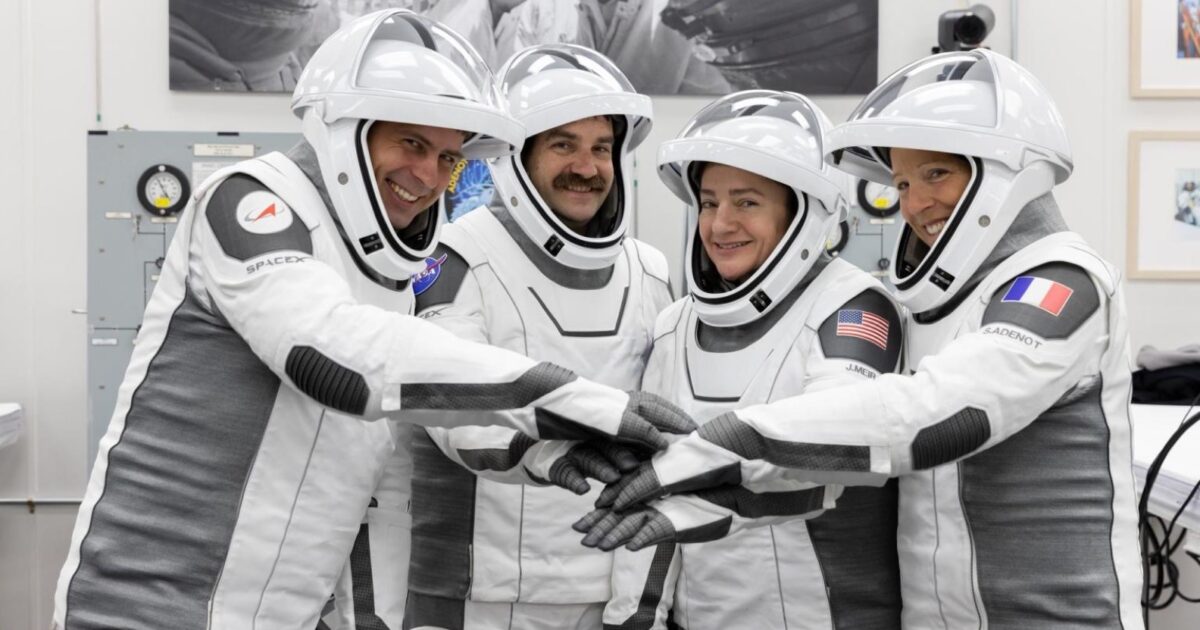
SpaceX Crew-12 is packing for home with more than personal gear aboard Dragon.
The four astronauts are finishing a mission that tested whether crews can print metal parts, make intravenous fluid, grow useful tissue and study dangerous microbes while living hundreds of miles above Earth.
Now Crew-13 is aboard the International Space Station, the handover is underway, and Crew-12 could begin its return as early as Monday if the weather cooperates.
The arrival that opened the door for that return began with SpaceX sending Crew-13 toward the station on October 1:
Liftoff!
The four astronauts of NASA’s @SpaceX Crew-13 mission are launching to the @Space_Station to perform research, technology demonstrations, and maintenance aboard the orbiting laboratory. pic.twitter.com/Du1IVmYEET
— NASA (@NASA) October 1, 2026
The handover is real, but the return date still depends on weather.
In its station update, NASA says the new arrivals lifted the station population to 11 and began the short overlap between the two crews. Crew-13 spent Saturday unpacking Dragon, moving safety equipment and reviewing emergency roles.
Crew-12 has been packing cargo, configuring its Dragon and checking pressure suits for the ride back. Commander Jessica Meir is also scheduled to hand station command to cosmonaut Pyotr Dubrov during Sunday’s farewell ceremony.
NASA and SpaceX are watching conditions at the California splashdown sites. The agency says Meir, Jack Hathaway, Sophie Adenot and Andrey Fedyaev could start home as early as October 5, but only after the weekend weather reviews support it.
That is the immediate mission picture: the replacement crew is aboard, Dragon is being prepared, and the calendar is now controlled by recovery weather rather than launch readiness.
A machine shop in orbit.
In its Crew-12 science roundup, NASA shows how practical much of the work became. Adenot installed a metal 3D printer that has already produced small parts in microgravity.
Those parts return to Earth for comparison with components made on the ground.
If engineers can prove that parts printed in orbit perform as intended, future crews would not need to launch every replacement item in advance. That changes the logistics of long missions, where one failed component can be a much bigger problem than it is on Earth.
The crew also tested a system for making IV fluid on demand. Commercial IV supplies expire after roughly 16 months, and hauling large stocks takes mass and storage space.
A reliable way to make medical fluid during a mission could matter far from Earth and in remote emergencies here at home.
Neither experiment is science fiction dressed up for a press release. They attack two unglamorous constraints that become brutal in deep space: spare parts run out, and medical supplies age.
Cartilage, stem cells and microbes.
The medical work went well beyond emergency supplies. Meir worked with engineered cartilage tissue grown in microgravity, research that could help produce implants resembling natural cartilage without taking healthy tissue from another part of a patient’s body.
Another investigation used microgravity to expand clinical-grade stem cells while preserving their ability to become other cell types. NASA says those cells could eventually help rebuild blood and immune systems after chemotherapy.
Hathaway also handled equipment that sequences DNA from antibiotic-resistant bacteria in orbit. A spacecraft is a closed environment, so learning how hard-to-kill microbes adapt there is both a crew-safety problem and a useful window into resistance on Earth.
Other Crew-12 work ranged from pharmaceutical crystal growth and bone-marrow analogs to a Cold Atom Lab upgrade that gives scientists more ultracold atoms to study. The results stretch from cancer therapies and osteoporosis research to quantum technologies used in electronics and solar cells.
Why Crew-12 matters to SpaceX.
The official mission record from NASA identifies this as the 12th operational crew rotation flown by SpaceX and the 13th Dragon flight with astronauts under the Commercial Crew Program, counting Demo-2.
That repetition is the point. Dragon is no longer just proving it can move people to and from the station.
It is carrying the crews who turn the ISS into a test bed for medicine, manufacturing and the systems needed to live farther from Earth.
Crew-12’s ride home will close one rotation, but the mission’s most interesting cargo is the knowledge coming back with it. Metal parts, tissue samples and experiment data may not look as dramatic as a Falcon 9 launch, yet they are exactly what makes the next launch more useful.
Join the conversation!
Please share your thoughts about this article below. We value your opinions, and would love to see you add to the discussion!