
Tesla has stretched its Austin Robotaxi operating day by one hour, and Elon Musk gave a remarkably specific reason the service is not yet running deeper into the night.
The new closing time is 11 p.m. The edge case Tesla is working to solve is a small animal with almost no visual contrast against the road: in Musk’s example, a grey kitten on grey pavement after dark.
That sounds almost comically specific. It is also the kind of problem that separates an impressive driver-assistance demo from a system trusted to carry passengers without a driver.
Tesla’s Robotaxi account announced the new Austin hours Saturday:
Robotaxi in Austin now available until 11pm
— Robotaxi (@robotaxi) October 3, 2026
One extra hour is measurable progress. It is not round-the-clock service, and Tesla did not announce a date for that larger step.
Musk soon supplied the engineering reason behind the cautious expansion:
Robotaxi operating hours moved from 10pm to 11pm.
The main thing we’re trying to solve is making sure that we don’t run over pets when they’re hard to see at night. Literally trying to avoid grey kittens on grey tarmac in the dark. https://t.co/y4HSVILLqd
— Elon Musk (@elonmusk) October 3, 2026
That is a brutal perception test. A camera has to extract the animal’s shape from a scene where the subject, road and available light are all working against it, then the driving system must classify the risk and respond soon enough to stop safely.
The kitten is the memorable example, but the engineering problem is broader. A dark object on dark pavement could be debris, an animal or something else that cannot be dismissed just because it occupies only a small part of the frame.
Not a Tesla App connects Musk’s post to Tesla’s next autonomy push. The outlet reports that FSD v15 is expected to reach Robotaxi vehicles first and that Tesla AI leadership has discussed using the new system to expand toward 24-hour commercial service.
Its report describes v15 as a major expansion of the neural network, from roughly one billion parameters to about 10 billion. The larger model is supposed to give Tesla more capacity for difficult driving cases before it reaches customer vehicles.
But Saturday’s post did not promise that v15 will immediately unlock overnight operation. The useful signal is more concrete: Tesla added one hour now while publicly identifying the safety case it is still trying to harden.
Tesla explains the scale of the camera pipeline in its FSD safety report. The company says eight exterior cameras provide a 360-degree view and feed more than one million pixels of visual data into the system every millisecond.
The page describes FSD Supervised as an assistance system that can drive almost anywhere but still requires active human supervision. That distinction matters because a customer can intervene in a privately owned Tesla, while a driverless Robotaxi has to resolve the same scene without that fallback.
Tesla’s Cybercab FAQ carries the approach into the purpose-built taxi. It says Cybercab uses camera vision and sensors to navigate city streets, highways, complicated intersections and parking lots, with no steering wheel available for a passenger to take over.
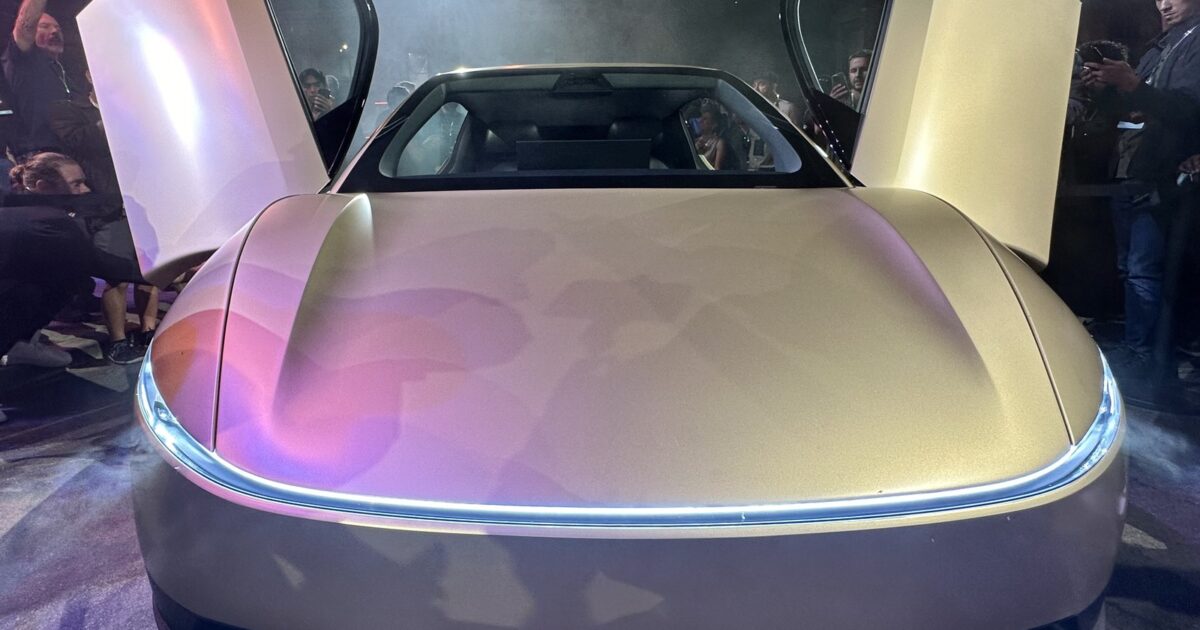
The Cybercab page also distinguishes the golden two-seat vehicle from the Model Y cars in Tesla’s Robotaxi fleet and directs riders to the Robotaxi account for operating updates. Saturday’s one-hour expansion puts a concrete operating change next to those technical claims.
That absence of passenger controls raises the bar. A driverless Robotaxi has to detect the grey kitten itself, make the right decision and do it consistently enough that Tesla is willing to keep the fleet operating.
Electrek supplies the skeptical side of the sensor argument. It notes that passive cameras depend on available light and contrast, while lidar sends out laser pulses to measure shapes and distance and radar continues working through conditions that can frustrate vision.
The outlet also points out that Austin Robotaxi accepted rides until midnight when it launched in June 2025. The new 11 p.m. cutoff therefore adds an hour to Tesla’s immediate schedule but remains one hour short of the service’s original closing time.
Electrek treats that history as evidence that Tesla’s vision-first bet is holding the service back. Tesla’s counterargument has always been that neural networks can pull more usable information from ordinary cameras as the software, compute and training data improve.
Saturday’s update does not settle that fight. It does show Tesla applying a harder standard than merely proving the car can drive after sunset.
The real test is whether Robotaxi hours keep moving. If 11 p.m. becomes midnight and then overnight service without a retreat in safety, Tesla will have evidence that its software is closing the low-light gap.
For now, the company has one more hour on the board and one tiny, difficult target in its sights: seeing the grey kitten soon enough to leave it safely on the road.
Join the conversation!
Please share your thoughts about this article below. We value your opinions, and would love to see you add to the discussion!