

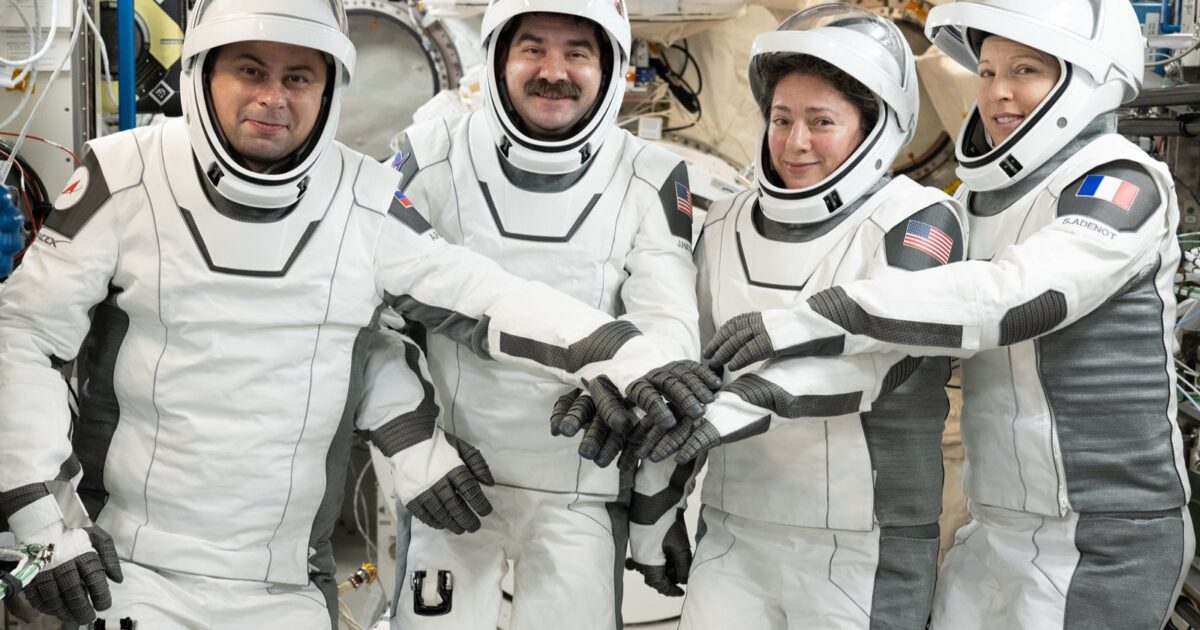
After nearly eight months in orbit, the four members of SpaceX Crew-12 are finally at the front door.
NASA and SpaceX are targeting 7:05 a.m. Central this morning for Dragon to undock from the International Space Station, beginning a weather-dependent trip toward a Thursday splashdown off California.
SpaceX put the departure in plain language Tuesday: Dragon and its astronauts are set to leave the station Wednesday.
Dragon and the Crew-12 astronauts are set to depart the @Space_Station on Wednesday, October 7 → https://t.co/8iEjkuIsDH pic.twitter.com/DjagDcIS2A
— SpaceX (@SpaceX) October 6, 2026
The crew coming home is an international one: NASA astronauts Jessica Meir and Jack Hathaway, European Space Agency astronaut Sophie Adenot, and Roscosmos cosmonaut Andrey Fedyaev.
Meir commands Dragon. Hathaway is the pilot, with Adenot and Fedyaev riding as mission specialists.
NASA says hatch-closure coverage began at 5 a.m. Central, with undocking coverage scheduled for 6:45 a.m. and separation targeted 20 minutes later.
If the schedule holds, Dragon will spend more than a day flying home before a planned 10:34 a.m. Central splashdown Thursday in the Pacific Ocean off California.
After undocking coverage ends, NASA plans to carry the communications between Crew-12, the station and flight controllers as audio. Thursday’s return broadcast is scheduled to begin at 9:20 a.m. Central, followed by the deorbit burn at 9:46 a.m.
Every one of those times remains conditional. Mission managers are watching Dragon’s readiness, the recovery team, and the weather and sea state in the landing area.
That is why “no earlier than” matters. A crewed return does not leave the station simply because a clock reaches zero.
The spacecraft and the people waiting in the Pacific both need a safe path through the same timeline.
NASA’s Crew Launch and Return Operations guide shows how much work sits behind a Dragon splashdown. Teams compare California sites near Los Angeles, Oceanside and San Diego, looking for the best mix of favorable weather, short travel time and, when possible, daylight.
General limits include winds no higher than roughly 10 to 12 knots, manageable waves, acceptable lightning and rain risk, and conditions that allow recovery helicopters to operate. Mission control continues taking go-or-no-go decisions after undocking and before Dragon commits to its deorbit burn.
NASA, SpaceX, the FAA and the Coast Guard also establish a 10-nautical-mile safety zone around the primary landing area. Two fast boats reach Dragon first: one checks the capsule and tests for hazardous propellant vapors, while the other secures and retrieves the parachutes.
Only then does the main recovery ship hoist Dragon onto its deck, open the hatch and begin the crew’s first medical checks back under Earth’s gravity.
Crew-12 launched February 13. Nearly eight months later, the flight has become much more than another entry in Dragon’s mission log.
NASA’s Crew-12 science recap traces work across medicine, materials and deep-space preparation. The crew supported studies involving cancer-targeting treatments, bone loss and regeneration, antibiotic-resistant bacteria, clinical-grade stem cells and the production of IV fluid in microgravity.
The common thread is using the station’s unusual environment to solve practical health and manufacturing problems before longer missions travel farther from Earth.
The IV-fluid experiment addresses a wonderfully practical problem. Premade fluid expires, takes up room and adds launch mass.
A system that can produce it on demand could help on long missions and in remote emergencies on Earth. NASA says the approach could provide a critical medical resource when resupply is limited while reducing the weight and space consumed by premade fluid.
The stem-cell work uses microgravity to explore whether researchers can produce larger quantities of cells while preserving their ability to become other cell types. Other investigations examined bone-marrow-like structures, cartilage, soft materials and metal printing.
Adenot also worked with a wood-based scaffold designed to imitate the structure of bone and support new cell growth. Meir helped study suspended particles whose behavior could improve pharmaceuticals, plant growth and 3D-printing materials.
Meir captured the human side of those final days in a short view from the station’s cupola.
Human reflections in the cupola. pic.twitter.com/X0155oFrdf
— Jessica Meir (@Astro_Jessica) October 5, 2026
The video needs no sales pitch. It is a quiet reminder of what this crew is leaving behind: one of the rarest views any human being can see with his or her own eyes.
Dragon still has work to do before Crew-12 is home. It has to separate cleanly, fly the departure sequence, hold the return timeline, execute the deorbit burn, survive reentry and place four parachutes over the right stretch of Pacific.
SpaceX has turned that chain of events into an increasingly familiar operation. Familiar is not the same thing as easy.
If weather and hardware cooperate, Crew-12’s long mission begins its last leg at 7:05 this morning. The next stop is Earth.
Join the conversation!
Please share your thoughts about this article below. We value your opinions, and would love to see you add to the discussion!