
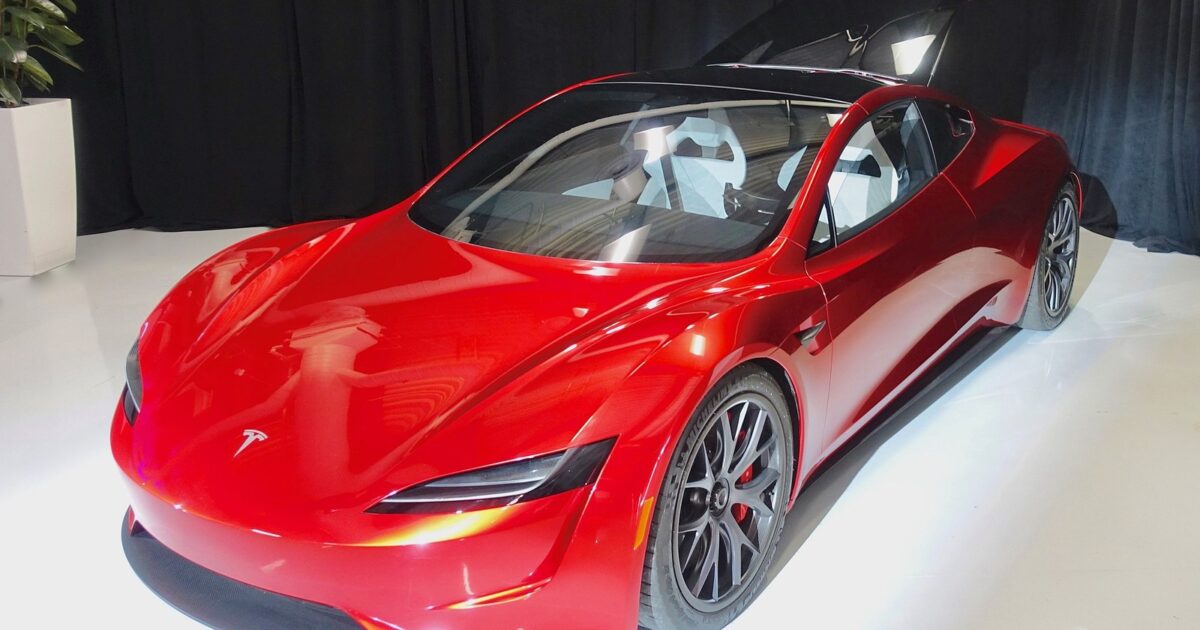
Tesla’s next Roadster reveal may finally be close—and the reported plan sounds more like a SpaceX test than a normal car unveiling.
A new report says Tesla could show a radically redesigned Roadster as early as this month at SpaceX’s test site in McGregor, Texas.
The headline act would be a limited version fitted with cold-gas thrusters. Because of the force and noise involved, the demonstration car could be operated remotely with no driver inside.
That is an extraordinary claim. It is also still a reported plan, not a public event announcement from Tesla.
TESLA PLANS NEW ROADSTER UNVEILING WITH A ‘FLYING’ STUNT AS EARLY AS THIS MONTH. – THE INFORMATION
— First Squawk (@FirstSquawk) August 14, 2026
Auto Helpers reported Friday that the second-generation Roadster could appear in August with flight capability built around SpaceX-developed hardware. The reported demonstration would use a remotely controlled vehicle because putting a driver inside would add risk without proving anything about the thruster system itself.
The report describes two Roadster paths: a limited SpaceX-branded machine with the thrusters and a standard version intended to be far closer to a normal road car. They may share a basic shape, but the extreme demonstration car is not expected to establish that ordinary customers will be allowed to drive rocket-assisted Roadsters on public streets.
McGregor would be a revealing venue. SpaceX uses the Central Texas site to test rocket engines and propulsion hardware far from ordinary traffic, crowds and city noise limits.
A thruster test belongs on a controlled range, not between velvet ropes at a showroom event.
If Tesla truly intends to lift a car with compressed-gas thrust, the company needs distance, control and a place built for violent machinery. McGregor checks those boxes.
Musk added fresh fuel to the idea just two days before Friday’s report.
You will get flying cars
— Elon Musk (@elonmusk) August 12, 2026
His new message was only five words and did not name Tesla or the Roadster. The timing still matters because the Roadster is the vehicle Musk has repeatedly tied to hovering or short-flight capability.
Musk first outlined the engineering concept in 2018: roughly ten small thrusters arranged around the car to improve acceleration, braking, cornering and top speed, with the possibility of flight thrown in at the end.
The Information reported in June that Tesla had pushed the public demonstration to August or later while the company and SpaceX continued work on the cold-gas system, known internally as A71. Tesla and SpaceX employees had reportedly shown Musk an early version in April.
That earlier account also described a limited SpaceX edition alongside a scaled-down Roadster. Friday’s report adds sharper edges to that picture: a specific SpaceX test site, remote operation and a demonstration dramatic enough to require real separation from an audience.
Those details explain why Tesla may be preparing something memorable. They do not tell buyers when a finished car will reach them.
The Roadster has lived in that gap for almost nine years.
Tesla unveiled the second-generation prototype in 2017 and originally targeted deliveries for 2020. That date passed, followed by more timelines, more redesign talk and more promises that a demonstration was close.
Associated Press reported after Tesla’s April earnings call that Musk again said the Roadster could debut in roughly a month. He also cast it as the lone manually driven car in Tesla’s long-term lineup while Cybercab and other future vehicles move toward autonomy.
That remark came as Tesla described a business moving hard toward machines that do the driving themselves. Robotaxi miles had doubled from the prior quarter, the company said, and Tesla had begun making Cybercabs without traditional driver controls.
Against that backdrop, Musk singled out the Roadster as the car that would preserve the act of driving.
The timing matters too. April’s “month or so” estimate passed without an unveiling, adding another missed marker to a program that was already years late.
An August event would therefore be more than a product update; it would be the first concrete chance to see whether the latest redesign has moved beyond internal demonstrations.
That makes the Roadster more than a low-volume halo car. It is Tesla’s argument that driving can still be the point—even as the rest of the company tries to remove the driver.
The official numbers remain enormous.
Tesla still advertises a 1.9-second run from zero to 60 mph, a top speed above 250 mph and 620 miles of range. The page also describes four seats and a removable glass roof, and it continues to accept interest in the car.
The official pitch is still built around a car that can set performance records without giving up everyday-car ideas entirely. Tesla describes an aerodynamic electric supercar with seating for four and a lightweight roof that stores in the trunk, not a stripped competition shell built only for one dramatic run.
What the official page does not provide is just as important. It does not confirm an August event, the McGregor venue, a final price, production specifications or how a thruster-equipped version would be sold and regulated.
A remote-controlled test vehicle lifting off the ground would be a spectacular engineering demonstration. It would not be the same thing as a customer-ready Roadster.
Tesla now has a chance to close that distance.
If the report is right, August could finally bring the redesigned car into view. Then Tesla will face the question that has followed the Roadster since 2017: when does the spectacle become a real product?
Join the conversation!
Please share your thoughts about this article below. We value your opinions, and would love to see you add to the discussion!