
Tesla has cleared a major regulatory hurdle in Las Vegas—but Nevada is making the company start small.
The Nevada Transportation Authority granted Tesla a commercial robotaxi permit for the Las Vegas Strip corridor. Tesla asked for authority covering as many as 5,000 vehicles in the first year.
The opening fleet will be capped at 10.
That is a dramatic haircut from the application, but it is not a rejection. Tesla now has permission to carry paying passengers in fully autonomous vehicles under a tightly controlled first phase.
The permit turns Las Vegas from a dot on Tesla’s expansion map into an approved operating market.
Nevada Transportation Authority records show Tesla Robotaxi, LLC received Autonomous Vehicle Network Company Permit 002 on July 27 after complying with the state’s earlier June 25 order. Service is limited to an approved operational design domain and geofence inside the Las Vegas Strip corridor, and Tesla must seek approval before expanding the fleet, map or operating parameters.
The order bars passenger service on roads posted above 45 mph. Every vehicle must be clearly marked “Robotaxi,” and passengers must be told before each trip that a driverless autonomous vehicle will provide the ride.
The state also requires “appropriate human supervision.” The order leaves the supervision method undefined.
Tesla must still maintain human oversight around the fleet rather than deploy 10 cars without operational support.
Nevada can suspend or revoke the permit if Tesla violates the Authority’s rules, the order’s conditions or the state’s autonomous-vehicle laws.
Tesla’s public message on Friday centered on the supervised version of its driving system currently available to owners.
Tesla owners share why they love FSD Supervised
Come try it https://t.co/239J4ZY8ZE pic.twitter.com/FlRIl3MQ6g
— Tesla (@Tesla) August 14, 2026
FSD Supervised in a customer car still requires an attentive driver.
Nevada’s new permit covers commercial rides in fully autonomous vehicles while adding operational limits and human oversight around the service.
The state is treating the first 10 vehicles as a controlled opening, not blanket approval for Tesla’s maximum ambition.
Axios reported Friday that Tesla had sought permission to deploy up to 5,000 robotaxis across Clark County. The granted permit confines the initial service to the Strip corridor and leaves any fleet expansion in the hands of state regulators.
The report also highlighted one of the most practical limits: Tesla cannot pick up passengers at Harry Reid International Airport. The official order prohibits pickups at or within one-quarter mile of the airport unless the airport operator and every required government authority separately approve them.
That matters in Las Vegas. Airport runs are among the most valuable trips in a tourism market, and roads around the airport and beyond the Strip are essential to building a full citywide network.
For now, Tesla gets a showcase corridor instead of a 5,000-car footprint.
The permit also imposes a five-working-day reporting deadline for accidents, security incidents, system failures, communication or data interruptions, and any event that leaves a Robotaxi disabled on a Nevada road.
Those conditions give the state a close look at how the service behaves before regulators consider a larger geofence or fleet.
Elon Musk shared a fresh clip Thursday showing a Tesla navigating a difficult real-world traffic moment.
Tesla self-driving is amazing pic.twitter.com/Tgc6Q7rABA
— Elon Musk (@elonmusk) August 13, 2026
The video did not come from a Nevada robotaxi, and it should not be mistaken for proof of the new service. It does show why Tesla believes its camera-based driving stack can scale into a much larger network.
The Las Vegas permit is where that confidence meets a regulator’s demand for evidence.
Tesla listed Las Vegas as a market in preparation in its first-quarter 2026 update. The company said it was laying the groundwork through testing and permitting so new cities could launch when Tesla was ready, while emphasizing that safety remained its top priority.
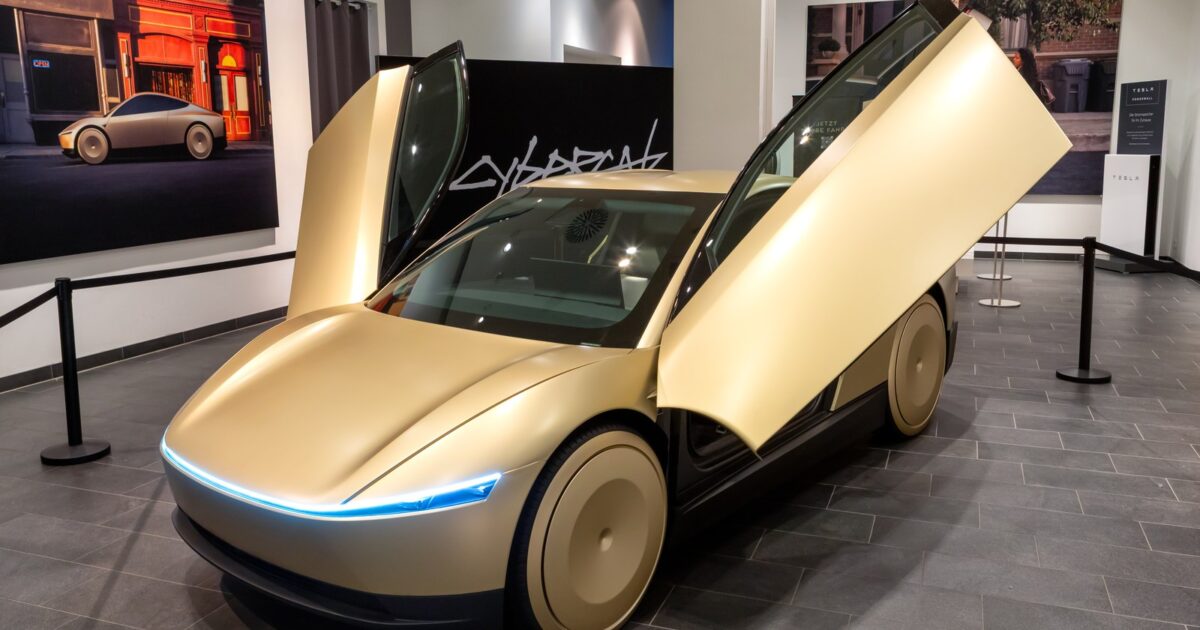
The same update said paid Robotaxi miles had nearly doubled from the previous quarter. Tesla also expects Cybercab to replace the Model Y vehicles now used in the service over time and ultimately become the fleet’s highest-volume vehicle.
That transition creates another regulatory step. Cybercab has no steering wheel or pedals, so Tesla must satisfy the rules governing a purpose-built driverless vehicle as well as the operating rules for the network carrying passengers.
Nevada’s permit gives Tesla a place to begin proving the commercial side.
Ten cars will not transform transportation in Las Vegas. They can, however, establish a safety record, test remote support, expose weak points and give regulators the data they need to decide whether 10 should become 100—or eventually something much closer to the 5,000 Tesla requested.
Tesla did not get the scale it wanted on day one.
It did get a real starting line on the Las Vegas Strip.
Join the conversation!
Please share your thoughts about this article below. We value your opinions, and would love to see you add to the discussion!