

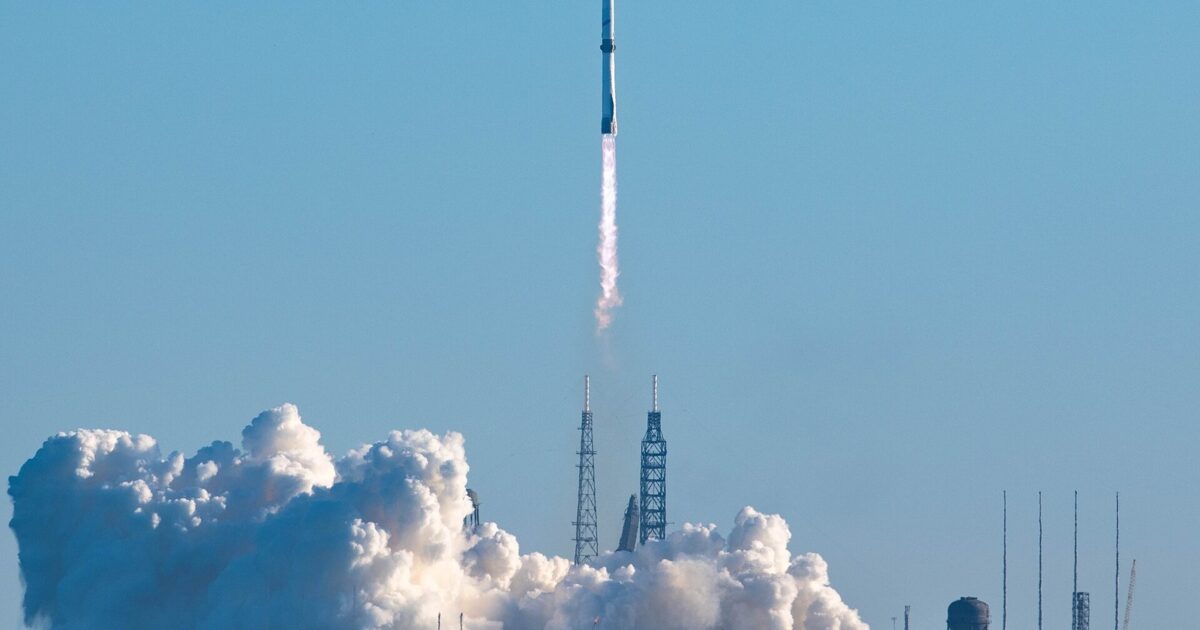
Falcon 9 is still flying at a pace no other rocket can touch. The problem for commercial satellite companies is that they may not be able to buy that ride for much longer.
Fresh industry reporting says SpaceX customers are having trouble securing Falcon 9 missions beyond 2028. One source went further, claiming the company has told the U.S. government that commercial Falcon 9 launches could end after that year while a limited number of federal missions continue.
SpaceX has not publicly confirmed that specific cutoff. The booking crunch is real, the Falcon-to-Starship transition is already public, and satellite operators are staring at a gap that the rest of the launch industry may not be ready to fill.
The anxiety makes sense when Falcon 9 can do this: two launches from opposite coasts in less than 40 minutes, with both first stages recovered.
Teams complete back-to-back Falcon 9 launches from Florida and California pic.twitter.com/6L4dyPAmXz
— SpaceX (@SpaceX) August 16, 2026
Ars Technica reports that commercial operators are struggling to purchase Falcon 9 launches after 2028. The outlet says one source described a plan to preserve a limited number of later Falcon flights for federal customers while commercial missions wind down, although SpaceX has not announced that policy publicly.
The pressure goes well beyond retiring a rocket. SpaceX has more of its own high-value payloads waiting for orbit: larger Starlink spacecraft, direct-to-cell infrastructure, and planned orbital computing hardware.
Every Falcon 9 assigned to an outside customer is a launch SpaceX cannot use for one of those systems.
Starship is supposed to take over much of that work, but timing is everything. If Falcon 9 availability falls before Starship is flying customer payloads frequently—and before competing rockets reach dependable production cadence—the market does not get a clean handoff.
It gets a bottleneck.
SpaceNews documented the warning earlier this summer through interviews with at least nine SpaceX partners and customers. Those companies said SpaceX was not accepting Transporter rideshare reservations beyond late 2028 or early 2029, while the manifest for the next several years was already close to full.
That matters because Transporter changed the economics of small satellites. Instead of buying an entire rocket, customers could purchase a comparatively inexpensive slot on a regularly scheduled Falcon 9.
Manufacturers, brokers, and constellation startups built timelines and business models around that dependable route to orbit. SpaceNews found that some operators were already booking farther ahead and considering larger, more expensive dedicated launches because the familiar rideshare calendar was filling up.
Replacing Transporter requires more than a rocket that can fly once. Customers need a competitive price, schedule certainty, integration capacity, and a launch provider that can do it again and again.
Via Satellite reported in March that SpaceX commercial-sales vice president Stephanie Bednarek described the company’s manifest as packed from 2026 through 2028 and already very busy in 2029. Other providers were adding capacity, but their own projections showed how hard the replacement problem is: Mitsubishi Heavy Industries was targeting eight H3 launches per year by the end of 2028, while several newer U.S. rockets were still working toward first flight or reliable reuse.
Blue Origin’s New Glenn, Rocket Lab’s Neutron, Relativity’s Terran R, Stoke’s Nova, ULA’s Vulcan, and Europe’s Ariane 6 could all benefit from overflowing demand. None has yet demonstrated Falcon 9’s combination of cadence, cost, payload flexibility, and hundreds of successful missions.
That is why a transition measured in corporate planning years can feel uncomfortably short to a satellite operator whose hardware may take years to finance and build.
TIME published the clearest public description of SpaceX’s direction in a March interview with president Gwynne Shotwell. She said Falcon launches would begin to tail off as Starship comes online after a record 165 Falcon missions in 2025 and a planned 140 to 145 in 2026.
Shotwell also explained that SpaceX itself has become its largest launch customer. Starlink created enormous demand for Falcon 9, and the company’s proposed AI satellite network is expected to create the same kind of internal demand for Starship.
Her public timeline did not promise outside customers a particular Falcon 9 end date or a guaranteed Starship replacement date. It did confirm the direction of travel: fewer Falcon missions as SpaceX moves its biggest ambitions and engineering effort to the new vehicle.
The financial incentive is just as clear. Via Satellite’s review of SpaceX’s second-quarter results put total revenue at $7.8 billion, with $4.3 billion coming from connectivity.
Outside launch sales are important to customers, but they are a much smaller piece of SpaceX’s business than the satellite network those launches helped create. Connectivity revenue rose 66 percent from a year earlier as Starlink’s subscriber base doubled, giving SpaceX a powerful reason to prioritize the payloads that feed its own fastest-growing operation.
SpaceX may ultimately move commercial customers to Starship, extend Falcon 9 service when the market demands it, or do some combination of both. The company has not announced which path it will take.
Satellite companies cannot build around a maybe. They need launch contracts years before liftoff, and the calendar is now forcing them to bet on which rocket will actually be ready when Falcon 9 stops being the industry’s automatic answer.
Join the conversation!
Please share your thoughts about this article below. We value your opinions, and would love to see you add to the discussion!