

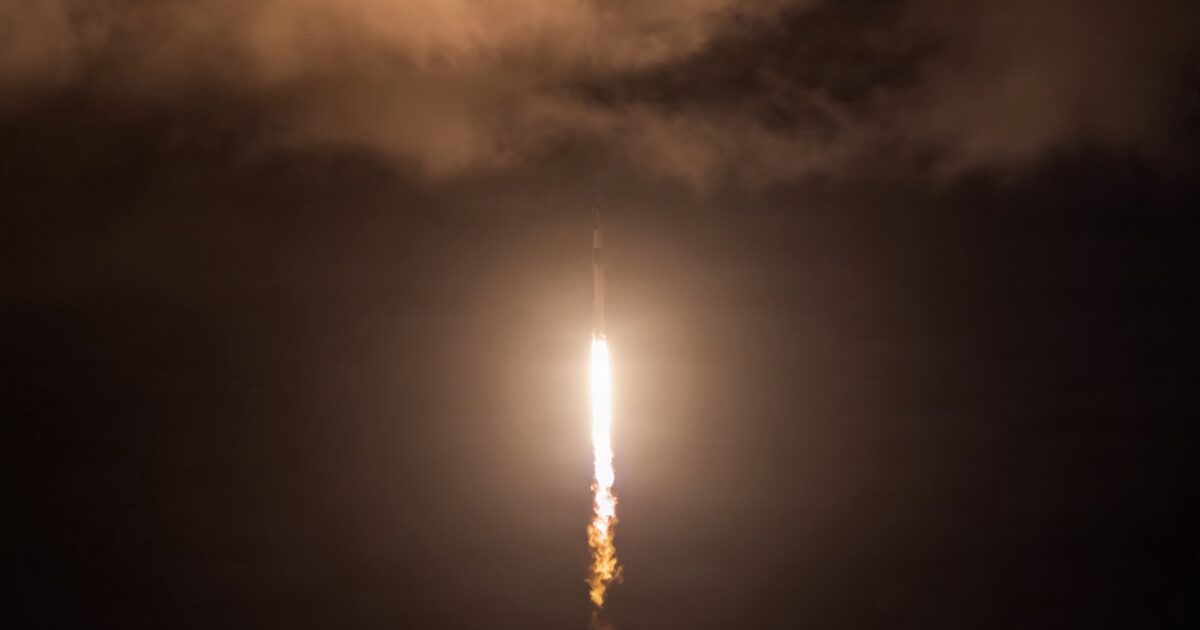
SpaceX is lining up a major number for late Tuesday night: its 100th launch of 2026.
The Starlink 17-50 mission is targeting 10:46 p.m. Central from Vandenberg Space Force Base in California. A Falcon 9 is scheduled to carry 24 more Starlink satellites into low Earth orbit.
That would put SpaceX at 100 launches before August is even over.
The timing can still move, as launch schedules often do. But the rocket, payload and recovery plan are all identified, and the mission tracker has been updated for tonight’s attempt.
SpaceX’s Starlink 17-50 mission page identifies Space Launch Complex 4 East at Vandenberg as the departure point. Liftoff is currently targeted for 03:46:10 UTC on August 19, which is 10:46:10 p.m. Central on August 18.
The payload is a batch of 24 Starlink satellites. After stage separation, the Falcon 9 first stage is expected to return to the Of Course I Still Love You droneship in the Pacific.
Booster B1097 is making its 12th flight. Its résumé already includes Sentinel-6B, Twilight, NROL-172, Transporter-17 and seven Starlink missions.
The mission plan gives the first stage a little more than eight minutes from liftoff to landing. The upper stage then continues alone, coasts for nearly 44 minutes, restarts briefly and releases the satellites about 61 minutes after launch.
That is the SpaceX formula in one vehicle: fly, land, inspect, and fly again.
r/SpaceX’s live launch tracker, which is fed by Launch Library 2 data, marks Starlink 17-50 as SpaceX’s 100th launch of the year if it succeeds. The tracker shows satellite deployment planned a little more than an hour after liftoff, following a second upper-stage burn.
The same tracker lists this as the 53rd launch from Vandenberg’s SLC-4E in 2026 and the 12th flight for B1097. Those numbers make the milestone feel less like a one-night stunt and more like the output of a mature transportation system.
The four-hour launch window runs from 9 p.m. Tuesday to 1 a.m. Wednesday in Central time. SLC-4E is turning around in just over three days after the USSF-366 mission, while B1097 is returning to flight after roughly 43 days.
SpaceX has room inside the window if the opening target slips, but a scrub would move the 100-launch milestone to another night.
SpaceX’s previous commercial Falcon mission ended with all eight Globalstar 2-R satellites safely deployed:
Deployment of all @Globalstar 2-R satellites confirmed pic.twitter.com/w05WLSOyac
— SpaceX (@SpaceX) August 16, 2026
That mission launched from Florida on Saturday night. Just 38 minutes later, another Falcon 9 lifted off from California with the classified USSF-366 mission.
Space.com reports that the coast-to-coast doubleheader set a SpaceX record for the shortest interval between orbital launches, beating its previous mark by 27 minutes. Both first stages landed successfully—one back at Cape Canaveral and the other on a droneship in the Pacific.
The report counted 96 Falcon 9 launches in 2026 after that doubleheader. Roughly three-quarters of those Falcon flights had carried Starlink satellites, showing how closely the rocket’s cadence is tied to the growth of SpaceX’s own broadband network.
Starlink 17-50 is therefore more than a round-number mission. It is another look at the machine SpaceX has built around booster reuse, two-coast launch operations and a satellite factory that keeps supplying payloads.
SpaceX’s June 2026 prospectus says Falcon 9 had completed about 620 orbital launches through March 31 with a mission-success rate above 99%. The company flew Falcon 9 165 times in 2025, including 157 missions on flight-proven boosters.
The filing credits reuse, manufacturing efficiency and higher flight rates with driving down SpaceX’s internal launch costs. It also makes clear that Falcon is not supposed to remain the center of the system forever.
SpaceX expects Falcon 9 volume to decrease over time as Starship takes a larger share of launches. Starship V3 is designed to deliver 100 metric tons to orbit in a fully reusable configuration—far more than Falcon 9 can carry.
For now, Falcon 9 is doing exactly what SpaceX needs it to do: launching often, landing routinely and filling orbit with working hardware.
If tonight’s window holds, the 100th launch of 2026 will arrive on the back of a booster already making its 12th trip. That may be the most SpaceX detail of all.
Join the conversation!
Please share your thoughts about this article below. We value your opinions, and would love to see you add to the discussion!