
Elon Musk just described a future in which every car carries a Starlink connection.
Not a basic emergency link. Not a phone hotspot.
Musk is talking about enough bandwidth to connect billions of vehicles directly through SpaceX’s satellite network.
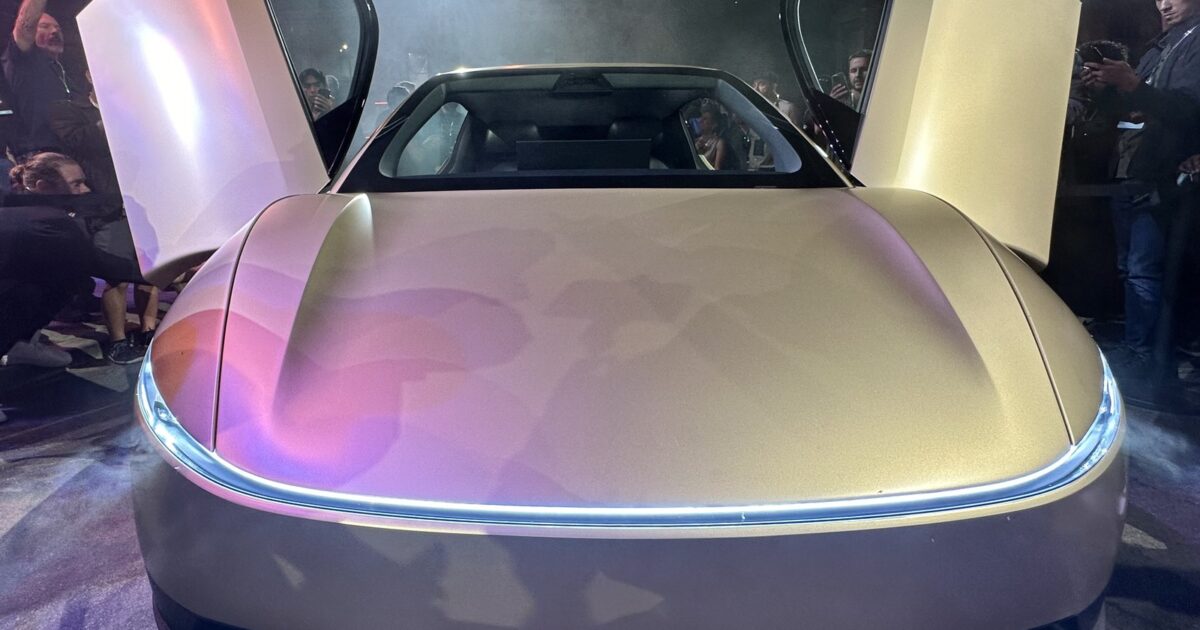
The statement arrived as a new Cybercab sighting raised questions about how Tesla may be testing the hardware.
Photos posted from Dallas show a gold Cybercab with a smooth, color-matched panel mounted on its roof. The observer said it may be a newly integrated Starlink terminal, while carefully stopping short of calling it confirmed.
All cars will have Starlink in the future.
It’s the only way to get super high bandwidth to billions of vehicles.
— Elon Musk (@elonmusk) August 9, 2026
Tesla has not announced that this is a production Starlink system. There is no confirmed rollout date, price, supported-model list, data plan or final antenna design.
Still, the timing makes the sighting more interesting than an ordinary test-car accessory.
Torque News traced the conversation from the Dallas Cybercab photos to Musk’s reply. Its report notes that Starlink terminals have appeared on Cybercab test vehicles before, but this installation looks more deliberate: the equipment is flush-mounted and hidden beneath a gold cover that matches the car.
The photos were first taken in Dallas and shared on August 8. The new installation was compared with earlier Cybercab sightings where the satellite equipment was more exposed, making the color-matched cover the most visible change.
The report also identifies the central question. A terminal placed on a development vehicle can support testing, demonstrations or temporary telemetry without proving that Tesla has locked the same design for customer cars.
Musk replied the following day with his much broader prediction about billions of vehicles. He did not identify the Dallas hardware, confirm a Cybercab production feature or attach a launch timetable to the statement.
Musk’s reply went much further than the single Cybercab, and it immediately raised a bigger possibility for Tesla’s connected fleet.
GOOD NEWS 📰 According to Elon Musk, Tesla will eventually integrate a dedicated broadband Starlink antenna to all cars in the future 🔥
Starlink could become the data backbone connecting Tesla’s physical AI fleet—cars, Robotaxis and possibly Optimus—to Tesla’s training… https://t.co/Oc7NVQaZVo pic.twitter.com/DAnCrGhtmm
— Ming (@tslaming) August 9, 2026
That is one interpretation, not a Tesla announcement. Musk did not mention Optimus, training infrastructure or a corporate merger in his post.
“All cars” is a remarkable target. It reaches beyond Tesla and beyond today’s premium satellite terminals into a world where high-bandwidth connectivity becomes part of the vehicle itself.
There is already a working foundation for that idea.
Starlink currently sells Land Mobility service for permanent installation on vehicles. Its Performance Kit is designed for in-motion use, harsh weather and high-vibration environments, and the company says the hardware can currently deliver download speeds of up to 400-plus Mbps.
The same official page says network upgrades are intended to enable gigabit speeds in 2026, beginning in remote areas. It also offers centralized fleet management for operators with anywhere from 10 to 10,000 connected vehicles.
That is real high-bandwidth vehicle service today, but it is still dedicated equipment sold for commercial and specialized use. Reaching billions of passenger vehicles would require a smaller, cheaper and far more integrated system, plus enough satellite capacity to serve it.
There is another important distinction.
Starlink Direct to Cell connects ordinary LTE phones and devices through partner-carrier spectrum. Starlink describes those satellites as carrying an eNodeB modem that acts like a cellphone tower in space, allowing compatible phones to connect without special hardware or a dedicated app.
That service is built to eliminate mobile dead zones and extend texting, calling and data coverage. It is not the same thing as mounting a high-capacity broadband terminal on a vehicle.
Musk did not say which architecture future cars would use. His wording points toward a dedicated high-bandwidth connection, but the hardware, network design and business model remain open questions.
For Tesla, the appeal is obvious. A persistent satellite link could keep vehicles connected outside cellular coverage, improve over-the-air software delivery, support navigation and entertainment, and give future Robotaxi fleets another communications path.
The challenge is scale. Billions of connected cars would demand enormous satellite capacity, global regulatory approval, unobstructed sky access and hardware that can survive years of heat, vibration, weather and daily use without turning the roof into an expensive afterthought.
Musk has now made the destination clear, even if he has not supplied the map.
Starlink is already moving from homes and aircraft into ships, trains and work vehicles.
If Musk gets his way, satellite internet will move beyond a few Tesla test cars and become a standard connection for the automobile itself.
Join the conversation!
Please share your thoughts about this article below. We value your opinions, and would love to see you add to the discussion!