
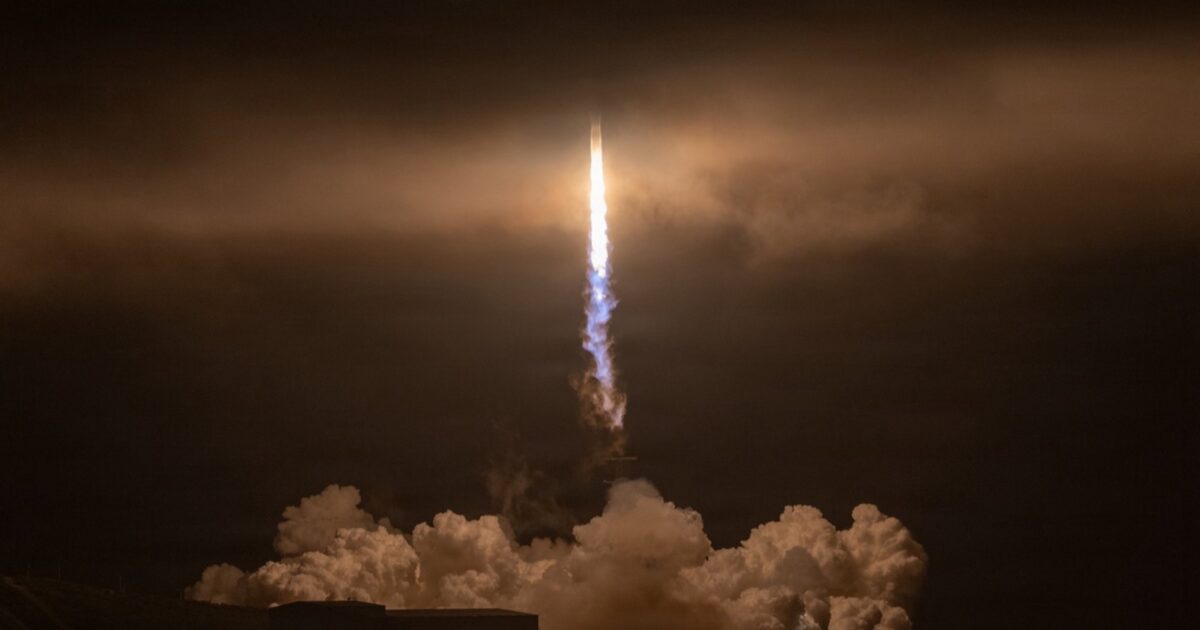
SpaceX has completed its fourth classified U.S. Space Force launch of November, sending the USSF-266 mission into orbit from California on a Falcon 9 booster flying for the 29th time.
The payload is secret. The operating tempo is not.
Falcon 9 lifted off from Space Launch Complex 4E at Vandenberg Space Force Base at 11:08 a.m. Eastern on Tuesday. The first stage then landed on the drone ship Of Course I Still Love You in the Pacific about eight and a half minutes later.
SpaceX carried the launch live:
Watch Falcon 9 launch the USSF-266 mission from pad 4E in California https://t.co/4fplvapUs8
— SpaceX (@SpaceX) November 24, 2026
The mission adds another national-security flight to a month when SpaceX has turned its West Coast pad into something closer to an active transportation hub than a traditional launch site.
Space.com reports that USSF-266 followed three other classified Space Force launches from Vandenberg this month: USSF-432 on November 6, USSF-627 on November 11 and USSF-317 on November 20.
The outlet says Tuesday’s flight was also the 29th mission for booster B1081. Its resume includes NASA’s Crew-7 astronaut flight, the PACE and EarthCARE science missions, two earlier classified Space Force launches and 16 Starlink missions.
Counting the NROL-136 flight between USSF-317 and USSF-266, SpaceX has launched five U.S. national-security missions from Vandenberg in less than three weeks. Every one used Falcon 9, while the individual payloads and exact orbital work remained largely out of public view.
That range is the point. The same core vehicle is carrying astronauts, science spacecraft, commercial broadband satellites and classified national-security payloads—and coming back to fly again.
USSF-266 came two days after SpaceX sent the National Reconnaissance Office’s NROL-136 mission from the same pad.
That launch followed USSF-317 by just 32 hours, 3 minutes and 21 seconds, setting a company record for the shortest gap between two missions from one pad.
SpaceX vice president of launch Kiko Dontchev said the West Coast team beat the previous 45-hour record with hours to spare—and immediately named a 24-hour turnaround as the next target:
Massive high five to the @SpaceX west coast team for a world record launch to launch turn from Pad 4e last night!
32 hr, 3 min, 21 sec! This smashed the previous record of 45 hrs from Pad 40.
Team got there with several hours of margin. Next goal… the 24 hr turn! 🏎️🚀🏎️🚀 https://t.co/16mu0qbEmM
— Kiko Dontchev (@TurkeyBeaver) November 22, 2026
USSF-266 did not extend that same-pad record because the Tuesday launch came more than two days later. It did show that the record was part of a sustained run, not a one-off sprint followed by a long recovery.
Space.com says the NROL-136 mission was the sixth NRO launch of 2026 and the 15th flight dedicated to building the agency’s proliferated satellite architecture. All six NRO launches this year used Falcon 9.
The report also notes that the NRO network is designed to increase surveillance coverage and resilience by distributing capability across more spacecraft. Exact satellite counts and onboard technologies remain classified.
For SpaceX, the strategic advantage is increasingly visible even when the cargo is not. A customer can buy more than a rocket: it can buy a launch system with flight-proven boosters, two-coast operations and a pad team pushing toward airline-like reset times.
The secrecy around USSF-266 creates an important limit. SpaceX and the Space Force have not publicly identified the payload, and neither has confirmed that this mission carried Starshield or Space-Based Airborne Moving Target Indicator satellites.
Those programs still explain why the Pentagon values frequent access to orbit.
Space Systems Command announced in May that it had awarded SpaceX a $4.16 billion agreement for the separate SB-AMTI program. The system is intended to track airborne threats from space and give U.S. forces more persistent awareness in contested airspace.
The command said the initial constellation is targeted for 2028 and emphasized that it plans to add multiple vendors rather than rely on one provider. That means SpaceX has a major early role, but it is not supposed to have the field to itself.
None of that proves what flew Tuesday. It does show the larger demand behind this string of classified missions: more sensors, more resilient networks and the ability to replace or expand them quickly.
There is another number worth watching besides launch totals. B1081 has now flown 29 times and returned again.
Rapid pad turnaround matters only if the rocket fleet can keep up. SpaceX is now demonstrating both sides of that equation at Vandenberg—reusing hardware deep into double digits while compressing the time between missions.
The cargo aboard USSF-266 may stay secret for years. The capability SpaceX displayed in putting it there is already in plain sight.


Join the conversation!
Please share your thoughts about this article below. We value your opinions, and would love to see you add to the discussion!