

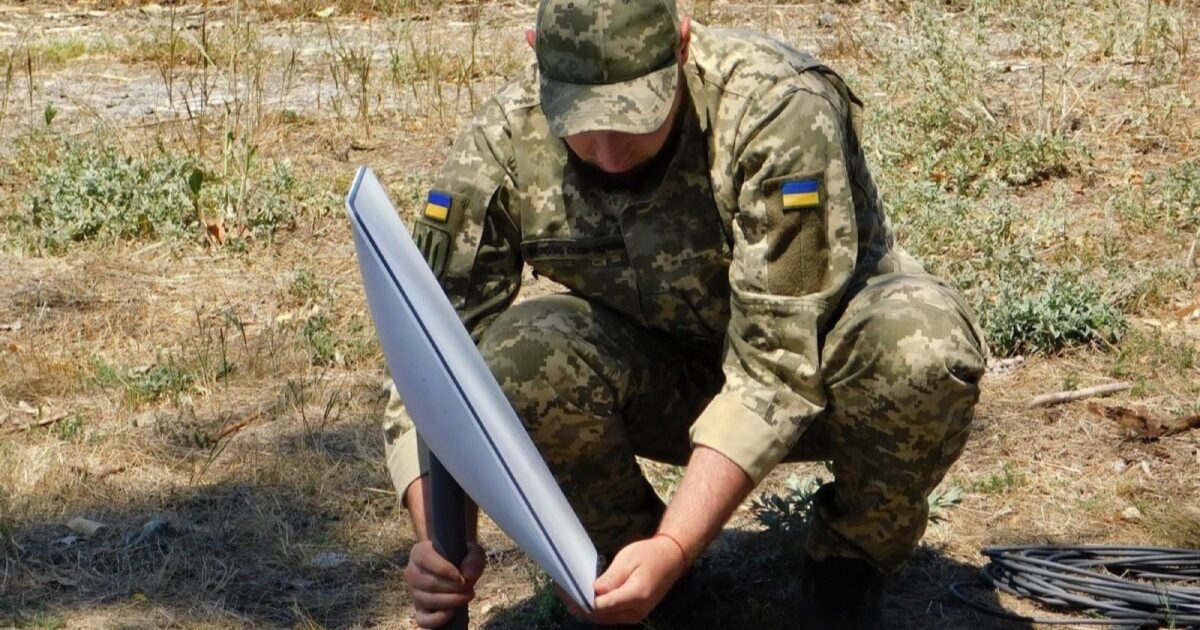
A sudden communications restriction disrupted Ukrainian drone missions Wednesday, then a partial restoration produced an unusually public argument over who controls the system.
Elon Musk says the answer depends on which network is involved.
According to Musk, the U.S. government controls Starshield and decides its operating limits. SpaceX controls commercial Starlink, which he says is restricted to civilian or defensive use.
Ukraine’s Mykhailo Fedorov reported later Wednesday that connectivity at speeds up to 160 kilometers per hour was returning, but he said the remaining Starshield limit still needed to be removed:
Starlink connectivity at speeds of up to 160 km/h is being restored.
Removing Starshield’s speed limit entirely is now critical for Ukraine’s defense.
Thank you, @elonmusk. We hope for your continued support.
— Mykhailo Fedorov (@FedorovMykhailo) October 14, 2026
The update avoided the worst version of the morning’s reports, but it did not erase the underlying problem. A 160 km/h ceiling is about 100 mph.
Ukrainian officials said some military connections had failed below that threshold, and faster interceptor drones still needed more headroom.
Associated Press reported that the restriction appeared overnight without warning and disrupted Ukrainian operations. Officials said slower-flying attack drones became easier targets for Russian defenses, while the satellite link remained central to front-line communications, logistics, long-range missions and defensive interceptor systems.
By late Wednesday, operators were reporting improved connections near 161 km/h. Ukrainian officials said that was still too slow for some drones used to intercept faster Russian aircraft, and they wanted the restriction removed entirely.
AP also reported that the Pentagon and U.S. Space Force did not immediately answer questions about whether the American military had imposed any restriction. The available accounts confirmed the operational failure, but they did not establish who ordered it or why.
That leaves two facts standing side by side: Ukraine experienced real operational failures, and the chain of authority behind the limits remained publicly disputed Wednesday evening.
SpaceX describes Starshield as a secure satellite network built for government users and national-security work. Its stated roles include encrypted communications, Earth observation and hosted payloads.
The company says Starshield adds high-assurance cryptographic capability for classified payloads and secure data processing. It also emphasizes interoperability, allowing its laser communications terminal to connect with partner satellites, and a modular design that can carry different government payloads.
SpaceX draws a clear product line. Starlink is built for consumer and commercial service; Starshield adapts the same technology and launch infrastructure for government missions, protected communications and national-security customers.
That distinction became the center of Musk’s response. He said Starshield systems are owned and controlled by the U.S. government, and that speed or usage decisions come from the U.S. military and ultimately the president.
Musk gave his account directly after Fedorov’s restoration update:
Starshield systems are owned and controlled by the US government. Any limits on speed or usage are decided by the US military and ultimately POTUS.
Starlink is a commercial service owned and controlled by SpaceX. Usage of Starlink is limited to civilian or defensive activities…
— Elon Musk (@elonmusk) October 14, 2026
His statement answers one part of the ownership question while opening another. If the affected terminals were operating under Starshield, Musk says the government set the limits.
If ordinary Starlink terminals were affected too, SpaceX still controls that commercial service.
Starlink Help Center says its standard Roam, Local Priority and Global Priority plans support in-motion use only up to 100 mph, or 160 km/h. The company directs faster applications to aviation plans.
The support page says General Aviation Local service supports movement up to 300 mph, while General Aviation Global reaches 450 mph. Those are commercial service-plan rules, not a public explanation of Starshield’s military configuration.
The page also tells users to reduce their speed when the service detects movement above the limit assigned to their plan. That ordinary 160 km/h rule closely matches the restored speed Fedorov described.
The reported lower-speed dropouts remain unexplained, and the commercial support page says nothing about Starshield’s military configuration. Calling every affected terminal simply “Starlink” can blur different systems, plans and chains of control.
Axios reported that Ukrainian officials believed both Starlink and Starshield had been restricted. The outlet also cited a senior U.S. official who denied that the Trump administration was behind the constraints and other U.S. officials who pointed to a technical malfunction.
The report said Starlink supports communications, ground forces, logistics and defensive drones, while Starshield is used for government-controlled military purposes. Ukrainian officials were contacting the White House, Pentagon and CIA for an explanation as service improved.
Ukrainian officials remained suspicious because the change arrived without warning during a broader crisis in U.S.-Ukraine relations. Suspicion is not proof, and the public record Wednesday did not establish a deliberate political order.
What the record does establish is serious enough. A satellite connection that has become part of battlefield command, logistics and air defense changed behavior with no advance notice to the people relying on it.
Service improved within hours, but a restored 100-mph ceiling is not the same as a full technical explanation. Ukraine still wants the remaining Starshield limit removed, and Musk has pointed responsibility for that military system toward Washington.
The next useful answer has to come from the institutions that can inspect the controls: SpaceX for commercial Starlink, and the Pentagon or U.S. Space Force for Starshield.
Until they explain exactly which service was changed, who authorized it and whether the change was technical or deliberate, the safest conclusion is narrow. Ukraine’s forces lost connectivity, some missions were disrupted, partial service returned, and the most important question—who moved the switch—remains unanswered.
Join the conversation!
Please share your thoughts about this article below. We value your opinions, and would love to see you add to the discussion!