
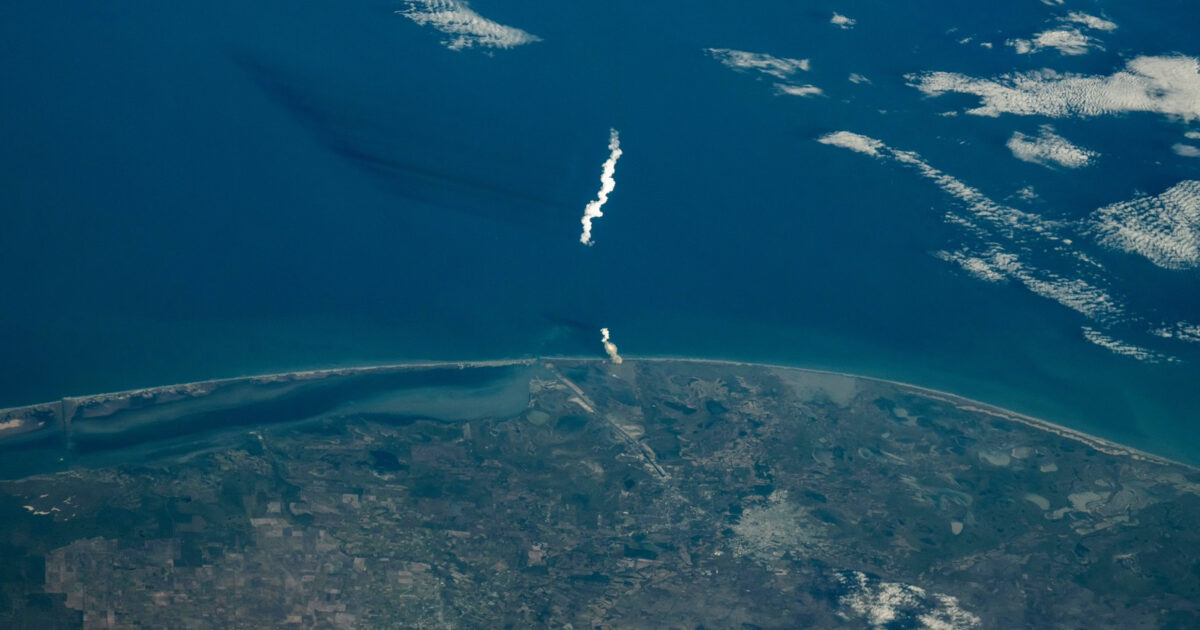
The FCC has given SpaceX conditional authority to build Starmind at a scale that makes today’s satellite industry look small: as many as one million orbital data-center modules.
The number is real, but it is not a forecast that one million spacecraft will appear next year. The order gives SpaceX until 2033 to operate the first module and until 2040 to complete the constellation.
FCC Chairman Brendan Carr announced the decision Wednesday and framed orbital computing as part of America’s race for superintelligence:
DATA CENTERS IN SPACE🇺🇸
Today, in a historic first, the FCC approved SpaceX’s request for 1 million satellites (orbital compute modules) to create data centers in space
The Starmind & competitor constellations will use solar power to extend America’s lead in Super Intelligence pic.twitter.com/VJinjK5e5E
— Brendan Carr (@BrendanCarrFCC) November 25, 2026
The FCC order is more precise than the celebratory announcement. It grants SpaceX’s application in part, defers it in part and authorizes a non-geostationary system in six orbital regions between 500 and 1,002 kilometers above Earth.
The radio license covers backup and emergency command links in two Ka-band ranges. SpaceX told the agency that Starmind’s primary data traffic would move through optical links connecting the modules to the existing Starlink network.
The deployment clock is unusually long but unforgiving once the deadlines arrive. SpaceX must operate one authorized module by November 25, 2033, then reach 100,000 by 2035, 500,000 by 2038 and the full authorized constellation by 2040.
Missing those milestones would make the authorization null and void. SpaceX must also file reports twice a year covering close approaches, maneuvers, removals, reentries, satellite totals and orbital positions.
Elon Musk answered Carr’s announcement less than an hour later, calling the approval an asset to both the United States and the world:
Much appreciated. This will be a great asset to America and the world.
— Elon Musk (@elonmusk) November 25, 2026
Ars Technica stresses the gap between regulatory permission and an operating business. One million modules would increase the number of satellites in orbit by roughly 50 times, while permission alone does not prove that orbital computing can beat ground-based data centers on cost or performance.
The order also leaves one significant disposal question unresolved. SpaceX asked for flexibility to move some retired higher-altitude modules into other Earth or solar orbits instead of bringing them back through the atmosphere, but the FCC said the company had not supplied enough information.
Before SpaceX deploys any module that will not be disposed of through atmospheric reentry, it must return with a modification request and a case that satisfies the agency’s debris rules. That is a condition, not a footnote, at the scale SpaceX is proposing.
The American Astronomical Society opposed the application and says the approval could fundamentally alter the night sky. Starmind’s modules are expected to be larger, brighter and distributed across higher altitudes and inclinations than much of today’s Starlink network.
The group warns that reflected light could interfere with optical work, radio emissions could affect radio astronomy and waste heat could raise the infrared background seen by sensitive instruments. It also points to collision risk and pollution from the launches and reentries required to build and maintain a fleet of unprecedented size.
The FCC said some launch-emission and astronomy concerns fall outside its authority, and it rejected petitions from the astronomy group, Amazon’s Kuiper operation and Viasat. The order nevertheless requires SpaceX to coordinate spectrum use and operate its emergency radio links without claiming protection from interference.
AP explains why SpaceX wants to try. Orbital compute could draw on near-constant solar power and avoid some of the land, grid and water demands that make giant terrestrial data centers increasingly difficult to site.
Space does not provide free cooling, however. A vacuum prevents ordinary convection, so the machines still need large radiators capable of shedding the heat produced by dense computing hardware.
That leaves SpaceX with a challenge bigger than winning a license: manufacture the modules, launch them cheaply enough, connect them through lasers, reject their heat and replace them on a schedule that keeps the network useful. Starship is the obvious transportation bet, but the FCC order does not make any of that hardware appear.
Starmind now has a legal runway and a clock. The next proof will not be another rendering or application—it will be the first working orbital data center, operating under the conditions SpaceX just accepted.


Join the conversation!
Please share your thoughts about this article below. We value your opinions, and would love to see you add to the discussion!